It’s time to set the record straight.
For years, people have accused me of being an “angry Black man” who is too focused on the past. I’ve been painted as a “hater ” just because I want my people to thrive. But some people would rather blame me for being “divisive” than accept a simple uncomfortable truth:
Comelita’s candied yams are genetically inferior.
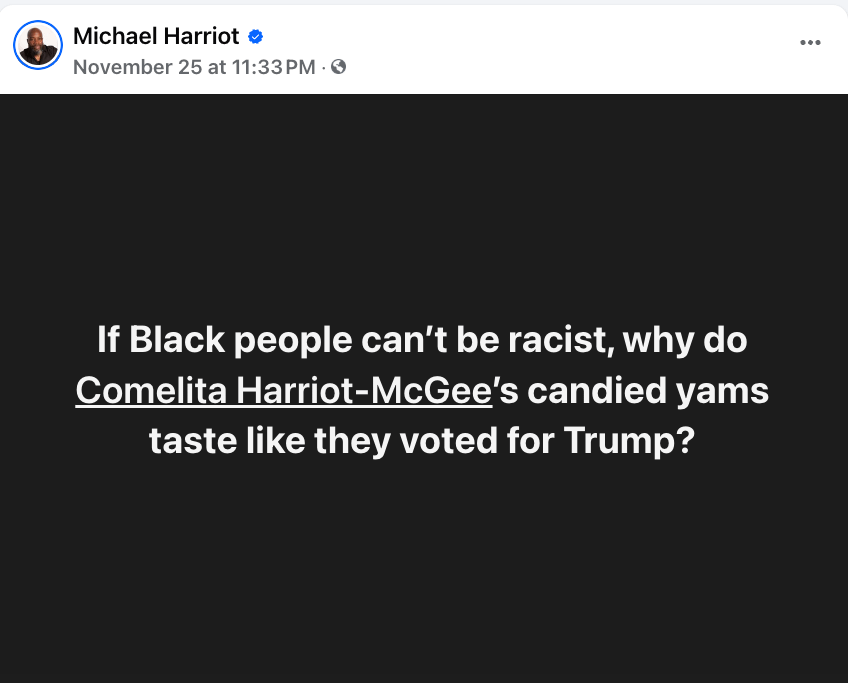
My youngest sister Comelita and I have been engaged in the Great Candied Yam War for more than 25 years.
Look, I’m not saying my little sister should be deported because her candied yams taste like a hate crime. I’m just saying that anyone who’s ever tasted Comelita’s yams knows they aren’t as good as mine. I just think we need an anti-CRT law to prevent Comelita’s Recipe for Taters from making children feel bad. Some of her dishes, I assume, are good. But when Comelita sends sweet potatoes to the Thanksgiving table, she’s not sending her best. That doesn’t make me a Mike supremacist…
I just want to make Thanksgiving great again.
A lot of people think I started this civil war. And because she has four children (including three girls) who all live in South Carolina, the United Daughters of Comelita continue to perpetuate the claim that this conflict had something to do with states’ rights. Many of my nieces and nephews think I started this whole thing. They truly believe their ancestors’ taste buds were happy to be enslaved on Comelita’s candied yam plantation. Even her grandchildren believe in this “Lost Cause” mythology. They still call it the “War of Uncle Mike’s Aggression,” even when I show them proof of who fired the first shots:
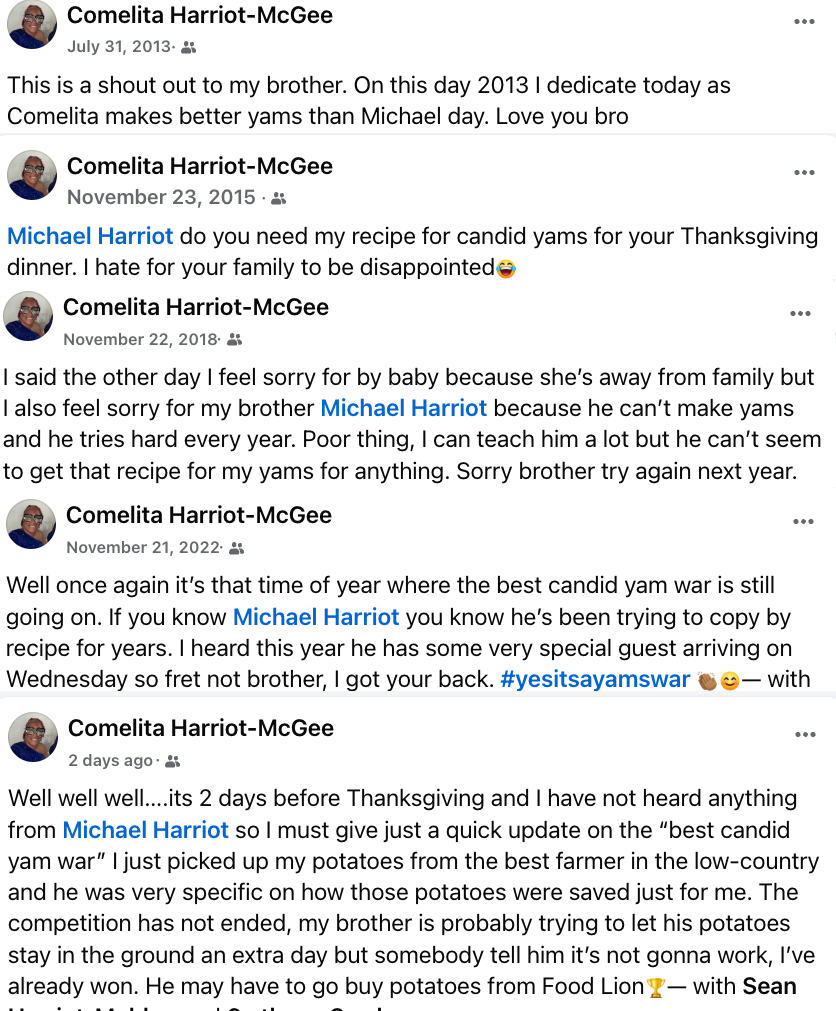
And if you’re wondering how two siblings with the same parents, raised in the same house, can have two vastly different recipes, I think I can explain:
My maternal grandmother, Marvell, passed away just before Thanksgiving my senior year in high school. The next year, I couldn’t come home for Thanksgiving my freshman year in college—the first since my grandmother’s passing—so my mother walked me through my grandmother’s candied yams recipe, which uses dark brown sugar and is heavy on the cinnamon.
Comelita, who is two years younger than me, attended college in Charleston, S.C., where my paternal grandmother Inez lived. That’s who taught her how to make yams with white sugar. It’s why Comelita uses more nutmeg than Marvell’s recipe.
It’s the sugar.
Brown sugar has more molasses and caramel flavor than white sugar. Brown sugar is moister and more nutrient-dense than its light-skinned sibling. White sugar wasn’t even a thing before slavery.
“[W]hen Christopher Columbus made his second voyage across the Atlantic Ocean in 1493,…refined sugar was a luxury product,” the New York Times explains. “It seems reasonable to imagine that it might have remained so if it weren’t for the establishment of an enormous market in enslaved laborers who had no way to opt out of the treacherous work.”
It is impossible to overstate how sugar increased colonization, fueled slavery and defined America. South Carolina became a slave economy because its first settlers imported their human property from sugar plantations in Barbados. It’s why the Carolina colony’s slave codes were based on Barbados slave codes. That’s why Gullah Geechee language resembles Caribbean patois. And it’s why English colonizer Joseph Blake came to South Carolina in 1683—he thought he was gonna get rich growing sugar like his wealthy British homeboy in Barbados.
He didn’t get rich off sugar, but by 1696, he literally owned part of South Carolina, including half the city of Charleston. His family holdings included a slave auction house and a “sugar house”—a processing factory where slaves from across the state were sent to be punished. His children spent most of their time at the family’s huge, 11,000-acre plantation in present-day Colleton County, near the first European settlement in present-day America. During the Civil War, the Blakes’ largest plantation was burned down during the Combahee River Raid and rebuilt.
That’s where my paternal grandmother, Inez, was born.
My maternal grandmother was born on a former slave plantation in Lee County, S.C. Like most people, they didn’t have refined, white sugar. Instead, they used sugar cane to make their own unrefined, brown sugar. That’s why my mom was so adamant about using “dark brown sugar.”
Anyway, after both of our grandmothers passed away, Comelita and I each made candied yams for Thanksgiving dinner. Our family considered it an homage to our ancestors; for us, it was a competition. I refused to eat hers. She refused to eat mine.
Comelita got sick.
As a matter of fact, she had to be rushed to the hospital. Her boyfriend at the time was so distraught that he proposed to her. They got married, had children and are still together to this day. According to the doctors, Comelita had appendicitis. But I’ve never actually seen the medical charts. If you ask me, her body was rejecting those mediocre sweet potatoes.
I blame Harriet Tubman.
Still, I understand why Comelita’s children believe her candied yams recipe is great. They grew up believing that they wouldn’t be here without those sweet potatoes. They have no idea that Comelita’s yams recipe almost killed her.
Appendicitis? Yeah, right.
This is also why white people think America is great. Their country didn’t try to kill them. They can’t taste what they’re missing.
So when I criticize America’s recipe for democracy, freedom or equality, I’m not criticizing my Caucasoidal bretheren or blaming their ancestors. I’m not even saying that this country is terrible.
All I’m saying is that it needs some work…
Like Comelita’s candied yams.
Today’s Reading List
The Barbaric History of Sugar in America by Khalil Gibran Muhammad
How to Fix a Plate in America by Michael Harriot
European colonization of the Americas killed so many it cooled Earth’s climate by Oliver Milman
How to talk to your racist relative at Thanksgiving by Michael Harriot
Thank you, J Davis, Greg Owens, TM, Gilda Johnson, MsB., and many others for tuning into my live video! Join me for my next live video in the app.