


Benjamin Green was different.
Green was born to formerly enslaved parents in Mound Bayou, Miss., and his father was one of the founders of the all-Black town. At 17, Green left his hometown to enroll in Fisk University. In 1914, he graduated from Harvard Law School and enlisted in the Army. Although the Army’s segregation policy prevented Black soldiers from serving in combat roles, as the judge advocate for the 92nd Division, Green helped convince President Woodrow Wilson and the secretary of war to essentially loan the all-Black unit to the French Army during World War I.
That’s why the 92nd was the only Black unit to serve in a combat role in WWI. In fact, the Black soldiers who fought in the Meuse-Argonne Offensive—which still stands as the largest and deadliest military operation in American history—were not actually fighting under the command of the U.S. Army. That’s why Green returned to Mound Bayou with a patch on his uniform that no one had seen before. Like most Army insignia, the patch represented America. The crossed rifles symbolized the infantry. But the uniquely American animal in the center and the nickname for Green’s division came from the Native American name for the toughest, most formidable animal on the entire North American continent.
Anyway, in 1919, when Green was 29 years old, he was elected mayor by the citizens of Mound Bayou. He built an HBCU. He traveled around the country, fighting Jim Crow as the NAACP's attorney. In a few years of taking office, crime plummeted, but not because Green was “tough on crime.” But because, well…
It would sound racist if I said that crime was low because white people weren’t around. So, instead, I’ll quote an article by David Beito, a white scholar writing for the Independent Institute, a non-profit, non-partisan public policy research and educational organization:
His diplomatic skills proved critical in heading off external threats from hostile whites and keeping the peace internally.
A hallmark of Green’s long tenure was an informal system of adjudication, negotiation, and consensus to control crime and resolve disputes. “The only rowdyism of any consequence ever known in or about the place,” one local citizen commented during the 1920s, “was caused by some poor whites coming to Mound Bayou on a Fourth of July picnic and getting drunk on whisky they had brought with them. There is not a loafer or vagrant in our town.” Crime was so low that the town closed its only jail in 1929 as “a useless and unnecessary institution.”
Told y’all.
In 1941, Mound Bayou broke ground for the Taborian Hospital. Built by McKissack & McKissack, the all-Black firm that designed the training facilities for the Tuskegee Airmen, the hospital was funded by a nationwide fraternal group initially created to organize a national slave revolt.

Twenty-five years before white people thought of Medicare, any Black person who paid the $8.40 annual dues could come to Mound Bayou for free medical care, including surgery. To lead the facility, Green hired chief surgeon T.R.M. Howard.
Called “the most militant Negro voice heard in the Mississippi wilderness,” Howard’s “Don’t Buy Gas Where You Can’t Use the Restroom” campaign would inspire the Montgomery bus boycott. He helped uncover the Emmett Till murder. He mentored Jesse Jackson, Medgar Evers and Fannie Lou Hamer. Jackson’s Rainbow Coalition was founded in his living room. Unfortunately, Howard had one problem:
White people wanted to kill him.
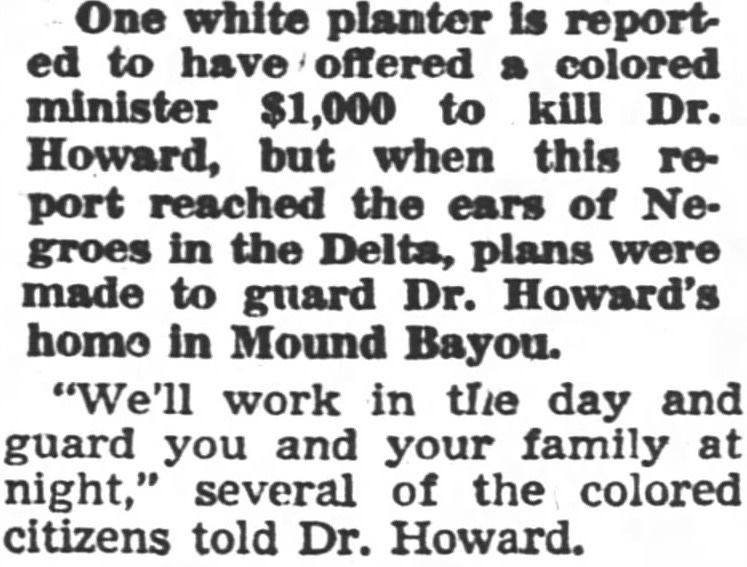
That’s how we know what happened to Emmett Till.
Howard eventually moved to Chicago and opened Friendship Medical Center on the South Side. After the U.S. Supreme Court decided Roe v. Wade, Howard performed the first legal abortion in the state. When people wondered how he was so prepared, he confessed that he had been performing abortions for women who traveled to Mound Bayou for years.
Green served as mayor of Mound Bayou for 40 years, until his death in 1960. And, if you’re wondering why his impact on an all-Black town isn’t celebrated more, it’s because Mound Bayou is not that different from most all-Black towns.
The all-Black Hayti District in Durham, N.C., organized one of the first sit-ins. It was so prosperous that it earned the nickname “Black Wall Street” long before Tulsa. Boley, Okla., boasted an electric company, two HBCUs and one of America’s first Black-owned banks and virtually no crime—except when white people came to visit. Ads for homes in all-Black Eatonville, Fla., claimed it had “solved the great race problem,” and in 1930, during the height of the Great Depression, 73% of residents owned their homes.
So what was so different about Benjamin Green?
Well, Mound Bayou was not the first all-Black town in America. But Black towns like Eatonville, Fla., Oscarville, Ga., and Nicodemus, Kan., evolved from Black farming settlements. Boley grew from a railroad stop that was settled by Black freedmen who already lived in “Indian Territory.” Hayti was ultimately absorbed into Durham.
Conversely, Mound Bayou’s founders were business owners who wanted to build a city. They built schools and mapped out a downtown area and the streets with the idea of “a self-reliant, autonomous, all-black community” in mind. Mound Bayou did not become a town; it was conceived as one when it was incorporated in 1887.
“The streets of the town are laid off regularly and are graded and graveled,” the Mississippi Clarion reported. “Concrete Sidewalks are along the principal thoroughfares, which are lined by tall and shapely Lombardy poplars.”
The article was framed by a picture of a Mound Bayou founder holding the first child born in the city…
Benjamin Allen Green.
But Green didn’t grow up on a farm. He grew up with Black neighbors and attended Black schools and went to a Black college and fought with Black people and then returned to the all-Black neighborhood where he learned everything he knew.
Benjamin Allen Green was the first boy in the ‘hood.
Today’s Reading List:
Something is wrong with white people by Michael Harriot
Where the Hood At? Fifty Years of Change in Black Neighborhoods by Michael Lens
Mississippi historic Black farming hub hit as White South Africans take farm jobs by Reuters
The Cruelty Is the Point by Adam Serwer
Thank you, KJ Kearney, Dr Bhembe's Newsletter, Sera Bella, Debra A. Bickford, TJC, and many others for tuning into my live video! Join me for my next live video in the app.


