


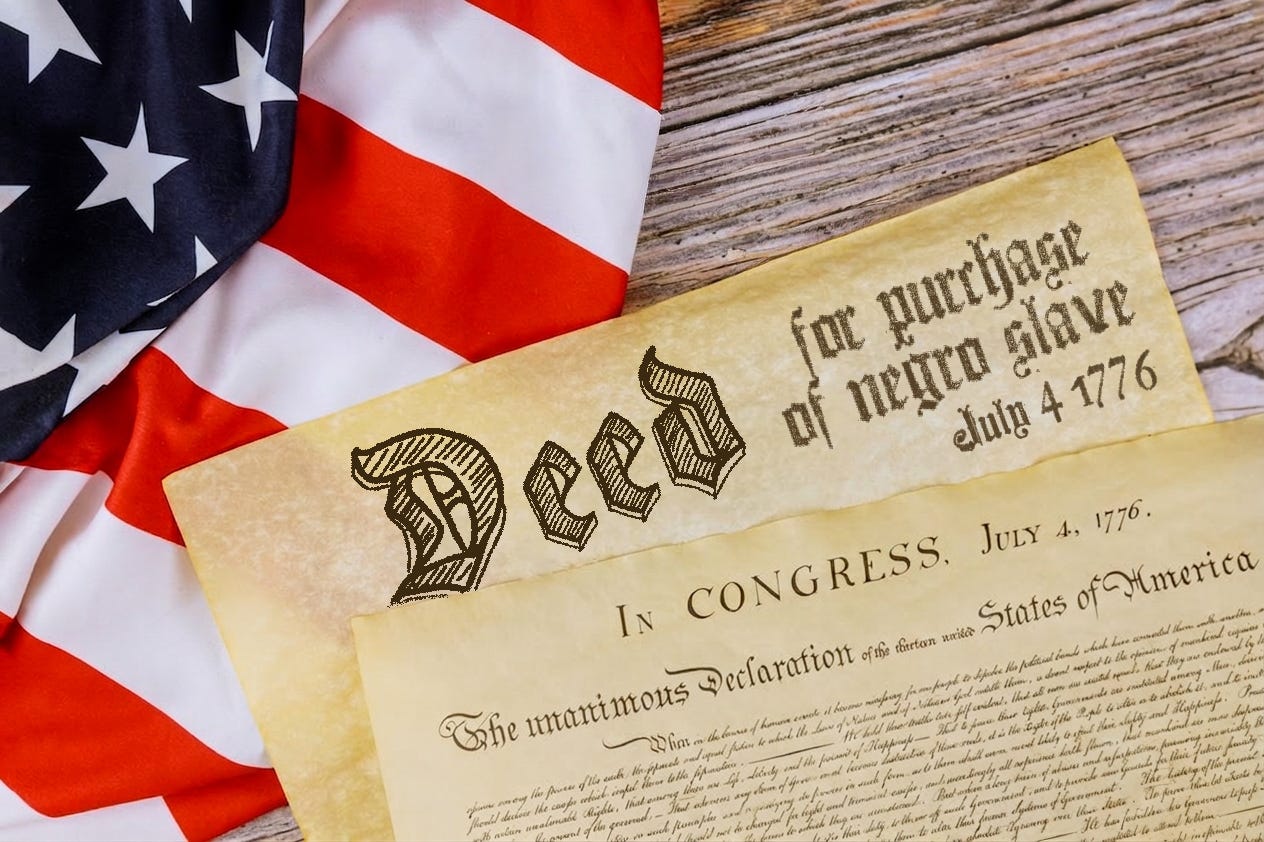
ContrabandCamp’s five-part series “250 in Black” will commemorate the nation’s 250th birthday by exploring America’s origin story from a Black perspective. This is part two. Read part one here.
When in the Course of human events, it becomes necessary for one people to dissolve the political bands which have connected them with another…a decent respect to the opinions of mankind requires that they should declare the causes which impel them to the separation.
— The unanimous Declaration of the thirteen united States of America
This week, you will hear stories about a nation founded by Christian white men who fought against tyranny to ensure liberty and justice for all. If you’re lucky, a historian may even mention that a Black man was the first casualty in this revolutionary quest for independence.
And yes, some of that narrative is true.
You can read the actual letters between the Founders to confirm their “opposition to tyranny and oppression.” While very few professed to have had the Holy Ghost, George Washington often swore upon his “honor and faith as a Christian.” We know the story of Crispus Attucks’ death at the Boston Massacre because a liberty-loving rebel named Samuel Adams named the historic event. Paul Revere never uttered the fictional phrase “the British are coming,” but he sold posters of the Attucks shooting.
Whether it was Jesus, taxation without representation or the tyranny of a king three thousand miles away, you don’t have to believe what anyone says about why the 13 colonies split from Britain. The reasons are listed right there in a little-known document called the Declaration of Independence.
This is also why you’re expected to just believe some of the things they say about America without any proof. You could’ve read how the founders opposed slavery if they hadn’t removed it from the original draft of the Declaration of Independence. To be fair, neither the original draft, Jefferson’s composition draft, nor the final version mentions their position on sugar in grits or going 50/50 in a relationship.
Still, I can promise there’s a story about the Founders you won’t hear this week. Your leftist media fave won’t bring it up. Your morning news won’t mention it, and your favorite historian won’t pen an op-ed about it in your local newspaper. In fact, none of the Founders ever brought up this subject until, less than a month before the signing of the Declaration of Independence, three bullet points magically appeared on the offical list of things King George did to create a “detestable & unsupportable tyranny”:
inciting insurrections of our fellow subjects with the allurements of forfeiture & confiscation
prompting our negroes to rise in arms among us; those very negroes whom by an inhuman use of his negative he hath <from time to time> refused us permission to exclude by law
endeavoring to bring on the inhabitants of our frontiers the merciless Indian savages whose known rule of warfare is an undistinguished destruction of all ages, sexes, & conditions <of life> of existence.
Two weeks later, these three offenses mysteriously merged into one item that appeared in the final draft of the document America is celebrating:
He has excited domestic insurrections amongst us, and has endeavoured to bring on the inhabitants of our frontiers, the merciless Indian Savages, whose known rule of warfare, is an undistinguished destruction of all ages, sexes and conditions.
What happened? How did three separate, unrelated grievances merge into one? Who were the insurrectionists? What happened to the armed negroes? Why weren’t they mad anymore?
This is the story of an imaginary insurrection, white paranoia and the mass murder that sparked a revolution.
But you shouldn’t believe a word I’m about to tell you.
You can just read what they wrote down.
The "Domestic Insurrection" that justified a revolution.
As Jefferson was writing the first draft of America’s breakup letter during the summer of 1775, the wealthiest colony and the two colonies with the highest concentrations of enslaved people in British North America were less concerned with King George's soldiers than with their own "property" walking off to join him.
That year, South Carolina held about 104,000 people in bondage, with an even starker imbalance in Charleston, the wealthiest city on the continent. Georgia's enslaved and white populations were close to even, hovering around 25,000 each, according to the research compiled by historian Jim Piecuch in his essay, "Preventing Slave Insurrection in South Carolina & Georgia, 1775-1776."
While Georgia delegates Archibald Bulloch and John Houstoun were up in Philadelphia lobbying John Adams for support, they warned their fellow founders about a nightmare scenario: “If one thousand regular troops should land in Georgia, and… proclaim freedom to all the negroes … twenty thousand negroes would join,” they whiteplained. "The negroes have a wonderful art of communicating intelligence among themselves; it will run several hundreds of miles in a week or fortnight.”
It turns out, their paranoia was justified.
On November 7, 1775, Virginia’s royal governor, Lord Dunmore, issued a proclamation offering freedom to any enslaved person who would take up arms for the Crown. Two centuries before Andre Young, Eric Wright, O’Shea Jackson, Antoine Carraby and Lorenzo Patterson documented the attitude of niggas, George Washington declared Dunmore the most dangerous man in America, warning that his strength would grow "as a snowball by rolling." South Carolina's Edward Rutledge called it the worst thing Britain had done to the colonies.
White fear didn’t just spread; it metastasized into policy.
South Carolina’s colonial legislature immediately tightened slave codes and beefed up militia patrols specifically to watch “our domesticks.” Then they went after the perfect patsy—the Jay-Z of Colonial America.
Born in slavery, Thomas Jeremiah was a free Black harbor pilot in Charleston who had done what white America still pretends isn’t supposed to be possible: he’d built wealth, owned property, and by some accounts, owned slaves of his own. When he was arrested on insurrection charges, he was quite possibly the richest person of African descent in British North America. Under interrogation, enslaved men he didn’t own claimed Jeremiah planned to distribute weapons and lead a Black company against the colony. The evidence was thin, and the process was so bad that South Carolina’s royal governor, Lord William Campbell, tried and failed to intervene. On August 18, 1775, Charleston’s revolutionary leadership hanged Thomas Jeremiah, burned his body and put his corpse on display to “deter others from offending in the like manner.”
It didn’t work.
Drawn by the presence of British warships and the promise of Dunmore’s proclamation, roughly 500 enslaved people had made it to Sullivan’s Island at the mouth of Charleston Harbor by December 1775. On December 9, General William Moultrie sent Major Charles Cotesworth Pinckney—another future framer of the U.S. Constitution—with 150 troops to storm the island. The first attempt failed, but on December 18, accompanied by 54 Catawba warriors, Pinckney’s men struck before dawn. This was, according to modern historical accounts, the first military action of the Revolutionary War fought on South Carolina soil.
The official report from the Council of Safety said only three Black people died in the raid. Contemporaneous accounts estimated that 50 Black people were killed, several more captured and fewer than 20 made it aboard British vessels. In “The Devil’s Lane,” legendary historian Peter Wood said: "If fifty unarmed black refugees had in fact been massacred, preferring death over re-enslavement, the Council of Safety probably would not commit such a gruesome fact to paper in its report. But its members ... were not afraid to sanction such brutality where their own chattels were concerned." Today, most historians, including Jon Sensbach, believe the number of murders was “in the hundreds.”
Regardless of the body count, we know what Council of Safety President Henry Laurens thought about the mass shooting. After the massacre, he wrote that the raid would “serve to humble our negroes in general, and perhaps to mortify his Lordship not a little.”
The negroes were not humble.
The white people were just warming up.
"It Is Better... If the Deserted Negroes... Be Shot"
By March 1776, an estimated 200 to 300 people had built a maroon community at the mouth of the Savannah River on Tybee Island. According to historian William R. Ryan’s research, about 65 belonged to Arthur Middleton, whose family ran one of the most prolific human trafficking dynasties in the history of the planet. As one of the richest, most powerful men in the state, Middleton was not worried about the loss of his property. He lobbied South Carolina militia leader Stephen Bull to take a shockingly drastic measure:
Kill them all.
“It is better for the public, and the owners, if the deserted Negroes who are on Tybee Island be shot, if they cannot be taken,” Bull wrote to his Council of Safety boss. The South Carolina group kept the plan secret from Georgia’s own Provincial Congress, worried that Georgia’s leaders were too “timid” to sign off. But when Laurens received approval for the slaughter around midnight on March 16, he wrote back that same night, calling it “awful business.” Then he approved it anyway, on one condition:
Make it look like the “Indians” did it.
Laurens specifically requested Creek fighters for the operation–not just for manpower; he wanted to engineer racial division between two peoples he was simultaneously exploiting, or, as he wrote, he hoped the mass murder collab would “establish a hatred or aversion between the Indians and negroes.”
Around 1 p.m. on March 25, 1776, Archibald Bulloch—future commander-in-chief of Georgia’s armed forces—led a group of about 30 Creek fighters, a dozen uniformed soldiers, and about 50 white officers painted to pass as Native Americans onto the island of five square miles
First, they burned the settlement
Aside from one house with a sick white woman and her white children, they burned every building on the island. At least three British Marines died, scalped, with their legs broken and shot in the head. On the raiders’ side, the only reported casualty was a Creek fighter killed in a drunken altercation with a Georgia militiaman who came with him.
Officially, the raiding party captured 12 or 13 formerly enslaved people and none were killed.

No firsthand account of the raid itself survives. What survives instead is the letter proposing the executions, written in a colonial officer’s own hand, and the silence afterward. But we know they lied about Sullivan Island. We know the royal governor of Florida said witnesses saw "signs of the most savage barbarity," noting that "the white people exceeded the ferocity of the Indians.”
Georgia’s Council of Safety records document coordinated searches of Black people’s quarters along the Savannah River in the weeks after the raid, confiscating any weapon found. After South Carolina’s leaders solved the slave problem, they convened to decide if they wanted to go to war with the British.
They did.
We don’t have to wonder why South Carolina joined the Patriot cause. On March 26, 1776, one day after the Tybee Island raid, the colonial legislature of South Carolina ratified a new constitution with a list of reasons why the wealthiest franchise in England’s most prosperous collection of colonies wanted to cut ties. The state's new constitution included a sentence that had never been written by Jefferson, Adams or any of the men who were planning to declare America’s independence:
The governors in the royal colonies … have caused the persons of divers good people to be seized and imprisoned, and their properties to be forcibly taken and detained' or destroyed, without any crime or forfeiture; excited domestic insurrections; proclaimed freedom to servants and slaves, enticed or stolen them from, and armed them against their masters; instigated and encouraged the Indian nations to war against the colonies; dispensed with the law of the land, and substituted the law martial in its stead; killed many of the colonists; burned several towns, and threatened to burn the rest.
Less than 90 days later, Thomas Jefferson wrote nearly the same accusation into the Declaration of Independence, charging King George with having “excited domestic insurrections amongst us.”
No credible historian even argues what “domestic insurrections” meant to the men who signed the Declaration of Independence: They know it is a reference to enslaved people trying to become free. We don’t have to speculate who actually recruited “ the merciless Indian Savages, whose known rule of warfare, is an undistinguished destruction of all ages, sexes and conditions.”
Yet, none of them ever explain that the most heinous accusation in the entire document was something that America did to Black people.
There are no monuments commemorating the massacres on Tybee Island or Sullivan Island, but there is a memorial for the murderers.
Besides trafficking more than 8,000 enslaved people during his lifetime, Council of Safety chief Henry Laurens gained fame by being elected president of the Second Continental Congress. The first sentence of Arthur Middleton’s bio doesn’t mention the 20 plantations he owned, his human trafficking empire or the mass murder he proposed. Instead, it calls him an “American patriot”…
… “and signer of the Declaration of Independence.”
We don’t have to speculate why the men who founded this nation participated in an act of terrorism. They wrote it down. But I understand why no one ever mentions their plan to shoot the negroes “if they cannot be taken.”
We could not be taken.