
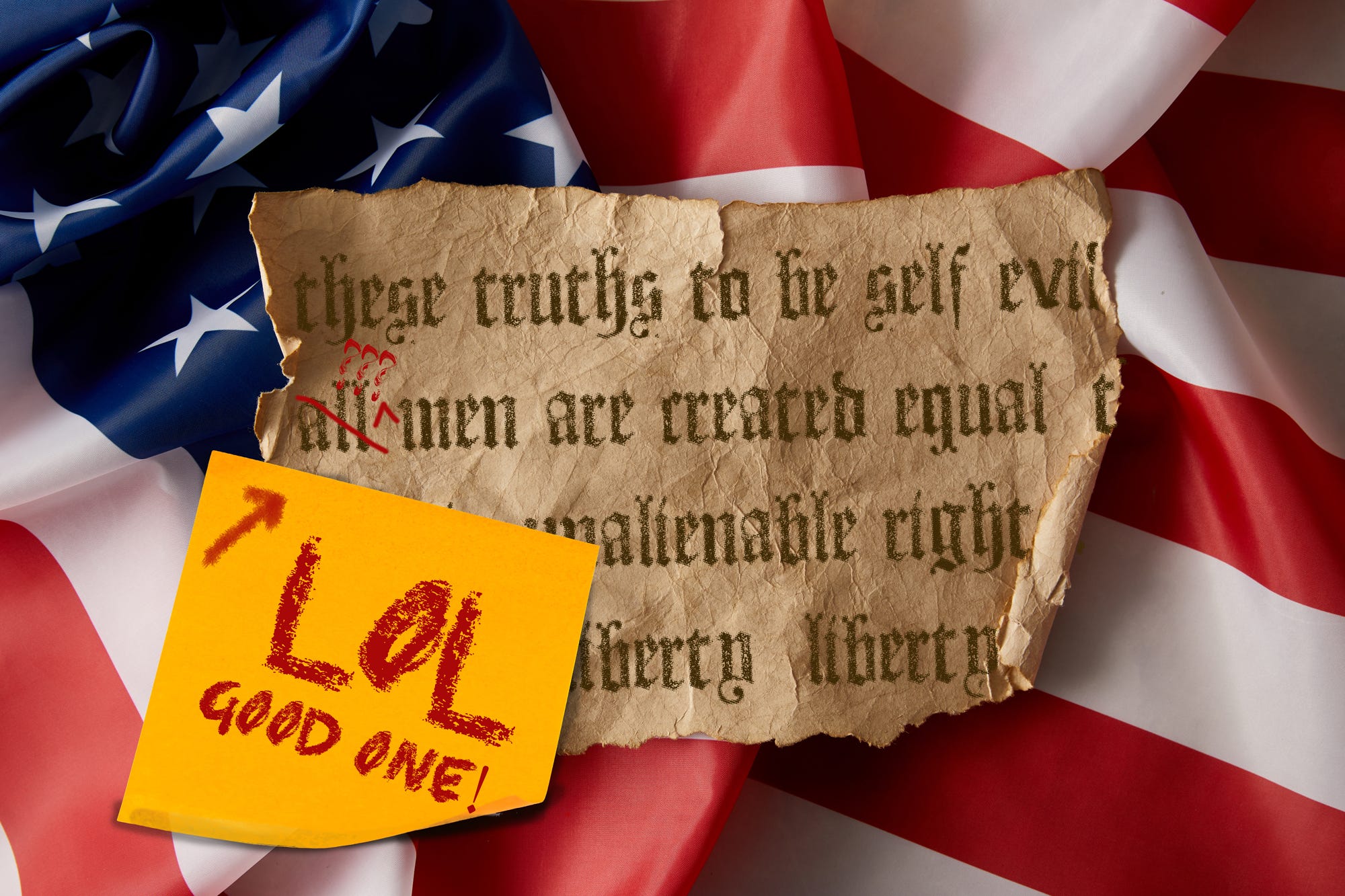
250 In Black: This.
Part 1 of our series commemorating the 250th anniversary of America's founding explores the origin story of two American families.
ContrabandCamp’s five-part series “Our America” will commemorate the nation’s 250th birthday by exploring the founding of America from a Black perspective.
“The democracy established in America in the eighteenth century was not, and was not designed to be, a democracy of the masses of men, and it was thus singularly easy for people to fail to see the incongruity of democracy and slavery. It was the Negro himself who forced the consideration of this incongruity, who made emancipation inevitable and made the modern world at least consider if not wholly accept the idea of a democracy including men of all races and colors.”
— W. E. B. Du Bois, The Gift of Black Folk
I used to hate my country.
Growing up in one of the few states where most Black people own their homes, I had no idea that South Carolina boasted the highest Black homeownership rate in America. Every Sunday, my aunts, sisters, cousins and my maternal grandmother, Marvell Bradley Harriot, would take the 20-minute ride to Wisacky, Mayesville and Elliot—three all-Black unincorporated communities in Lee County, S.C.
One hundred years after the Palmetto State amputated the blackest parts of three slaveholding districts and named the new county after a Confederate general, most of my maternal grandparents’ family still lived on the land where their ancestors were enslaved. But our visits were not intended to be educational. They mostly consisted of old people sitting around talking. So while my siblings and cousins hated these mandatory weekly trips, my grandmother loved going to “the country.”
From her honored position in the front passenger seat of our air-conditionless station wagon, my grandmother would deliver the same guided tour of her homeland every week. I can still point out the fields where my ancestors cropped tobacco, which is down the street from where Mary McLeod Bethune was enslaved. Even if I were blindfolded, I could still take you to the house where my grandfather was born.
To be fair, my family lived so far in the wilderness that FM radio waves refused to make the trek, so we couldn’t listen to the radio. So, years before white people discovered the phrase “stay woke,” I got my grandmother a tape recording of Martin Luther King Jr.’s second-to-last speech, “Remaining Awake Through a Great Revolution,” for her birthday. (I was 12, OK?). She later revealed that she didn’t even like the sermon (“He doesn’t quote enough scripture for my taste,” she explained). But because it was a gift from her grandchild, the cassette became the default selection during our weekly trips.
One Sunday, my cousins and I began reciting King’s speech from memory along with King. “We’re going to win our freedom because both the sacred heritage of our nation and the eternal will of the almighty God are embodied in our echoing demands,” we screeched in King’s same regal sing-song tone. “We shall overcome because the arc of the moral universe is long, but it bends toward justice. We shall overcome because Carlyle is right—no lie can live forever. We shall overcome because Bryant is right—truth, crushed to earth, will rise again.”
I still don’t know who Carlyle and Bryant are (Rick and Kobe, maybe?), but as my grandmother rewound the tape for another round, my cousin elbowed me and whispered a question for which I had no answer, so I asked my grandmother. From my position in the cargo part of the station wagon (which we called the “way-way back”), I yelled to the front:
“Aye, grandma, what exactly are we gon’ overcome?” The tape whirred. The cabin waited. My grandmother contemplated. Then she twirled both her hands in a flourish that ended in a gesture towards the windshield, saying:
“You know…This.”
Everyone in the car looked out of the window. The land, watered with six generations of our family's sweat, whizzed by. No one said anything, as if every passenger understood her answer. My cousin elbowed me again, but I answered before he could even ask his follow-up question. “I don’t know, either,” I shrugged, twirling my hands as my grandmother did, gesturing like Vannah White at a wheel, a fortune, an entire nation.
“This.”
I could tell my cousin was as confused as I was. The heat at my Uncle Curly’s house was no more oppressive than the temperature in the way-way back. My Aunt Eloree and Uncle Gator were too nice to warrant an overcoming. What “this” was she referring to?
“But Grandma,” I said. “I thought this was where our people were from?”
“How do you think we got here?” she replied.
When 56 of the British American colonies’ most privileged aristocrats gathered for an event on July 2, 1776, America was Blacker and less free than it would ever be.
The first federal census was not conducted until 1790. But based on counts conducted by individual colonies, the U.S. Census Bureau estimates that people of African descent made up almost a quarter of the U.S. population in 1776 (23.9%). More than 92% of the Black population was enslaved, thanks in part to the Ouldfield family.
On Sept. 29, 1683, more than two centuries before a criminal immigrant named Friedrich Trump arrived in America, John Ouldfield, his wife, Anne, and his 10-year-old son, John Jr., arrived in the Pennsylvania colony from Taddington and Priestcliffe, England, with nothing but a dream and a sackful of money. In 1709, the Ouldfields’ investment in the human trafficking industry helped Junior earn two gift certificates for 1,000 acres of free land in Berkeley County, S.C. When he died, he passed the land to his daughter, Polly.
Polly wanted a cracker.
Born in 1743, Mary “Polly” Ouldfield was an orphan by the time she was 8 years old. As a single woman, she couldn’t manage the thousands of acres and 73 slaves she had inherited from her parents. Fortunately, she was left in the care of Col. Thomas Middleton, the patriarch of one of the most prolific human trafficking dynasties in American history. In 1759, Thomas introduced his ward, Polly, to Robert Heriot, a broke, homeless immigrant who had just arrived in the country. Although Bob was the colonial version of white trash, his prowess at slaughtering Native Americans during the Cherokee Wars made him the perfect candidate to marry the 16-year-old heiress of a slave empire. There was just one problem.
Bob had been raised by actual Christians.
“I was surprised to hear from Mr. Moodie of your voyage to Jamaica and nothing of it from yourself,” read the August 20, 1759 letter from Bob’s father, James, who still lived in Scotland. “I suppose Mr. Mayne encouraged you in this by something flattering to youth more than some small profit…I must in the way of my Duty as a parent who had the Charge of your Education as a Christian tell you that those are all deceptions of the Corrupt heart of man.”
But Bob was a cracker.
As the literal epitome of the Scottish-Irish term for the “lawless set of rascalls on the frontiers of Virginia, Maryland, the Carolinas, and Georgia, who often change their places of abode,” Bob married Polly. By 1772, Polly and Bob had been married for 10 years. Even if a few of his human chattel escaped from the forced labor camp in Georgetown, S.C.–as Hector and his 7-year-old son Carlos did in 1773—the more than 10,000 acres of plantations scattered across South Carolina more than met the minimum threshold of 500 acres and 20 slaves required to sit on the state’s General Assembly. After taking an oath of allegiance to the British Crown, Bob moved his brother George into a house across the street. In less than 20 years, Bob had gone from cracker to royal colonizer.
When the American Revolution broke out, Bob was happy to answer the call. Polly didn’t mind being stuck on the plantation with their two young sons because she knew her husband was essentially a loss prevention agent.
On Nov. 7, 1775, two weeks before Bob was named captain of the Georgetown Volunteer Light Infantry Company, John Murray, 4th Earl of Dunmore, royal governor of the British colony of Virginia, issued a proclamation that shook Polly, Bob and the entire population of the richest and Blackest colony on the North American continent.
I do hereby farther declare all indented servants, Negroes, or others (appertaining to rebels) free, that are able and willing to bear arms, they joining his Majesty’s troops, as soon as may be, for the more speedily reducing this Colony to a proper sense of their duty, to his Majesty’s crown and dignity.
While Black Americans from all over the country jumped at the chance to seize freedom on their own terms, no one took the opportunity to emancipate themselves like the Black residents in the “slave trade capital of North America.” It was Bob’s job to prevent this from happening.
Desperate not to lose his wealth, Bob ignored his oath of allegiance and joined South Carolina’s Continental legislature. After he personally nominated three of the four S.C. delegates to sign the Declaration of Independence, he submitted a bill that mandated the death penalty for any slave who joined the British military. When that didn’t work, the Continental Congress dispatched a team to South Carolina, offering slave owners $1,000 for each able-bodied Black male under 35. When the war ended, the slaves would get their freedom and $50.
Bob led the opposition to this crazy idea. He knew white South Carolinians were already outnumbered 2 to 1. What did they think would happen if they gave the Black guys guns? He was a slavehunter now, but he would never be a cracker again.
Bob was not good at his job.
By the war’s end, an estimated 25,000 of South Carolina’s slaves had left with British forces or escaped into the surrounding swamps. Some were part of the Ethiopian Regiment, the Carolina Corps, the Black Pioneers or the Black Dragoons. Others, like the maroons known as the King of England’s Soldiers, formed paramilitary units to protect themselves. When the Black Pioneers helped defeat the city that slavery built in 1780, many served as guards for the prisoners captured during the Siege of Charleston. At least one of the white POWs realized that being kept in bondage in South Carolina was untenable.
“I, Robert Heriot, of the Province of South Carolina, acknowledge myself to be prisoner of his majesty’s force,” read Bob’s parole certificate. “[I] hereby promise upon my parole of honour, that I will repair to James Island, John's Island, Edisto Island, Edings's Island, St. Helena in the said Province… and that while prisoner I will not write, speak or act directly or indirectly against His Majesty's interest, and that I will surrender myself at any time & at any place when ordered by the Commander in Chief or any other of His Majesty's officers.”

On April 30, 1791, the first president of the United States made his first trip to South Carolina. Although George Washington spent his first night across the street from Polly and Bob, he never actually saw the real South Carolina.
From the day Polly, Bob and Washington were born until the moment America declared its independence, South Carolina had been a majority-Black state. For the next 30 years, the Palmetto State was majority white and was consumed by slave revolts. When Bob died six months after Washington’s visit, his sons inherited their slave empire. Their youngest, Robert Jr., inherited the 2,000 acres and 100 slaves in Georgetown. The youngest, John O., took over the 800-acre agricultural concentration camp in Sumter County, S.C. When John O. died in 1833, he willed all of his property—human and otherwise—to his wife and children…
Except for his Black daughter, Sally.
“To the first of my children who shall attain the age of twenty-one-years or marry, I give my Mulatto Woman Sally, who was born in May in the year eighteen hundred and two, now in the care of my Brother Robert Heriot in Georgetown, with a request that he or she will immediately emancipate her according to Law,” reads John O.’s 1830 will. “[I]t is my wish that my Brother Robert Heriot in Georgetown should heretofore continue to hire her out to a person of Good Character as a House servant who is not to put her to any laborious employment.”
They didn’t.
When John O. died in 1833, his oldest son, future Confederate Col. Robert Laroche Heriot, had just turned 20. Instead of fulfilling his father’s wish, he never emancipated his mixed-race sister. After he blew his father’s estate, Robert L.’s siblings sued their eldest sibling. According to an “account of sales of Negroes belonging to the estate of John O. Heriot listing Negroes by name, purchaser, and price,” Robert L. tried to sell his half-sister Sally, but there was just one problem:
Sally resisted.
"[Sally] is an obstinate negro,” read the account from the law firm handling the estate. “[She] persists under Severe punishment in what She has once asserted—whether true or false.” Although John O.’s will instructed the family to provide for Sally out of his estate, by 1870, Sally was living on the Heriot plantation with her only son, Wilson, his wife, Annie, and their five kids.
One day, the last of the white Heriots approached Sally’s oldest grandson, Willie, and asked why his children weren’t out picking tobacco. Willie was confused. He wasn’t a sharecropper; he was a blacksmith who paid rent. When Willie tried to explain that the children were in school, the overseer replied: “You better get those pickaninnies into the field or find someplace to live.”
This was 1919, so unlike his smart-mouthed grandmother, Willie didn’t resist. Instead, he packed up his children, left the Heriot plantation and used his savings to build a house nearby. When Willie’s wife gave birth to a son on Juneteenth during the Red Summer, for some reason (perhaps out of spite), Willie made a slight alteration to his boy’s name.
That’s how my grandfather, James Harriot, got his last name. I can even show you where it happened.
You got a blindfold?
As America celebrates its 250th birthday, you’ll hear a lot about the industrious, blue-blooded patriots like the Heriots. America’s most esteemed mythmakers will cast this intergenerational cast of characters as hardworking, rugged individualists who came to America for religious liberty, freedom and the opportunity to build a democracy from scratch. Moreover, anyone who contradicts this narrative is an American-hating liar who is pushing critical race theory.
But I am a Heriot and a Harriot.
Like most Black Americans, my U.S. lineage traces back further than the average white person. Some of my ancestors were not hard-working patriots. Their freedom, status and generational wealth were handed to them because they were oppressors. They were not “products of their time”; they were raised to not be enslavers. They were not loyal patriots; they were traitors who violated their oath to protect their property. They were not Christian men who loved their families. They were rapists and enslavers who rejected their God, defied their faith and kept their own children in bondage.
The Heriots were not planters. They did not have the expertise, ability or work ethic to build the intergenerational empire. The Harriots did. The Heriots were not warriors; the people they enslaved were. They did not fight for liberty and justice; they obstructed it. And no, I’m not demonizing white people to center my people in the American story.
My people built this country.
I am the descendant of a welfare queen who relied on government handouts and a grandfather who literally freed himself from the Democratic plantation. My ancestors risked their lives to free their countrymen from enslavers, colonizers and rapists. But somehow, I can admit that the slaveholders, colonizers and rapists are my people, too.
Because no lie can live forever.
Truth, crushed to the ground, will rise again.
This week, ContrabandCamp will commemorate the 250th anniversary of our country by explaining how we got here. Our five-part series will tell the truth about the most beautiful, improbable thing a people has ever created:
This.


Michael Harriot is a national treasure. ty
Amazing story