
When Life is Life-ing: The Struggle and Juggle of Black Women
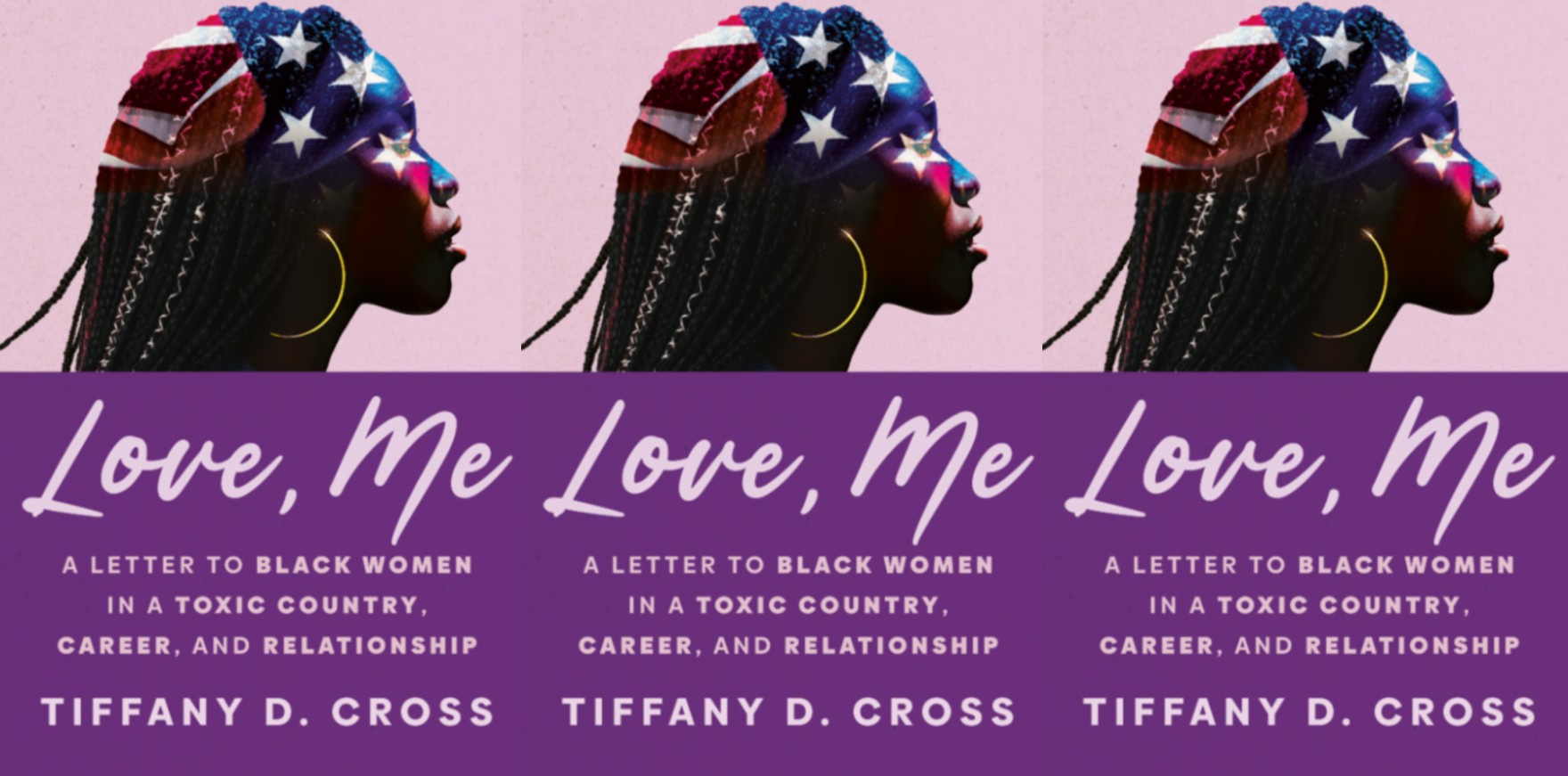
In her new book, “Love, Me: A Letter to Black Women in a Toxic Country, Career, & Relationship,” journalist Tiffany Cross breaks down how we navigate predominantly white spaces to survive.
“Love, Me: A Letter to Black Women in a Toxic Country, Career, & Relationship” is available for order now everywhere books are sold. We encourage you to buy from Black-owned and independent bookstores. Michael Harriot will be in conversation with Tiffany on Saturday, May 9, in Atlanta and Tuesday, June 23, in New Orleans. Click here for ticketing info.
The white patriarchal system of America has long tried to muzzle Black women. Our tongues are thick with the words we’ve swallowed. Our rage is leatherbound inside our mouths as we’re accused of lashing the achromatic skin of pilgrims with nothing but our voices. We’ve learned to speak our own language, to smile as a way of saying fuck you, to be curt so we don’t cut. We are often tasked with the added labor of painted politeness to bypass the politics of white privilege.
Might you please get this back to me by five today? Thanks so much. This style is how we must ask for things, softening our directives to make them digestible to white people who are not used to being directed by us. To them, it’s not the natural order of things. When Black women in positions of authority are entitled to something, the directive must be presented as though we’re asking for a favor. We aren’t allowed the simplicity of I need this back by five. We reread emails again and again, second-guessing our tone, not because of our delivery but because of the recipients’ reactions.
Our colonizers taught us well. We know how to maneuver, shelter, and even fight in the secrecy of our silence. We don’t want to engage in polite chitchat, make small talk, or discuss politics with colleagues whose wives, husbands, mothers, grandmothers, siblings, and friends cast ballots for our collapse. Spare us the feigned ignorance and performative shock of the carnage white supremacy leaves in our path—we haven’t the energy to console the complicit. What we have to say, America does not want to hear. So, we keep it to ourselves and speak only among ourselves.
Black women are tolerable in positions of authority that mimic a “mammy,” where we’re caring for or serving white folks. But positions of authority that challenge their intellect, systems, processes, functions, information, history, and mediocrity? We are quickly moved from being the most liked to the most despised. When Black people push for accountability or have the audacity to call out racism, we are met with irritated frustration. We can be criticized, ostracized, or simply dismissed—figuratively or professionally. Why is everything about race with you? Meet this insult with dead silence and a knowing look. Let them be uncomfortable in their awkwardness. It’s their discomfort to manage, not ours.
In the months following George Floyd’s murder, I was invited to many dinners with CEOs and other private-sector leaders. They’d all boast about how they’d had “very honest” conversations with their Black employees. They’d had “truthful” town halls and intimate roundtables. No they hadn’t; they only thought they had. What Black people know, and these private-sector leaders did not, is that the real meetings always take place among ourselves, before the CEOs’ meetings. We coordinate diligently about what will be said and what will not. Equally important is the recap meeting exclusively for us, where we review the content for effectiveness and try to predict any fallout.
We cannot trust white people with our truth, so we rarely give them the wisdom of our voice. We are not interested in speaking within the confines of what white people deem appropriate and not disruptive to their belief system. When will we stop debating facts and celebrating fiction? We grow weary of choking ourselves with all that’s unspoken. When will our truth be accepted? The sharp words we swallow in mixed company prick our throats bloody, eager to be set free.
When I began to appear on television, I was often the sole Black voice on shows across the cable news channels, which almost exclusively aired all-white hosts and panels. I was (and still am) regarded as controversial. I can never relax into my intellect and remain in a constant state of unrest, ready to do battle at any moment, never knowing from where the attack may come. When I show up on set and point out how policies are damaging to people of color because white people are not as vested in the greater humanity when harm just affects us, you can hear a mouse pee on cotton.
When discussing Donald Trump’s inhumane treatment of migrants crossing the border and his empowering a government agency to “disappear” people without due process, I point out that 20 percent of immigrants in this country are white. Yet we see mostly Latinos being rounded up and carted off to concentration camps, facilities or prisons used for the internment of political prisoners or those with politically targeted demographics. If white people were being snatched off the streets, there would be outrage.
My “hot takes” make for awkward exchanges with my colleagues, swift subject changes, and a return to boring reporting that doesn’t cause anyone too much discomfort. Many of my professional peers reduce me to the “Black woman’s voice of grievances.” Bringing up race disqualifies me from weighing in on anything else that might be happening in the world, in their myopic perception.
Decision-makers are unable to comprehend that I am perfectly capable of speaking comfortably on any news; I can discuss the increasingly confrontational relationship the United States has with China just as easily as I can speak on the increasingly confrontational relationship Kendrick Lamar has with Drake. I can freely speak on issues that contribute to the rise of the Global South as effortlessly as I can speak on Black political power in the Dirty South. I am more than capable of speaking about the migrant crisis of the Northern Triangle with the same command that I speak about the atrocities in Central Africa’s “triangle of death.”
White people simply cannot understand the ambidexterity of our kind. We contain multitudes that transcend the images we allow them to see. We are the multilingual and articulate professionals who can construct the most vulgar of sentences to curse out the person who dares offend us. We are the Ivy League, advanced degreed, corner office executives who won the twerking contest at our college homecoming. We are the church girls who hit the club on Saturdays and praise the Lord on Sundays. We are the great legal minds who can effortlessly recount case-law precedents as easily as we can recite every lyric of Biggie’s hip-hop classic “Juicy.” Shape-shifting is easy for us. Tolerating their authority over how we show up and use our voices is hard.
The stress of it all even attacks the mysterious magic of our melanin. In my own reflection, I see how Mother Nature and Father Time convened and birthed a storm inside me. We weather the storm—but it also weathers us. Think Black don’t crack? Surround it in whiteness. Our graceful aging may be enviable, but the biological playing field gets leveled internally. Black women ages forty-nine to fifty-five may look a decade younger, but biologically? We are seven and a half years “older” than white women.
After being made to feel like we don’t belong for decades—in classrooms, on college campuses, in certain neighborhoods, in first-class cabins, at nice restaurants, in certain shops, in boardrooms, on television sets—we begin to internalize the voices labeling us as aggressive, overassertive, rude. And after a while, there are times when we can’t tell whether the voices telling us that we don’t belong are coming from the inside or the outside. We either silence the voices or, in self-preservation, we flee.
Black women are the only group whose turnover and promotion are negatively influenced by white coworkers. A study from Harvard Kennedy School found that “no other employees of color, even similarly sized numerical minorities such as Black men or Hispanic women and men, were [as] negatively affected by their initial white coworkers” as Black women. When we are surrounded in whiteness, the environment is not only isolating but hostile, and we have the worst job outcomes. “Black women reported numerous ways in which interacting with their majority white coworkers negatively influenced their participation, and identified challenges related to their task assignments and performance evaluations,” the researchers write. In these spaces, we are frequently despised, antagonized, and patronized. When it gets to be too much, we are either pushed out or we peace out.
This is not to say that our beloved Black men enjoy the comforts afforded to whiteness. Our brothers have their own struggles, which we see, recognize, and support. Anecdotally, however, I’ve noted how some Black men are more likely to effect change in ways that are perceived as less confrontational and thus more palatable to white people. I have seen my own Black male counterparts challenge perspectives many times and be lauded for it.
Ta-Nehisi Coates, one of the greatest writers of our time, has never minced words when beautifully depicting the disgust he feels for the racist system in America and the world. He has been widely celebrated by, at times, mostly white rooms. Yet when Nikole Hannah-Jones, the Pulitzer Prize–winning writer for The New York Times Magazine, created the 1619 Project, she set massive numbers of angry whites ablaze. Consequently, she was later denied a tenured position at the University of North Carolina, her alma mater, after the school’s board of trustees took the highly unusual—and I believe racist—step of disapproving the journalism department’s recommendation. Tenure offers educators job security and allows professors flexibility for teaching and research. It’s the career pinnacle in academia, and it’s very challenging to achieve. They could not silence Nikole’s voice, so they simply punished her for it.
Even The New York Times itself, Hannah-Jones’s place of employment, took the unprecedented step and allowed its conservative columnist, Bret Stephens, to echo Donald Trump’s criticisms and complain publicly that the 1619 Project had “failed.” He writes, “The 1619 Project is a thesis in search of evidence, not the other way around.” What a pompous, ill-informed, incurious dolt. The New York Times’ code of conduct states that criticizing “colleagues’ journalism or other work is not permitted outside of designated forums.” I could not find any other example that allowed another journalist from The New York Times to attack the credibility of its own work within its own pages that the newspaper published. Hannah-Jones was also not permitted to respond to the mediocre white man publicly. Coates and Hannah-Jones landed at Howard University, more luminaries in the highly regarded HBCU’s roster. They went home, where they were safe.
Some of my peers, from attorney Bakari Sellers to political scientist Dr. Jason Johnson, are better received when rightfully calling out lies and systemic oppression, and introducing an uncomfortable truth on broadcast news channels. I’ve seen white anchors delight in these exchanges. Truth, it seems, is less off-putting if it comes from someone with a Black penis. Or, when perspectives comes from someone unenlightened altogether. Media companies are all too eager to equate a Black celebrity with an actual Black intellectual—not that one can’t be both. However, leave it to white-run outlets to elevate the unknowledgeable opinion of shock jocks, podcast hosts, and sports commentators over actual experts. I’ve never seen mainstream networks ask Joe Rogan or Skip Bayless to weigh in on the direction of the country when it comes to domestic politics. But Stephen A. Smith? By all means, tell everyone what you would do if you were president! They make a mockery of us silencing the cerebral and giving a bullhorn to bullshit.
What’s true for Black women is that if we don’t show up within the confines of their rules, we’re restricted to being regarded as obligatory Black interlopers stubbornly sitting in place as unqualified freedom fighters occupying their whites-only lunch counters. It’s exhausting to have to constantly defend and define our humanity, to have to constantly declare that our lived experience matters. I choose to be audacious in professing that our conscious thought and societal sensibilities do not rob us of our intellect; they sharpen it.
We will always fall short of being their idealized version of the magic negress, gifted in serving only their profit and seeking only their promotion. But the magic negress is no more safe than I am; the white corporate structure will not save her, either. So, why serve their interests blindly when doing so not only runs contrary to the interest of community but just as easily sets you up to be discarded? Why not be a revolutionary? That’s what I set out to do.
What exactly happened with you at MSNBC? I often get this question. When I was first flooded with such inquiries, luckily, I was surrounded by a sisterhood of women whose voices white society had also tried to mute. Jemele Hill, who left ESPN after speaking out against the apparent racism of Dallas Cowboys owner Jerry Jones and Donald Trump. Angela Rye, who brought in ratings for CNN yet did not have her contract renewed. Sunny Hostin, who is often left to square up against bratty nepo babies and Trump apologists on ABC’s The View. Tamron Hall, who had been pushed out of NBC’s The Today Show to make room for the apparent blackface expert Megyn Kelly. Errin Haines, who had been told by leaders at The Washington Post that she should consider a career other than journalism. I was also warmly wrapped in the arms of a woman who was the embodiment of her name: Joy.
Joy-Ann Reid was the first Black woman to host a primetime cable news show. There was no way to know at that time that we were to meet the same network fate, and yet there was every way to know. Joy, who was also a ratings success, would be fired by MSNBC in early 2025, shortly after Trump was sworn into office. We suffered the same treatment, as do many Black women working in white spaces. Without Joy as an advocate at MSNBC, I would never have gotten the opportunity to host my own show. So, before I tell you how it ended for me, let me tell you how it began.


