
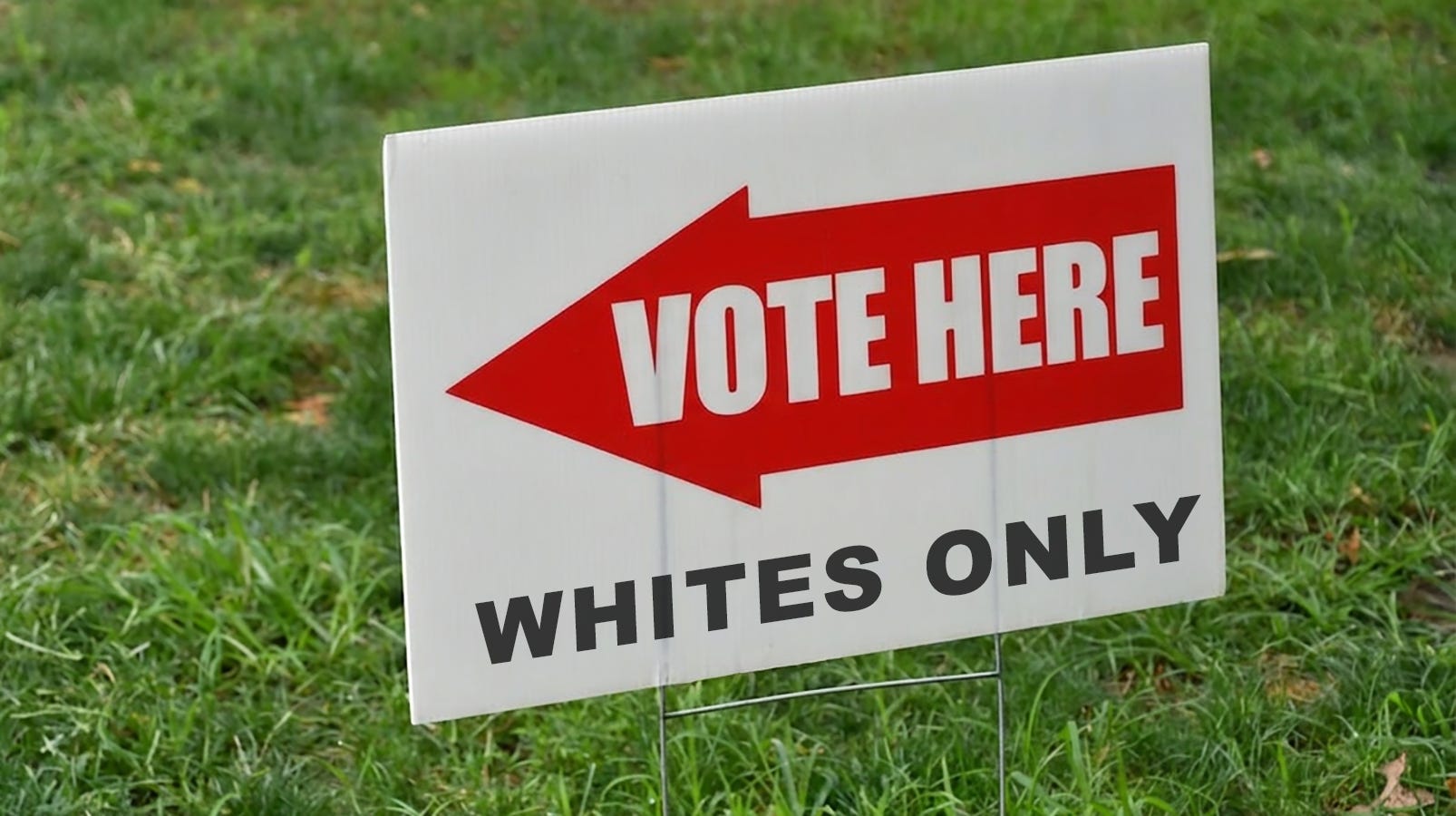
We Lost.
When the Supreme Court dealt the final blow to the Voting Rights Act, it completed its mission to erase the tangible results of the Civil Rights Movement.
The dictum,"once a free man, always a free man," though founded about as deeply in law, history and reason as, that "all men are born free and equal,” … [is] unimportant and ineffectual to protect the rights of citizens of slave States.
— Judge Hamilton Gamble
On March 22, 1852, America made a slave.
America’s race-based, constitutionally enforced system that legally extracted labor and intellectual property through violence or the threat of violence existed long before the 13 English colonies staged an insurrection against their British master. Colonial law made the condition intergenerational and perpetual. The founders wrote the fugitive slave clause to ensure that people who had already been reduced to human chattel couldn’t free themselves. But the Constitution didn’t make someone a slave.
In 1846, Sam Blow filed a freedom suit against Irene Emerson, arguing that she had re-enslaved his entire family. After he had been legally purchased by Irene’s deceased husband, Dr. John Emerson, Sam had lived in three different free territories (Illinois, Minnesota and Wisconsin). His oldest daughter was born on a steamboat while they were traveling from Minnesota to St. Louis. So, according to the Missouri Compromise, she was born free. Sam’s wife, Harriet, had lived in the free state of Pennsylvania before they married in Fort Snelling, Minnesota. And since the rules of slavery say that children inherit the status of their mother, Harriet’s children were technically born free. And on Jan 12, 1850, Sam Blow finally got his day in court.
Sam won.
Because these kinds of freedom suits were common in Missouri, the Blow trial didn’t even make headlines. Plus, Sam’s was so clear-cut that the jury took less than an hour to return its verdict, which didn’t exactly make headlines. The case essentially came down to one frequently quoted legal principle that defined the status of every American, free or enslaved:
“Once free, always free.”
Irene was not done.
When she filed her appeal, the judge ordered the St. Louis County sheriff to take Sam and his wife into custody until the Missouri Supreme Court settled the issue. Thinking the process would take a few months, the couple sent their daughters into hiding. As the appeal worked its way through the system, the state of Missouri hired out Sam and Harriet and collected the wages. For exactly 800 days, the state of Missouri enslaved two people who were legally free. On March 22, 1852, Missouri Supreme Court Justice William Scott announced the court’s decision.
Sam lost.
The case affected every enslaved person in the country, so of course, Sam appealed. And on March 6, 1857, seven years after he was first declared legally free, the chief justice of the U.S. Supreme Court boiled Sam’s decade-long quest for freedom down to its fundamental essence:
The question is simply this: Can a negro whose ancestors were imported into this country and sold as slaves become a member of the political community formed and brought into existence by the Constitution of the United States, and as such become entitled to all the rights, and privileges, and immunities, guarantied by that instrument to the citizen?
The answer is no.
Ultimately, the justices dismissed Sam’s claims—not because he was wrong or because he was enslaved, but because he was Black. As far as the law was concerned, Sam didn’t even have a wife. Legally, his daughters were fugitives. In fact, the only thing that belonged to Sam was the name he had given himself as a young boy to honor his deceased brother Etheldred, who was enslaved on the Scott plantation:
Dred Scott.
Even though the Declaration of Independence, the Constitution, and the founding fathers considered him “so far inferior that [he] had no rights which the white man was bound to respect,” Dred Scott was “once free.” Making him a slave would require America to ignore legal precedent, its own history and that a Black man was morally, legally and constitutionally correct.
America won.
Democracy lost.
On Wednesday, April 29, 2026, a scant 61 years, three months, three weeks and five days after the largest social movement in American history celebrated its crowning achievement, the U.S. Supreme Court finally killed the Voting Rights Act.
In a 6-3 decision split along ideological lines, the Supreme Court struck down a majority-Black congressional district in Louisiana, ruling that the state had relied too heavily on race in drawing the map. While the conservative majority used the age-old “colorblind” premise that white people invented out of thin air to frame their reasoning, the three liberal justices called the decision what it was: the final blow to the most consequential civil rights legislation in American history.
“Today’s ruling is part of a set,” wrote Justice Elena Kagan in her blistering dissent. “For over a decade, this Court has had its sights set on the Voting Rights Act … And finally, today, the last piece.”
She continued:
I dissent. The Voting Rights Act is—or, now more accurately, was—“one of the most consequential, efficacious, and amply justified exercises of federal legislative power in our Nation’s history.” It was born of the literal blood of Union soldiers and civil rights marchers. It ushered in awe-inspiring change, bringing this Nation closer to fulfilling the ideals of democracy and racial equality. And it has been repeatedly, and overwhelmingly, reauthorized by the people’s representatives in Congress. Only they have the right to say it is no longer needed—not the Members of this Court. I dissent, then, from this latest chapter in the majority’s now-completed demolition of the Voting Rights Act.
Wednesday’s decision leaves the Voting Rights Act intact.
It just no longer does anything
Like Scott v. Sanford, the white nationalist wing of the court insists that Louisiana v. Callais was a “narrow” ruling that only applied to this one district. Believing this nonsense requires a familiar form of Caucasian amnesia. Republicans have spent the better part of two decades dismantling the enforcement mechanisms of the law. In 2013, Shelby v. Holder gutted the act’s preclearance provision. Brnovich v. DNC essentially declared that legislators must yell “nigger” while redrawing districts to prove a map is racially discriminatory. Hours after the SCOTUS decision dropped, Louisiana’s Republican governor, Jeff Landry, and Attorney General Liz Murrill issued a statement suspending the statewide congressional primaries.
The judicial branch of the GOP didn’t just destroy the Voting Rights Act. Working in conjunction with Donald Trump, Republican legislators, state lawmakers and private citizens, they have completed the final phase of their project to raze the legislative achievements of the Civil Rights Movement.
They won.
Although many historians mark the beginning of the Civil Rights Movement at the 1955 murder of Emmett Till, Black people didn’t wake up in 1955 and realize they were being treated as second-class citizens.
In 1941, after hearing that Black activists were planning a large protest called the “March on Washington,” President Franklin Roosevelt recruited Howard University professor Rayford Logan to draft Executive Order 8802, which desegregated defense contractors. The NAACP forced Harry Truman to sign Executive Order 9981, which desegregated the armed forces. A Black lawyer named Hobart Taylor Jr. helped write Executive Order 10925, which ordered all government contractors to take an “affirmative action” to end discrimination and led to the creation of the Equal Employment Opportunity Commission.
The Supreme Court killed affirmative action. Pete Hegseth is returning the military to its straight white-male roots. Donald Trump handled the rest.
To be fair, quotas are bad. That’s why civil rights activists toppled the National Origins Formula from the Asian Exclusion Act in 1965. Congress recently brought that back. Trump helped make immigrants white again. The Supreme Court will ultimately decide if colleges must comply with the administration’s demands to hand over data on Jews and nonwhite students.
Remember Brown v. Board?
When the Black citizens of Clarendon County, S.C., filed Briggs v. Elliot, the first of five cases that the Supreme Court combined in its decision to end Jim Crow K-12 schools, they were not asking the court to allow their children to attend schools with white children. The Black parents wanted the school district to stop funneling their tax dollars to whites-only public schools. When the Supreme Court outlawed Jim Crow segregation, white parents created a voucher system to funnel money to private “segregation academies.” In 1964, the Supreme Court outlawed the voucher system.
After the Montgomery Bus Boycott, Alabama’s attorney general banned the NAACP from collecting dues, fundraising and recruiting members. When the organization refused to comply, authorities aggressively investigated the leaders and demanded the organization’s membership rolls. Other states followed, until the Supreme Court determined that it was illegal.
Today, the group would be declared “antifa,” and the DOJ would indict them for … something.
We fought to desegregate the military. Welcome back, poll taxes and Klansmen at the voting booth. The Fair Housing Act is a thing of the past, too. See ya later, Title IX. Remember that thing called due process? The Supreme Court doesn’t.
They have dismantled every single battle we have won.
At least we have the names and the memories of our ancestors.
Face it, y’all. We lost.
It’s important to know when you’ve lost
More importantly, acknowledging that your opponent has won and learning from your defeat is the first step to victory. Michael Jordan’s strength and shooting ability didn’t make him one of the greatest players in NBA history. But because the Detroit Pistons kept kicking his ass in the playoffs, he realized that he needed to make himself stronger and work on his shooting to defeat his opponent.
Then he won.
Sometimes we lose. Civil rights activists recruited Homer Plessy to get arrested on a Louisiana train in order to challenge racial segregation. Black Americans endured nearly six decades of the separate but equal doctrine because we lost. Plessy v. Ferguson.
Then we won.
Those Black parents in South Carolina filed Briggs v. Elliot after a judge dismissed their first attempt to challenge segregated schools in Pearson v. Elliot. The Selma to Montgomery March was an attempt to persuade the Alabama governor to protect Black citizens’ constitutional right to vote. He refused. Days before the August 1963 March on Washington, 60% of Americans had an unfavorable opinion of the event. In May 1964, two months before Congress signed the Civil Rights Act of 1964, even more people thought “Mass Demonstrations hurt the Negro cause for racial equality.”
Southern Republicans and Democrats filibustered the legislation in Congress for 60 days. Of the 94 Southern Democrats in the House of Representatives, only seven voted for the Civil Rights Act of 1964. Zero Southern Republican congressmen supported it. Only one of 21 Southern senators (Democrat or Republican) voted in favor of the Civil Rights Act (a Texas Democrat).
American democracy became stronger because we kicked its ass.
The Dred Scott decision actually changed American history. The panic over enslaved people in the free territories rising up caused entire railroad companies to close their doors. The national economy cratered into a recession. A brand new political party created a platform to fight “the new dogma” that “carries slavery into any or all of the territories” and ran a political newcomer named Abraham Lincoln.
On May 26, 1857, Judge Alexander Hamilton signed emancipation papers for “Dred Scott, aged about forty eight years, of full negro blood and color, and Harriet Scott wife of said Dred, aged thirty nine years, also of full negro blood and color, and Eliza Scott a daughter of said Dred and Harriet, aged nineteen years of full negro color, and Lizzy Scott, also a daughter of said Dred and Harriet, aged ten years likewise of full negro blood and color.”
He died 16 months later.
Almost every credible historian credits Scott v. Sandford with inflaming the tensions that led to the Civil War. There is no doubt that the “or any place subject to their jurisdiction” part of the 13th Amendment, and the 14th Amendment’s citizenship clause and due process clause exist because of Dred Scott.
He won.
It’s possible that we haven’t lost at all. Maybe we just wrongly assumed that we’d always have the right to vote. Meanwhile, they were making their anti-Black efforts stronger. But as we know, “once free” doesn’t necessarily mean “always free.” The only way to lose is to stop fighting, and this battle is far from over. We’ve been here before.
And yes, sometimes we lose…
But not “always.”
America cannot make a slave.
We will win.


Votes have consequences. Not voting for Hilary and Kamala are precisely why we're here, in addition to the Democrats not maximizing the supermajorities they had under Obama to fully codify all the rights people clearly took for granted. Can only pray whoever wins in '29 does the right thing and packs the Court and eliminates the filibuster so we can roll back all this trash for good.
SIXTY ONE YEARS. God help us