
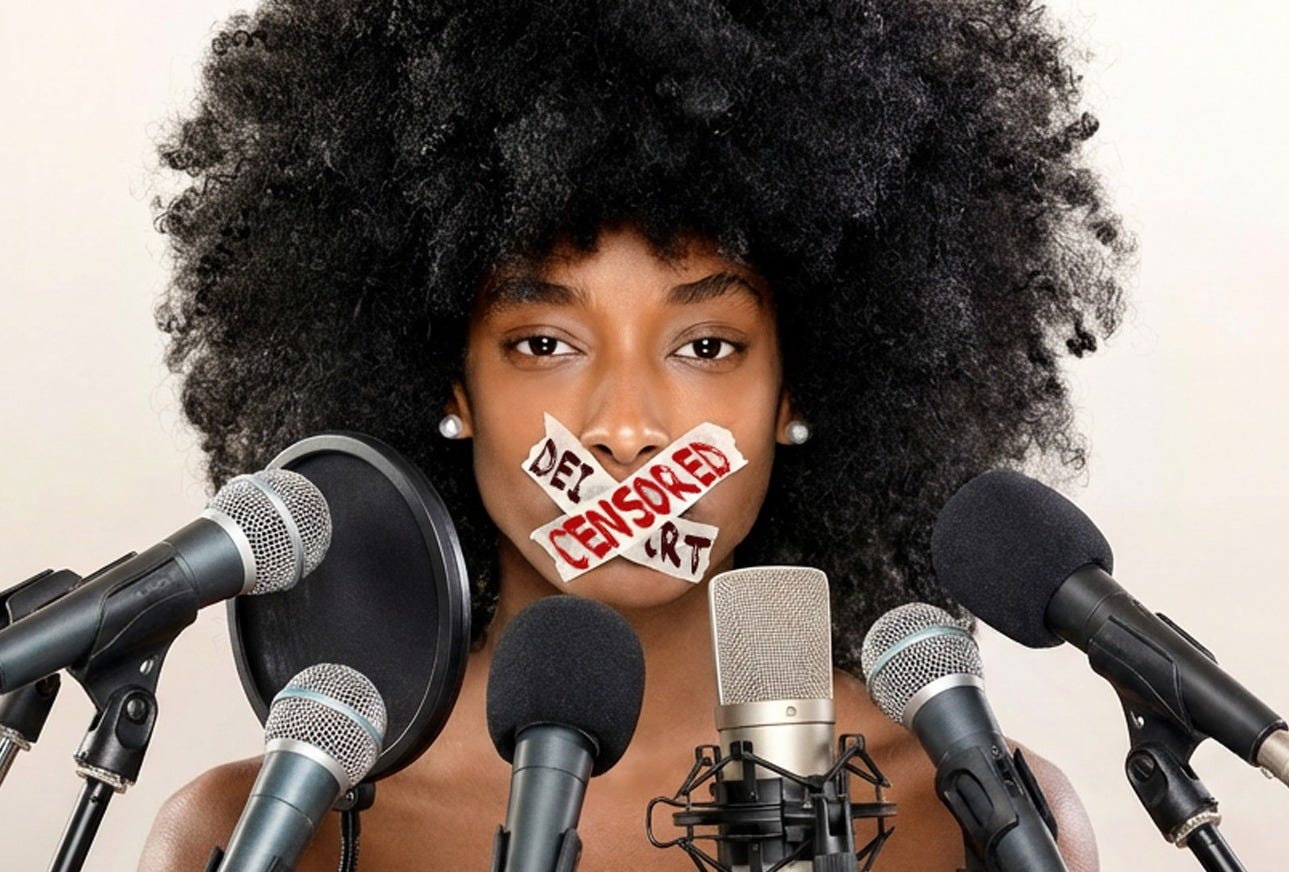
Trump Wants to Silence His Critics. Colleges, Corporations and Nonprofits Are Doing It For Him
As America pivots toward authoritarianism, institutions across America are not just ditching diversity, free speech and facts; they are embracing the fascist fad, too.
At colleges and universities across the country, students (and sometimes faculty and staff) participate in their respective school’s mandatory common reader program.
Although the initiative goes by many names, the goal is always the same. “Common reader” programs aim to create a collective intellectual experience through classroom lectures, dialogues and group discussions by assigning one specific text– usually on an important issue or topic–to the entire campus community. Many schools even invite the author of the common read to speak to the campus during the spring semester. For instance, Heather Cox Richardson gave a keynote address at the University of Washington after her book, Democracy Awakening, was chosen as the common read. Students heard Pulitzer Prize winner Nikole Hannah-Jones after Sonoma State University selected The 1619 Project as its common read.
At 8:41 a.m., on Jan 30, 2025, the author of the 2024 common reader selected by 10 historically Black universities received a message from the school at which he was scheduled to speak. “Just checking to see if [Mr. Harriot] arrived safely,” read the text from the vice provost’s office. “Please let us know what time we should expect [you] to arrive so our team can be at the entrance gate.”
By 8:51 a.m., leaders at the publicly funded HBCU had decided to cancel the learning opportunity for the 1,200 freshmen who spent their first semester in college reading Black AF History: The Un-Whitewashed Story of America.
As of today, they have not rescheduled.
“If they can bring Harvard and NBC to their knees, what do you think they’ll do to our little HBCU?”
Although ContrabandCamp has decided not to disclose the name of the institution, at least three administrators at the university separately confirmed that the event was canceled because of concerns surrounding the Trump administration’s anti-DEI executive order. According to sources, the university’s leaders were also concerned that using state funds to purchase the common reader and pay the author could be construed as violating state and federal bans on critical race theory, including the executive order to “deter programs or principles (whether specifically denominated ‘DEI’ or otherwise)” at corporations, nonprofits and state and local educational agencies that receive federal funds.
To be clear, we found no evidence that the school canceled the event at the behest of the Trump administration or state officials. However, university officials privately acknowledge that the conservative “anti-woke” agenda created an atmosphere that made the administrators “hesitant” to host voices of dissent.
“[The school executives] had to make a tough decision,” one official told ContrabandCamp. “They had to choose between protecting academic freedom and free speech at the expense of the students. Do they stand up to the administration if that means putting a target on the student’s back?”
“I didn’t agree with the decision,” another faculty member said. “But I’m glad I didn’t have to make it.”
The Return of Cancel Culture
Over the past few weeks, ContrabandCamp has spoken with dozens of Black authors, writers, organizers, artists and scholars, who each shared similar experiences. The appeasement trend in academia is worse than when white sorority girls started pairing sundresses with cowboy boots or when white frat boys discovered “Low” by Flo Rida. Ever since Donald Trump took office, Black voices—and any progressive voice whose perspective could be considered too “woke”—are no longer welcome.
Cancel culture is back in style!
In addition to employing professors, researchers and graduate teaching assistants to educate its students, nearly every institution of higher learning engages guest lecturers, hosts workshops and forums, and invites keynote speakers to supplement the education provided by the university. In exchange for a stipend or a speaker’s fee, these professionals provide diverse perspectives and crucial real-world experience for aspiring college grads.
“I can teach my students about political theory and philosophy,” explained Dr. Christina Greer, an associate professor of Political Science at Fordham University who also serves on Tufts University’s advisory board. “But they also need to see what the practical application of their education looks like. What good is learning a concept if you don’t know how to apply it in the real world?”
College students are not the only beneficiaries.
Paid speaking engagements also provide the financial freedom and income for authors, activists, artists and scholars who have dedicated themselves to their work. It’s how authors can take sabbaticals to write books and how artists fund their work. For instance, a nonprofit community center might pay a well-known voting-rights advocate $20,000 to speak at a charity fundraiser. Not only does the mutually beneficial agreement allow the community center to raise $100,000, but it also funds the activist’s fight against voter suppression. It’s how colleges get wealthy donors to pay $10,000 a plate for a scholarship dinner, why corporations get employees to attend training sessions and why scientists attend research conferences.
Well…it used to be.
To be fair, the number of speaking gigs hasn’t declined since Donald Trump took office. The atmosphere of authoritarianism that has enveloped the country has changed who nonprofits, corporations and educational institutions are willing to book.
“This is the quietest year we’ve had since I’ve been in business,” said Rolisa Tutwyler, founder of CCMNT Speakers. Tutwyler’s speakers bureau represents a diverse roster that includes economist Andre Perry, scholar Julianne Malveaux, writer Damon Young and a couple of white men. She estimates that her agency has seen a 43-45% decrease in bookings.
“The decline is not across the board; it’s subject matter specific,” Tutwyler added. “Institutions are shying away from topics such as maternal health, democracy, and anything related to race. The ones who want our clients also try to dictate what our speakers say.”
Even the agencies that serve colleges and nonprofits have preemptively acquiesced to the fascist vibes. Publicly, the National Association for College Activities (NACA) and the Association for the Promotion of Campus Activities (APCA) publicly express support for diversity and inclusion. But many of the artists who depend on the talent agencies that control the higher education booking market have noticed subtle changes.
Before the movement to destroy CRT, DEI and “woke ideology,” spoken-word artist Ashlee Haze was performing on NPR’s Tiny Desk and crisscrossing the country to perform at more than 100 colleges per year. Although she was NACA’s first or second-most-booked poet, when agents began asking her not to use “divisive” language, and schools began scrubbing words like “DEI” from her bio, Haze saw the writing on the wall.
“Well, I’m working a side job,” Haze told ContrabandCamp. “This year, I have exactly one booking for Black History Month.”
Poet Kyla Jenée Lacey was a mainstay on the college touring circuit for years until officials requested that she not perform her viral poem “White Privilege” at the APCA’s college showcase in 2024. “They didn’t explicitly say I couldn’t perform it, ” Lacey explained. “But they implied it. They took my artistic autonomy away from me.” Since she refused, the celebrated poet estimates her college bookings have declined 80-90%.
But this trend is not just about the speakers or the artists. College is where students first explore their creativity and exercise intellectual curiosity. Because of institutional surrender to anti-intellectual authoritarianism, students will be exposed to fewer perspectives and less information. “I’ve met genuinely talented poets who never heard spoken word before I came to their college,” Lacey explained. “Imagine not pursuing your dream because some white boy was afraid of the word privilege.”
The effects also extend to faculty and university administrators. Greer noted that non-tenured professors may be reluctant to invite controversial speakers for fear of jeopardizing their permanent positions. Dr. Malik Henfield, the founding dean of the Institute for Racial Justice at Loyola University Chicago, pointed out that public and private institutions are often hesitant to run afoul of the people who can earmark or rescind state funds and federal grants on which institutions of higher education rely.
“There’s definitely a concern, whether real or imagined, that universities could face consequences if they don’t follow federal shifts around DEI,” Henfield explained. “It’s not hard to understand how a university might make decisions out of fear of losing funding or facing other pressures, even if those decisions don’t align with the institution’s core values. It’s a tough balancing act, and the risk is very real.”
“I am concerned over discrimination in favor of Negroes and get the impression that this is occurring in high and unnatural places.” Douglas VN Parsons, Princeton Class of 1938
When the state of Alabama passed a bill banning DEI, Auburn University had to close its Office of Inclusion and Diversity and discontinue its “Critical Conversations” speaker series on “topics such as inclusion, intellectual diversity and free speech in higher education.” The legislation didn’t prevent the campus from hosting a Turning Point USA event in the same building where a student organization invited white nationalist Richard Spencer during the first Trump administration.
After Utah legislators passed an anti-DEI bill, Weber State University banned and censored a conference on censorship featuring “one of the foremost academic experts on book banning in modern politics.” In December, school officials presented Apache writer Darcie Little Badger with a list of “prohibited words and concepts” to avoid during the university’s Native Symposium. The banned words allegedly violated state law and included “equity,” “diversity,” “inclusion,” “oppression,” and “bias”–terms that Charlie Kirk was allowed to use during his visit to a Utah campus. However, it is reasonable to assume that Weber State didn’t want to subject its students to similarly divisive political rhetoric from a leftist activist.
Darcie Little Badger is a fantasy novelist.
Keep That Same ERG
The silencing of dissenting voices reaches beyond the boundaries of higher education. More importantly, before the long tentacles of the Trump administration began strong-arming these institutions into compliance, they realized the value of diversity. Many corporations enable employees to organize affinity teams or Employee Resource Groups (ERGs).
In addition to building community among employees, ERGs often invite speakers to corporate events and ERG gatherings. In many cases, the company will even foot the bill. For instance, instead of booking a speaker for a companywide MLK Day celebration, a tech company might ask the Black affinity group to select one.
Black@, a team of Black employees at Meta’s Reality Labs, told ContrabandCamp that the company initially had no problem with their employee resource group. The ERG was even allowed to continue after the social media behemoth ended its diversity program, fired three of the top women employees and moved its chief diversity officer to another role.
The only change was that they were no longer allowed to invite students, inclusion advocates and people from underrepresented groups to speak to employees. The changes seemed reasonable…if not for the company’s goal of building “a diverse, equitable and inclusive metaverse.” At least Meta allowed the ERG to maintain the veneer of inclusivity by allowing the diversity team to keep its Facebook page.
Oh, wait…for some reason, the link isn’t working
On Tuesday, Meta Reality Labs laid off 10% of the team and scrubbed that Facebook page.
T-Mobile also recognized that diversity was important for recruiting employees and keeping them engaged. The company’s ERG regularly invited speakers to help employees learn about antiracism from Ibram X. Kendi, racial inequality from Equal Justice Initiative founder Bryan Stevenson, and civic engagement from Voto Latino co-founder and actress Rosario Dawson. Unfortunately, in July, T-Mobile announced it would end its DEI programming.
Two days later, Trump’s FCC chair granted the wireless carrier permission to acquire two smaller companies.
Titled “Forward Together,” AT&T’s 2024 Employee Group Conference featured a panel on cultural allyship and a fireside chat titled “Embracing a culture of inclusion.” The FCC greenlit AT&T’s acquisition of UScellular a week after the company committed to dropping DEI.
Cowardice or Capitulation?
In 1960, a group at Princeton University invited a “woke” Black activist to speak to students on campus. To get there, the leftist radical had to sit on segregated transportation and stay at a segregated hotel
The alumni were incensed. They wrote letters to the school administration and penned op-eds. They could not believe their beloved institution would invite an anti-white outside agitator who promoted violence to speak to their students.
“It was not academic liberty. It was a taking of sides. It was a signing up with a man who cries ‘fire’ in a crowded theater,” wrote Princeton grad John Temple Graves. “He is not entitled to be called a man of God or a man of peace, either. His pious expressions continue, but he is nevertheless the leading individual now in a move that has brought violence nearer than anything that has gone before. Far from continuing the advancement of his race, he may have reversed it.”
Douglas V.N. Parson, class of 1938, agreed. “Christ never broke any laws to teach Christian standards of morality or justice,” Parsons wrote. “I am concerned over discrimination in favor of Negroes and get the impression that this is occurring in high and unnatural places.”
Princeton’s alumni didn’t suddenly become anti-Black when their alma mater invited King to its campus, nor did extending the invitation make the school become a bastion of antiracism. Four years later, that violent leftist campus speaker won the Nobel Peace Prize.
ContrabandCamp could not find any letters from those Princeton alums rescinding their statements.
It’s easy to assume these institutions are aligning themselves with Trump’s authoritarian agenda because of profit or fear. However, it’s also possible that these storied institutions and these profitable companies never believed in diversity or equality at all. Maybe they were going with the trend by pretending they cared about inclusion, until Trump allowed them to return to their racist ways.
Perhaps the learned men who lead America’s greatest institutions are not racist; they’re just weak. Perhaps these colleges and corporations are led by cowards who would rather capitulate to capitalism and their own cowardice. Fortunately, for them, we tend to forget the cowards. They are never held accountable.
But here’s the thing:
Can you remember a single time when the cowardly racists were right?
I know someone who could write a poem about it.


Michael — this piece is razor-sharp and terrifyingly on point.
Trump's regime isn't just going after critics; it's systematically trying to **criminalize** dissent itself.
From threats of prosecution against journalists and activists, to weaponizing federal agencies against political opponents, to the chilling use of "national security" as a catch-all excuse to silence voices.
— this is textbook authoritarian playbook.
The most dangerous part? It's working in real time. People are self-censoring, outlets are hesitating, and the chilling effect is already real. When the president says "the press is the enemy of the people" and then follows through with legal harassment, gag orders, and selective enforcement, it's not rhetoric anymore — it's policy.
Thank you for calling it what it is: an attack on free speech, free press, and the fundamental right to criticize those in power without fear of retaliation.
We can't let this become normalized.
We can't let fear win.
We have to keep speaking, keep writing, keep exposing — louder, clearer, together.
Solidarity with every journalist, activist, and citizen refusing to be silenced. Your voice matters more than ever right now.
Keep fighting the good fight, Michael. The truth needs warriors like you. ✊🖤
If you're following the broader resistance against this crackdown on dissent, join the fight at Americans Against ICE (they track the violence, organize, and push back hard):
https://americansagainstice.substack.com/
Free forever, paid subs fuel the real work.
We won't be quiet. We won't be afraid.
#DefendFreeSpeech #NoOneIsAboveTheLaw
For $1,000 I’ll go with, what is, “going with the trend by pretending they cared about inclusion, until Trump allowed them to return to their racist ways.”