


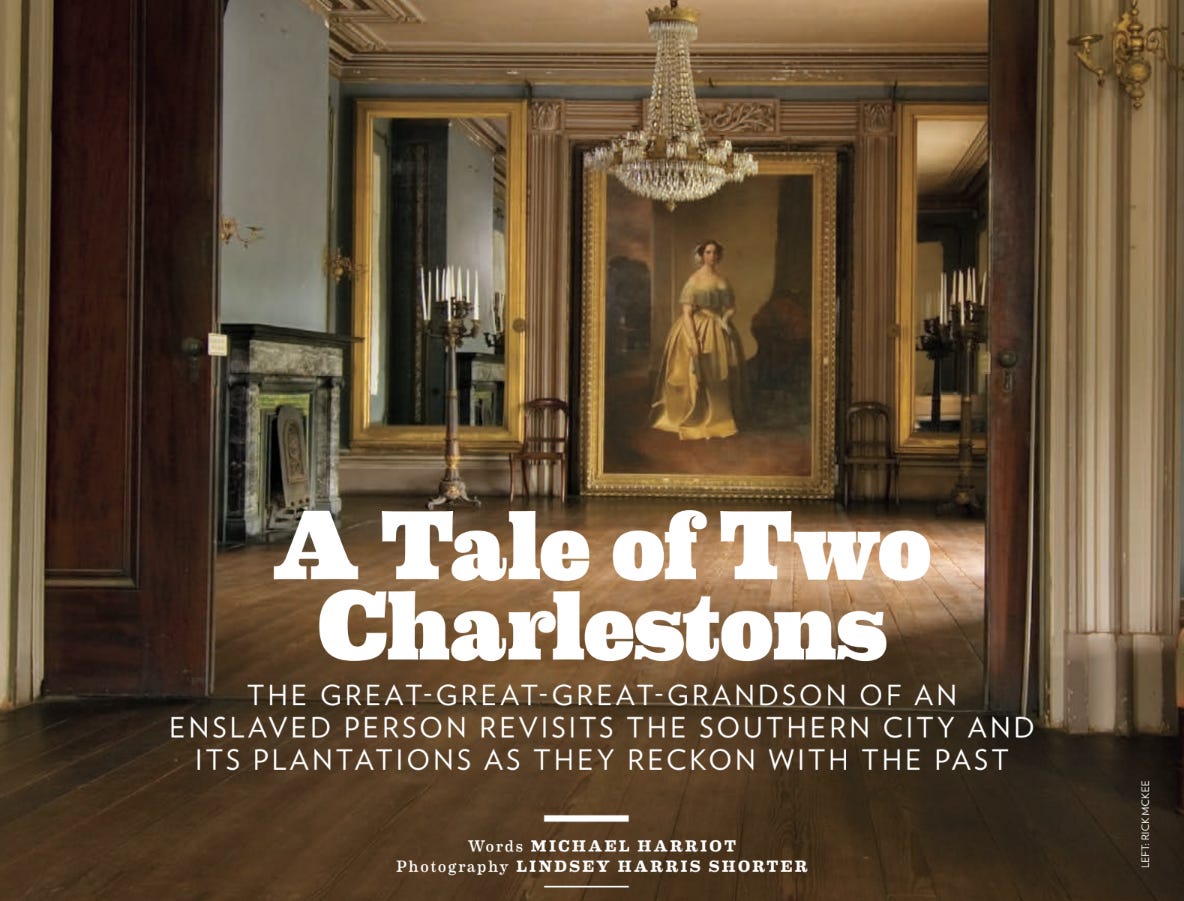
In 2020, amid the nationwide protests over the murder of George Floyd, American Airlines commissioned me to write a feature on Charleston, S.C.’s plantation tourism industry for the company’s now-defunct in-flight magazine. The magazine’s editors said they wanted “an honest account of a city reckoning with its history.”
My original draft, a 4,000-word piece called “A Plantation Called America,” was far too long. It eventually evolved into a beautifully photographed feature called “A Tale of Two Charlestons” (you can read it here).
This is the original draft of the story that was published in the Feb. 2021 issue of American Way Magazine.
At 4:17 a.m. on Thursday, I pulled up to the entrance of the Emeline Hotel in Charleston, S.C., and…
OK, maybe it was 3:17 a.m.
I have no idea. In any case, the valet seemed unusually chipper at such an ungodly hour. Then again, he hadn’t completed a seven-hour drive from Birmingham, Ala., to report on Charleston’s infamous plantation tourism industry. As a South Carolina native who happens to be Black (I love when people say that, as if they don’t know how it happened), I am not what you would call a “plantation kinda guy.” I’ve spent countless hours in “Chucktown.” My paternal grandparents lived here. It’s where my father and his 10 aunts and uncles were born and raised. Still, I hadn’t visited a tourist attraction in the city since…I don’t know when.
After a few minutes, I checked into my room, dropped my bags and returned to the lobby. As I walked out of the Emeline, the woman at the front desk (who somehow knew my name) asked if I needed anything.
“No,” I reply. “I just wanna…Yeah. Which way to the ocean?”
She points. I walk.
I lumber past the Old Slave Mart, which once served as the headquarters of America’s human trafficking system. Outside the Old Exchange and Provost Dungeon, tourists are already snapping selfies while standing in front of the site where more enslaved people were trafficked than anywhere else in the history of the planet. A line has already formed to tour the “House of Correction,” the prison where Charleston residents could drop off their human property to be punished by professional torturers.
I keep walking.
Even in my foggy memory, I clearly remember thinking that this city remains one of the most beautiful places I have ever set foot in. As I pass the Charleston Customs House, I remember a church trip, my baby sister’s hand in mine. Decades after she had left home to attend the College of Charleston, marry a Charlestonian, raise four children and somehow enhance her Geechee accent, I can hear her squeaky voice say, “I wanna live yah.” Years later, my mother retired and moved there, too.
And here I am, staring at the ocean in the salty-soft morning breath of God in the city of my family’s reclaimed home. I wonder if I'm standing in the same spot where my family’s legacy began more than two centuries ago, when a ship stocked with stolen Africans docked at the beach of this time machine called Charleston. I wonder if he told them in his native tongue that he wasn't a “plantation kinda guy.”
I am one of the people whose ancestors’ forced labor built a quaint Southern empire of wealth and privilege. Charleston still thrives on the sweat-stained history of slavery that, for centuries, has been treated as if it wasn’t the reason for this city’s existence. The plantation tourism industry has created an impressionist painting of this town’s history—all color, no shadows. Perhaps that is why it took a storm to unwhitewash this bloodstained canvas. Still, I must admit:
It really is gorgeous.

Before my grandmother died, she would tell me the story of her great-great-grandfather, Ervin. I knew it so well that I could recite it by heart. In 1849, South Carolina militiamen stopped Ervin Bradley and asked him for his “pass.” Ervin had become accustomed to this treatment and pulled out a copy of John Bradley’s will. Before his death, John Bradley divided his three plantations, livestock, money, interests in the Statesburg Bridge Company and the Stave Landing Ferry.
“My belligerous [sic] negro man Ervin is to have his own time consistent with the laws of the state,” the will’s last paragraph began. “He is not to be appraised when my estate is valued, and no further services are required of him.”
And just like that, the freedom part of my family’s history began.
I thought about how Ervin must have felt, walking around with his liberty in his pocket, as I sat in a rideshare on my way to meet with Elijah Heyward III, the chief operating officer of the International African American Museum. When I arrived, I figured I had given the driver the wrong address because he dropped me off in front of a tiny, residential house. Next door, a woman was holding a broom, smoking a cigarette. I asked her if she knew where the museum was, and she began giving me directions in the way only a Charlestonian could.
“Oh, you got to go waaay down deh,” she began. Her warm Gullah accent sounded like fish frying. Like spitting out watermelon seeds on a front porch with your favorite cousin. She sounded like home.
“Go all de way down. You gon’ thank you walk too far, but if you ain’ in de ocean, you ain’t to it yet. You’ll see it.”
Slated to open in 2022 at the historic Gadsden’s Wharf, the museum plans to tell the story of Africans in the Americas and throughout the diaspora. A “museum” in name only, the IAAM won’t merely be a collection of artifacts and exhibits; it will feature a Center for Family History that hopes to advance the study of African-American genealogy and unlock a long-lost past that has been obscured for millions of families of African descent.
It only makes sense that the “slave museum,” as it is colloquially called, would be located here. Historians estimate that 40% of the African chattel imported into this country entered through Charleston, making it the wealthiest city in the 13 original colonies. According to historian David Blight, by the beginning of the Civil War, America’s four million enslaved Africans were the single largest financial asset in America, worth more than all the railroads and manufacturing combined. And at the center of that human trafficking economy was the “capital of the slave trade”—Charleston, S.C.
I would soon find out that there was a mixup in our meeting time. But instead of taking an Uber back to the Emeline, I decided to walk the half-mile or so back to the hotel. I stood on the sidewalk to get my bearings when I noticed I was standing directly in front of the “Mother” who gave the blood sacrifice that changed Charleston.
Technically, Emanuel African Methodist Episcopal Church is also a tourist attraction.
On Wednesday, June 17, 2015, around 9:05 p.m., Dylann Roof walked into the historic Mother Emanuel AME Church during a Bible study session and opened fire, killing Rev. Clementa C. Pinkney, Cynthia Graham Hurd, Susie Jackson, Ethel Lee Lance, Depayne Middleton-Doctor, Tywanza Sanders, Daniel L. Simmons, Sharonda Coleman-Singleton and Myra Thompson.
Investigators would later discover that Roof espoused white supremacist ideology and had a particular affinity for the Confederate battle flag that had become inextricably intertwined with the culture of Charleston history and tourism. Although the city existed even before America, Charleston remains frozen in a romanticized antebellum time warp that fuels its tourism.
This is where the first shots were fired when 11 states decided they would rather not be a part of the United States if their citizenship required them to grant their human captives the most American thing of all—freedom.
Or, Charleston is the place where rebellious Southerners stood up against the mightiest army on earth and fought for their…yada yada yada..states rights…something something…Northern aggression…heritage…Southern way of life.
This is the “lost cause” fairy tale that Charleston not only embraces but perpetuates for a tidy profit.
But with the smoke and bloodstained pews of Mother Emanuel, exacerbated by the death of George Floyd, there came a reckoning in Charleston. After profiteering on 400 years of enslaved Africans’ sweat equity, Charleston began to recognize how perpetuating an ahistorical narrative may have romanticized a society built on subjugation. Local leaders pledged to stop glorifying and partially erasing the historic location’s real history.
But how?
For 400 years, the “Port City” has subsisted on the commodification of Black bodies. According to the Charleston Area Convention and Visitors Bureau, tourists poured a record $8 billion into the city in 2018. Tourism—and in large part, plantation tourism—is the one unwavering part of Charleston’s economy.
Then, there are the weddings.
On any given weekend, you will undoubtedly encounter a wedding party using the city as a backdrop to come together in matrimony. Disneyland doesn’t have a Charleston location, and—if we’re being honest—you and I know that Americans aren’t dropping $8 billion every year for in-person history lessons. If plantations are the star of Charleston’s show, then the weddings are the moneymaker. Now, Charleston has vowed to change.
But can it?
There is no such thing as historic Charleston.
According to the 1670 census, South Carolina’s population was 90.3% white and 9.7% enslaved. By 1708, the slave population had increased to 57.4%. The state wouldn’t have a white majority again until the 1920 census. Before the Civil War, Charleston was the only major American city with a majority-slave population. Black South Carolinians and slavery are not part of this city’s story; they are the story. If any museum, man or mouth purports to tell that story without centering it in the majority, are they reciting history or retelling a fictional tale?
“The very first time I came to Charleston was in 1975,” Dr. Bernard Powers says. “I was visiting Fort Sumter. At the time, they gave you a mini-lecture, which focused on the coming of the Civil War, all the reasons for war, and so forth. You know—the cultural differences between North and South; tariffs, states’ rights, and this, that, and the other. And not a single word about slavery. It apparently had no role!”
Powers is the director of the College of Charleston’s Center for the Study of Slavery and the acting director of the International African American Museum. On this night, he was one of three panelists discussing “Perspectives of the Historical Narrative: Balancing Charleston’s history in the 21st Century.” The gathering took place at the historic Aiken-Rhett House, a sprawling antebellum home in downtown Charleston that was once home to South Carolina Gov. William Aiken Jr.
After the event, a representative from the Historic Charleston Foundation showed me around the “urban mansion” that embodies the oxymoron of Charleston’s historical “preservation.” Acquired in 1995, the residence-turned-museum features imported artwork, photos and architecture that impressively reflect 200 years of history, during which as many as 19 unpaid captives cared for the two or three white people living in the 22,000-square-foot behemoth. Aiken owned a pair of rice plantations outside the city, where he enslaved more than 800 human beings. Yet, Aiken’s story is the one that’s told.
It wasn’t until 2018 that the historic foundation began telling the stories of the dozens of enslaved people who lived in the cold, dank “servants’” quarters behind the home. In 2016, during a pledge to fulfill the promise to Mother Emmanuel, a team of archaeologists began surveying the slave quarters; they found more than 100,000 artifacts. As we ended our evening, I asked my tour guide when the last enslaved person lived there.
“I think a servant who was a descendant of the enslaved lived here until the mid-80s,” he said.
“Wait,” I replied, doing a quick bit of math. “That was more than a decade after the end of the Civil War, which means—”
“No…The nineteen-eighties,” he interrupted before shrugging casually. “But it may have been the nineties.”
I awake with one unshakeable thought:
I want shrimp and grits.
Instead, I head to the lobby where my new-millennium chariot awaits. The desk manager greets me again. This time, it’s a man who happens to be Black. We chat for a second while I wait for the car. I learn a little about his history and how much he loves working for the Emeline, but all I could think about is grits. And how does he know my name? As the car pulls up, I ask him where I can find a good plate of shrimp and grits.
“Oh, you want to go to Gillie’s,” he said.
For a brief second, there is an awkward pause. He is poised, but I am not, so I don’t know how to broach the subject.
“Ummm…I’m lactose intolerant,” I stammer.
He chuckles and responds: “It’s Black-owned.”
Real Carolina grits have a creamy texture that touristy restaurants try to replicate by adding milk or cream to the grits pot. While every restaurant in Charleston offers its own version of this authentic South Carolina staple, real South Carolinians can taste the absence of someone standing over the grits pot, stirring slowly. I didn’t come all this way for milky grits. I’m going to Gillie’s. But first, I head to the McLeod Plantation, which, I’ve been told, is the model for what the plantation tourism industry would look like if it told the true history of Charleston.
“Some people see this huge beautiful house; some see the slave cabins,” explains Shawn Halifax, interpretation coordinator at the McLeod Plantation. “Even your eyes are interpreting history.”
William McLeod purchased the McLeod Plantation in 1851. I know this because I looked it up on the website. McLeod Plantation tours aren’t really about the plantation-style, two-story home on Charleston’s James Island. In 2011, Charleston County Parks purchased the house from the Historic Charleston Foundation, to whom the property was bequeathed by the last surviving member of the McLeod family. Like the Aiken-Rhett home, the last surviving member of the dozens of McLeod’s forced laborers moved off the property in 1990, when the last McLeod died.
Instead of a personal tour, I joined a couple from Pennsylvania on their guided tour. We learned about the life of the enslaved, their daily routines and how their lives contextualized history. The site is intentional about teaching the real story of James Island, where more than 1,500 Black Americans worked “under violence, or the threat of violence,” according to the tour guide, providing the labor for around 200 James Islanders.
After the hour-long tour, Halifax told me he has traveled the country to craft a plan for interpreting the plantation’s history. Charleston County has invited James Island’s descendant community to participate in every part of the site’s decision-making process, including incorporating their oral histories into telling the landmark’s actual story. It is an unprecedented idea in his profession, which he hopes will reflect the McLeod Plantation’s real past.
During a pause in our conversation, something (or someone) tells me Halifax wants to show me something, so I give him space for the words. Sure enough, he says: “Let me show you something.”
We walk across the street into a heavily thicketed area. Halifax tells me to watch my step, but I already know where I am headed. I am not even a spiritual person, but I swear this is true—I could feel myself getting closer to something. When we stop, we are in an unkempt, overgrown area sprinkled with gravestones pointing in every direction.
Black people are buried here.
I wonder if I belong to one of them.
After the tour, I visit Gillie’s, but I don’t get the shrimp and grits because there is only one thing more authentically Charleston than shrimp and grits. In fact, today may be the first time I have ever seen the words “chicken perloo” spelled out. Later, after dinner and a few drinks at Emeline’s Franny and the Fox, I drive 12 miles north to visit my mother and sister. We sit up until 1 in the morning laughing until my mother dozes off. She’s the one who uncovered most of my family’s history, including the legendary will that set Ervin free. Just before I leave, I ask her if she ever found Delia.
She has not.
Before James Bradley died, he split his considerable fortune among two sons and three daughters. According to the will, the bulk of his 89 enslaved humans was handed over to his daughter, Elizabeth Long Bradley, including one he referred to as “Delia the Nurse, together with her future increase.” For years, my mother has been trying to find Elizabeth or her husband, John McLeod. She knows they were in the Charleston area or the “lowcountry” because Bradley’s “belligerous Negro Man Ervin” was headed there on foot from Sumter County, S.C.
For years, the newly freed Ervin was obsessed with Delia the Nurse because of the “future increase” part of James’ will. But Ervin never found her and, after particularly brutal interactions with two different counties’ slave patrols, he eventually gave up. He was broke, homeless, without food and only had his freedom because he was the kind of slave no father would burden his children with, and no man would want on their plantation.
Ervin Bradley could read.
Delia the Nurse, his wife, was pregnant.
He would never see her again.
On Feb. 19, 2003, the South Carolina Senate passed a resolution to express its “profound sorrow”:
Whereas, the members of the Senate are deeply saddened to learn of the death of Mrs. Inez Williams Brown on Saturday, February 15, 2003, in Charleston; and
Whereas, Mrs. Brown was born on the Blake Plantation in Colleton County. Her father, Burton, was the youngest of five children born to Sally Prince. At an early age, he married Mamie Daily, and they had five children. Inez, the youngest, was born on February 20, 1913. Before she reached her first birthday, Inez’s mother died in childbirth. Her father attended South Carolina Normal Institute, now South Carolina State University. He was an ordained Baptist minister and also taught school; and
Whereas, Inez met and married Willie Williams, also a minister. They began their lives together in Hendersonville, South Carolina, later spent four years in Georgia, and settled in Charleston in 1940. They had eleven children. After the death of Reverend Williams, Mrs. Williams raised ten children by herself with the help of her eldest son, Alfred Williams, the Pastor of Canaan Baptist Church with a membership of over eight hundred parishioners
Whereas, Mrs. Brown was active with the National Association for the Advancement of Colored People, the Senior Citizens program in Union Heights, and an avid Voter Education and participation activist. She is the Mother of her church, Canaan Missionary Baptist Church, where she has been a member for over sixty years…
…
Born the granddaughter of slaves, Mrs. Brown daily demonstrated her commitment to her family, her community, and her God throughout a long and fruitful life. Her life is both an inspiration and an example of courage to all who knew and loved her, and she will be sorely missed. Now, therefore,
Be it resolved by the Senate:
That the members of the Senate, by this resolution, express the profound sorrow of the members of the Senate upon learning of the death of Mrs. Inez Williams Brown of Charleston and extend their deepest sympathy to her family and many friends.
Be it further resolved that a copy of this resolution be forwarded to the family of the late Mrs. Inez Williams Brown of Charleston.
Emanuel AME was already considered a tourist attraction when the South Carolina Senate presented that proclamation to Inez Williams Brown’s homegoing service.
So technically, my grandmother’s funeral was the last time I visited a tourist attraction in Charleston.
“Why is Santa at the slave place?” I ask myself. “Is this where he gets his Black elves?” As I pull up to the final plantation visit, Santa Claus and his wife (Rebecca Claus, maybe?) are waiting at the entrance to greet me.
Founded in 1676 by the wealthy Drayton family (who still own the site), the Magnolia Plantation touts itself as Charleston’s “most visited plantation.” When you think of plantations, you’re thinking of this place. It sits on the Ashley River and features boat rides, botanical garden tours, train rides, birdwatching and a tour of the plantation centerpiece—a three-story antebellum home that looks like Bob Ross painted it on God’s canvas.
Because of its gorgeous romantic-style garden, Magnolia Plantation is one of the most-desired venues in the plantation wedding industry, hosting hundreds of weddings a year, often multiple weddings in a day. On the day I visited—a sunny, 71-degree day in the second week of December—only two were scheduled. Still, throngs of visitors, tourists and vendors had packed the 390-acre property by noon.
Magnolia is a contradiction. On one side of the expansive property is one of the most literal examples of living history in Charleston’s ahistorical hamster wheel, a veritable celebration of how much wealth a family can accumulate if they had the benefit of owning an unpaid labor force. Across the property, out of view of the plantation wonderland, one can catch a glimpse of the human cogs and enslaved machinery that built Magnolia.
Joe McGill, Magnolia’s history and culture coordinator, gives Magnolia’s enslaved people a living history. Perhaps no archaeologist or historian knows the life of the enslaved as well as McGill. His Slave Dwelling Project has taken him across the country, living and sleeping in slave quarters in 25 different states. He took me to a clearing to see the graves of Magnolia’s enslaved people. The people who built this historic generator of generational wealth were not necessarily buried as much as they were put in holes and covered with dirt, like things. You do not bury “things.”
While Magnolia gives plantation tours, hosts weddings and presents a romanticized version of its owners’ history, it also hires people like McGill, who gives a separate tour, “From Slavery to Freedom,” on the history of the plantation’s enslaved. He is careful to note that part of why the plantation tourism industry whitewashes the past is because that’s what visitors want to see.
“Every time I sit in front of an audience under that pavilion—usually it’s couples—I gotta figure one half of that audience didn’t want to come,” McGill explained. “Your chances of getting a couple who both want to be there—I mean, it happens, but it’s rare. And the biggest pushback comes from white males.
“Some of these plantations are at least putting forth the effort to tell a more inclusive story.’ McGill says. “And because they’re putting forth that effort to tell that more inclusive story, you catch some of those folks by surprise.”
I also took one of the hourly plantation house tours with historian and archivist Caroline Howell and a large group of awestruck tourists from Tennessee. After explaining how the Draytons arrived in Charleston a century before the Revolutionary War and built their fortune growing rice, she opened the floor to questions before moving on with the tour.
“Whose idea was it to grow rice when rice is from the Far East?” asked a visitor in a syrupy Southern drawl.
“They tried everything when they first arrived here in the 1670s,” Howell explained. “They tried silkworms, citrus fruit—you name it, they tried it. But nothing would grow here because our land is either swamp or dirt, which is the perfect environment to grow Carolina gold rice, which made this the wealthiest part of the country right before the Civil War.”
“So did they bring Asians over to show them how to do it?” the woman pressed.
“No ma’am,” responded Howell. “The sla—the people on the West Coast of Africa have been growing rice there for centuries. So they are the ones who had the knowledge and taught the planters how to do it.
“Any more questions before we move on?”
Unsurprisingly, no one even asked why these insanely wealthy students of the gracious African teachers were called “planters” if they didn’t know how to plant things. Minutes later, on the porch, I spoke to the only African-American visitors I would see that day. Just as McGill predicted, it was a husband and wife from Iowa, both veterans.
“I personally didn’t come here for an informative visit,” he told me. “Me and my wife just came to spend some time together. My wife read the reviews, and it was a good review. I realize the history because I’m Native American and Black, so I got both sides against me. But I’m not going to dwell on it.”
After I told him it was probably time for his tour, so he should go inside, he gave me a funny look.
“Nah, I’m here to tour the slave cabins,” he said. “I would never go in that house. It’s probably haunted.”
As we both chuckled, the woman who asked the question about the Asian rice planters marveled at the size of the wraparound veranda and interrupted:
“Isn’t this all just to die for?”
If only she knew.
In the 350 years since the city of Charleston was founded, no one has ever imported a slave from Africa. Human traffickers transported already-captive priests, doctors, storytellers, mothers, fathers and children and turned them into slaves.
Before leaving Charleston, I walked through the Charleston City Market again just before closing, watching tourists mill about, and women in wedding dresses pose for pictures while the vendors packed up their wares for the day. I found it confoundingly interesting that in all of these various plantation visits, no one even attempted to paint the wealthy human trafficking barons as extraordinary. They were not exceptional men. They did not invent anything or create something new. They just owned people.
I realized Charleston is not much different than it has ever been. Its tourism industry is the same as its slave industry once was—just a business. Whether the product is lies, fantasies, backstories or Black bodies, this city is a seller of things. And, as long as there are buyers, what the “thing” is has never mattered to the sellers.
While chitchatting with Emeline’s desk manager, I watch the valet pull my car in front of the hotel as I check out. I walk toward the door, then pause and turn around.
“Hey, quick question,” I ask. “Who is Emeline?”
“Well,” he began. “Emeline is who we think of when we imagine our guests—a well-traveled, sophisticated woman who really lives nowhere. She’s both in the past and the present at the same time.”
“So, Emeline is a fictional character?” I ask.
“I guess you can say she’s an idea,” he explained.
“OK,” I replied. “Like America.”
He had no idea what I meant.
Ervin would have known. Delia would have understood, too. So would my grandmother and my mother.
As I drove past the sightseers still beholding the slave empire that rests atop the labor, lives and loves of my ancestors, I had to admit:
It is beautiful.