
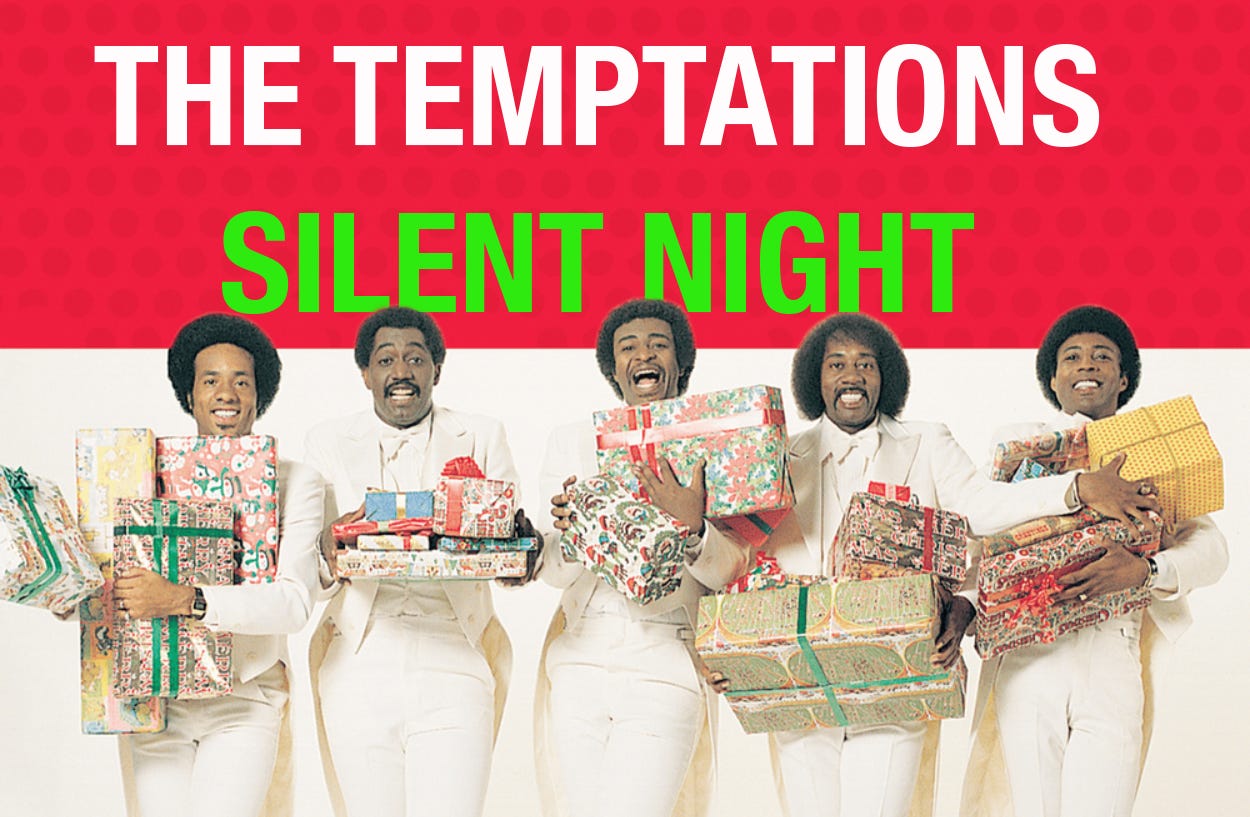
Throwback Thursday: A Complete Breakdown of the Blackest Christmas Carol of All Time
This article originally appeared on NegusWhoRead on December 24, 2015.
First of all, let’s get this out of the way:
I can’t argue with anyone who considers “This Christmas” to be the greatest Christmas song of all time. When Donny Hathaway released the iconic tune in 1970, it wasn’t an immediate hit. It wasn’t until the 1991 re-release that the song became a staple in households that clap on the beat.
More importantly, “This Christmas” isn’t really a carol. Anyone can sing a carol, but there are fewer than 17 people in the history of the planet who can perform an adequate rendition of Hathaway’s timeless classic. If I saw the Mormon Boys Choir singing it in the mall, I’d call the police and report them for desecrating a national treasure. In fact, according to my sources at the North Pole, attempting to sing “This Christmas” automatically lands you on Santa’s
”Naughty” list.
When the Temptations released Give Love At Christmas in 1980, they had already cemented their position as one of the greatest musical groups of all time. Now I know some Caucasian baby boomer who stumbled across this article is already guffawing at that statement, but I bet your 17-year-old nephew can summon the words to the chorus of “My Girl” 10 times faster than he can spit the lyrics to “Sergeant Pepper’s Lonely Hearts Club Band.” Until Paul and Ringo can shimmy-slide-kick while staying in perfect harmony or Mick Jagger can produce a song where he sings actual notes, don’t come around here with that Rolling Stones and Beatles bullshit.
Anyway, 20-years into their career, the group went into a recording booth with a carton of Salem 100 cigarettes in the soft pack, a fifth of Martell and a liter of S-Curl activator (it was 1980, after all) and proceeded to record what would stand forever as the theme song for the Black Holiday Season. The Temptations’ “Silent Night” is more than a carol—it is a love song to Christmas. It is a sermon, a slow jam and a gospel hymn. It brings tears to the eyes of Jehovah Witnesses and Five Percenters. Even though the song has become the signature tune for any Christmas gathering, it can only be fully appreciated after closely analyzing it like a great painting or dissecting it like a great piece of poetry.
It begins with a prelude of a spoken word recital of “Twas the Night Before Christmas,” which has nothing to do with the song they’re about to sing!
The only explanation I could come up with is that it’s a trap to lure in Caucasian listeners. I imagine Hannah and Bradley Callahan gathering around the fire with their children Kyle and Amanda smiling at the first few notes before Eddie’s falsetto interrupts with that unmistakable real nigga sanging. I’m sure it startled Hannah, but it was too late. By the time they reached for the eject button on the 8-track, Otis had already begun.
Most people don’t know that until the mid-’90s, to get licensed as an R&B group, every fourth song had to feature a deep-voiced member whispering smooth-talking come-hithers to their female fans. It was called the “Race Music Bass Act of 1957.” I know this sounds like an inane fact I created out of thin air, but it is no more preposterous than following the introduction to a song about the birth of Jesus with the beginning of a poem about Santa Claus. It makes absolutely no fucking sense except for a congressional decree or a little too much cognac. Either way, it still bangs.
By now you have two parallel trains of thought going on simultaneously.
On one hand, you’re thinking: “Another introductory part?” In his mind, he wants you to be free. What does this mean? Why is the rest of the group in perfect harmony behind him while he’s imploring you to listen to him? Why did he think you bought the record? And how is this “Silent Night”? More importantly, WHAT THE FUCK DOES THIS HAVE TO DO WITH THE BIRTH OF JESUS? I bet this shit isn’t written down! We know you’re just stalling, Temptations! I am already aware that you wish me a merry Christmas! I bought the fucking record! Put out those cigarettes and sing my song! While all of this is running through your head, you’re also saying to yourself, “Damn, this song sounds good.”
OK, Now we are down to the actual traditional version of “Silent Night.” Here is where the Temptations shine. It is as if the Mighty Clouds of Joy showed up at Jesus’ manger to sing him a lullaby. I’m sure when Franz Gruber penned this classic in 1818, he had no idea five doo-wop singers sporting jheri-curled shags would put so much “stank” on it that Christ himself would request it at every one his birthday parties.
If you came here for the original version of “Silent Night,” you should feel free to leave at this point. That took all of 45 seconds. But there’s a second verse. Only your church deacon knows this verse. And Otis.
When he hits that second “Christ … the savior is born,” You get goosebumps in the back of your knees and in the folds of your elbows. Don’t front. I know you did. That was worth wading through the preface, forward and introduction of the song to hear.
Wait. Is this nigga about to preach? In the song?
That’s how you know Jesus is Black—because there’s no operatic or hard rock version of this song that puts water in the corners of your eyes. The song is over, and now there’s a thick, syrupy feeling in your chest. That’s called “love.” A song did that. A motherfucking song.
“Jingle Bells” could never.
The Temptations’ “Silent Night” actually brings joy to the world every time someone hears it, so play it often, because—like the song—in my mind, I want you to be free …
This Christmas.


excellent article. happy holidays to you and yours!