


Wilmeth Sidat-Singh got a full ride.
When Syracuse offered Sidat-Singh a basketball scholarship in 1935, the sport was as popular as lacrosse. The NCAA didn’t even have a national tournament, so Sidat-Singh’s Indian heritage didn’t make headlines. But when a coach saw him shredding students during an intramural football game, Syracuse begged him to play quarterback.
That was a problem.
Although the Orangemen and Cornell were two of the first colleges to recruit Black football players, football was a revenue-generating sport. So whenever the team played segregated schools from the South, the schools agreed to keep their “negro athletes” on the sideline.
But Syracuse’s football team was terrible. They had only won one game the previous year. The coaches wanted Sidat-Singh so badly that they found a solution. They noted that segregation laws only applied to Black players. And since Sidat-Singh was Indian, he became the “Hindu Halfback,” the first Indian college football star in America.
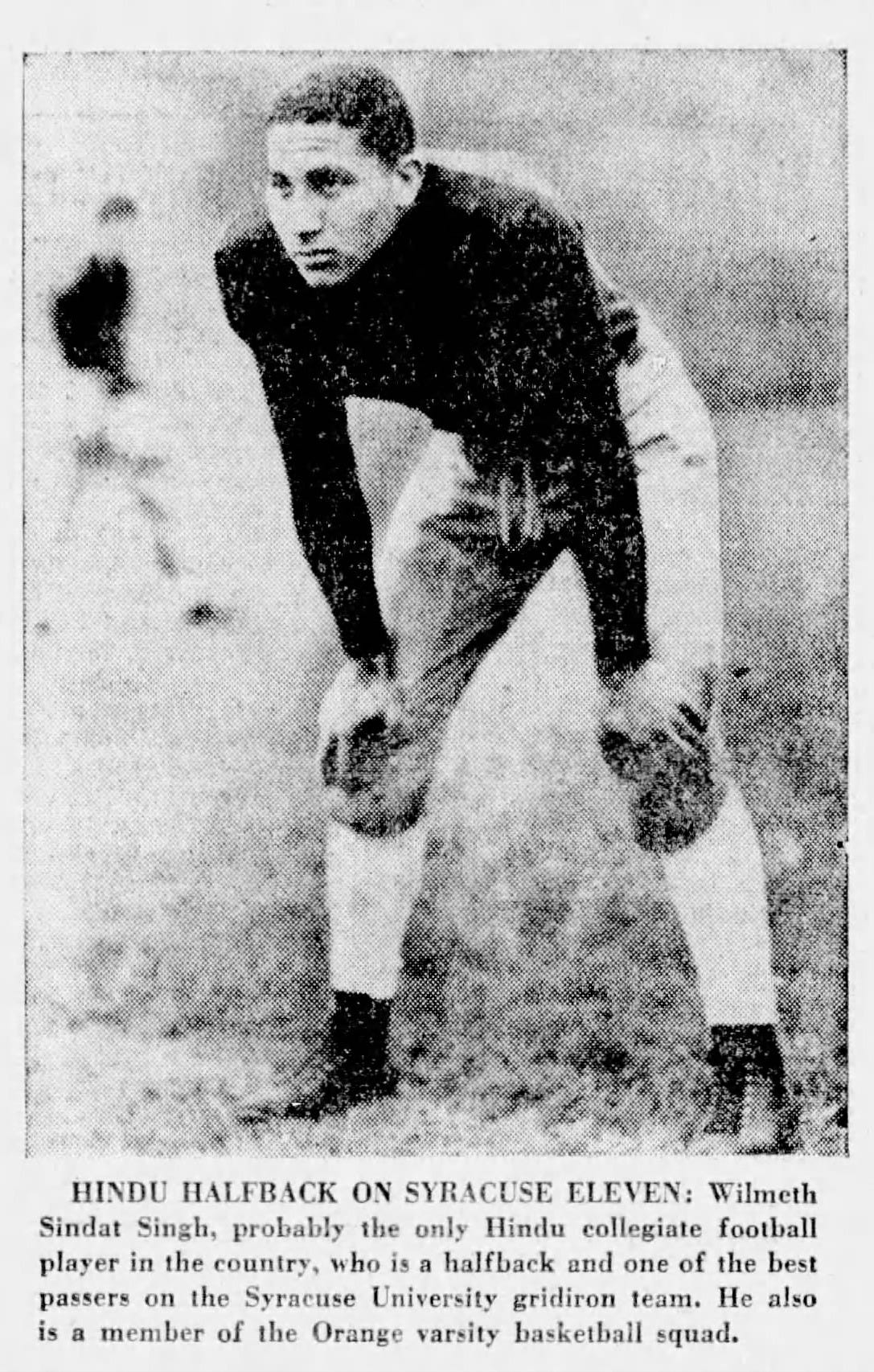
It worked. In 1937, Syracuse faced Cornell in a battle of two undefeated teams— Syracuse was nationally ranked for the first time in school history. Syracuse trailed until they put Sidat-Singh in the game.
“A new forward-passing hero stepped in front of the great white spotlight of fame at Syracuse today,” wrote Grantland Rice. “This phenomenon of the rifle shot even went on beyond Sid Luckman and Sammy Baugh. His name is Wilmeth Sidat-Singh, a Negro boy from Harlem wearing an East Indian name and with the deadly aim of Davy Crockett and Kit Carson.” Yes, Rice, maybe the greatest sportswriter who ever lived, had almost buried the lede that he had just learned from Sam Lacy, a legendary Black sportswriter:
Wilmeth Sidat-Singh was Black.
His mother was Black. His father was Black. But after his mother remarried when he was young, Sidat-Singh took his stepfather’s name. He wasn’t passing—but he wasn’t going out of his way to correct anyone, either. But Lacy and the Black students at Syracuse knew Sidat-Singh's secret. How?
Sidat-Singh had just pledged Que
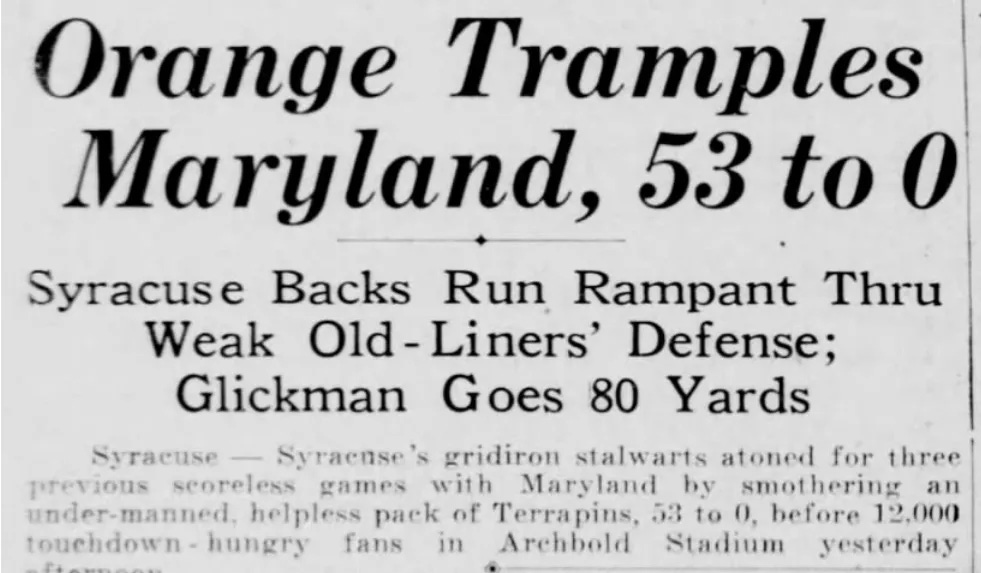
Syracuse's next game was at Maryland. Howard University, where Omega Psi Phi was founded, had an away game that week. Every Black person who’s ever eaten Que Dog Chicken knew what was about to happen. But when Lacy noted that Maryland's stands might be filled with purple and gold at the next game, Grantland spilled the beans. And when Maryland found out that Wilmeth was not “Hindu,” Sidat-Singh was benched.
Cuse lost. But the following year, Sidat-Singh and his teammates drew a line: no more sitting. Maryland had a choice—forfeit or play against Black men. They folded. And you can guess what happened when Sidat-Singh hit the field.
Two weeks later, Sidat-Singh’s team traveled to North Carolina to play against Duke. If Syracuse won the game, they had a shot at the biggest college football game in America: the Rose Bowl. But without Sidat-Singh, they realistically had no shot. And since Duke was private, the contracts with their opponents stipulated that Black players could not participate.
“A Rose Bowl bid may hinge on the color line!” wrote the Chicago Defender. “Syracuse may come to the Duke game undefeated. But Sidat-Singh won’t be in the lineup. The Southerners have drawn the color line!”
Thankfully, Duke’s coach found a workable solution.
As soon as Duke’s coach heard that Sidat-Singh was Black, he sent the Syracuse coach a telegram (it’s like a text message except…well, actually, it’s just a text message). He notified the Orangemen that Duke’s “no negro” clause had been written before his tenure and that he would not be enforcing it.
It turns out, you can just not be racist.
When Sidat-Singh graduated, he was a natural selection for the emerging National Football League. Unfortunately, NFL owners had just quietly entered a “gentlemen’s agreement” to ban Black players. Pro basketball wasn’t much better. Because of his stance, Singh was effectively blacklisted. He joined the D.C. police and played semi-pro ball on the side.
Then Hitler happened.
The U.S. government needed pilots. They didn’t have enough. Mary McLeod Bethune told FDR she knew where to find some, if the country could manage to stop being racist for five minutes. FDR hid the funding in the budget. They went looking for sharp, fearless recruits with good hand-eye coordination and college degrees. And, of course, Wilmeth Sidat-Singh was one of the first names on the list.
He was in the first class of Tuskegee Airmen. He died when his engine failed on a training mission. He was 25 years old.
The government that had spent years telling him he wasn’t good enough to play professional football had no problem sending him to die fighting fascism.
The Kid Who Ran Alone
In 1945, Rep. Adam Clayton Powell asked 18-year-old Wesley A. Brown to give up a track scholarship at Howard University and try to desegregate the U.S. Naval Academy in Maryland. The previous attempts had all ended with Black students dropping out under sustained harassment from classmates and faculty.
When Brown refused to give up his college athletics career, the white members of the cross-country team voted to boycott any race he ran…
Except one.
One senior midshipman refused to participate in the racist plan. He’d grown up around Black people but had never seen integration in practice. But because he had seniority, he also had the authority to make his white underclassmen run. Then he made them race against Black athletes from other schools. And the other sports teams at Navy started watching.
That senior midshipman’s name was Jimmy Carter.
On Feb. 8, 1968, police lined up on the campus of S.C. State University and shot at least 28 students during a campus protest. Two of the three killed—Delano Middleton and Samuel Hammond—at the most violent event of the entire Civil Rights Movement were student athletes.
Black high school and college athletes were at the forefront of every Civil Rights Movement. The members of the Little Rock Nine had to give up sports to desegregate their school districts. Emmett Till dreamed of becoming a professional baseball player. As a junior college athlete, Jackie Robinson was arrested for confronting a racist police officer.
So why do we think they’re “too young” to lead movements?
Black members of UTEP’s track team were not too young to boycott a meet against Brigham Young University over the Mormon church’s anti-Black doctrine. Black student athletes across the country joined the boycott. By 1970, five schools had cut BYU from their schedules. In 1978, the church’s leader suddenly had a “revelation” that Black people were worthy of God’s grace.
Jesse Jackson was not too young to play QB at N.C. A&T while leading civil rights protests and serving as the student body president. Kareem Abdul-Jabbar was only 20 years old when he boycotted the Olympics “to point out to the world the futility of winning the gold medal for this country and then coming back to live under oppression.”
The next time someone tells an athlete to shut up and dribble, remember Wilmeth Sidat-Singh, who died flying a plane for a country that wouldn’t let him play football or basketball professionally. Remember Wesley Brown running cross-country alone. Remember the Orangeburg Massacre.
They were never too young. They were always right on time.
But here’s the thing:
You can say you’re scared. You can say you care more about money than the well-being of your community. You can just say, “I ain’t built like that.” Most of us aren’t.
But if you object to this strategy because it’s too burdensome...
No one was talking to you in the first place!
Today’s Reading List:
“No Black Jurors. Thirty-Five Years” by Damario Solomon-Simmons
“Kyle Rittenhouse wasn’t convicted because, in America, white reasoning rules” by Michael Harriot
“Hit Them Where It Hurts” by Jemele Hill
“Republican Redistricting Maps Are Motivated By Race, Not Politics” by Michael Harriot
Thank you, Damario Solomon-Simmons, Susan Gorman Gerke, TM, Zgirl820, JustUsChelle, and many others for tuning in.
Join us every Friday for The Wake-Up Call Live.


