


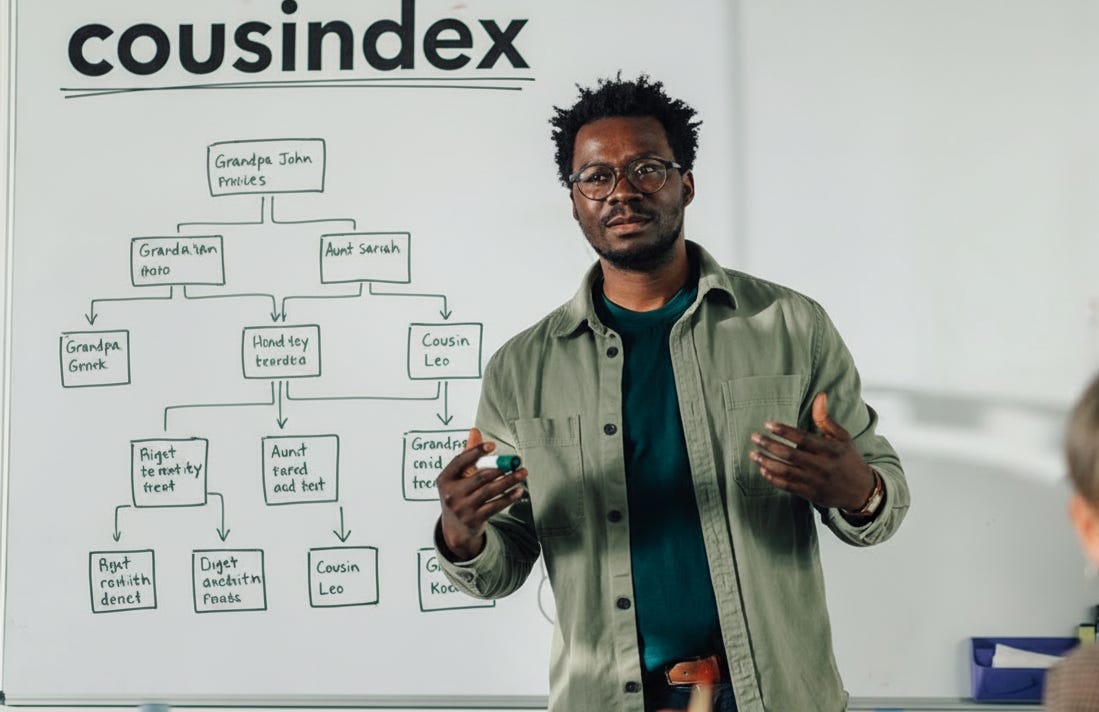
As one of the world’s foremost experts in cousinomics, my inbox exploded a few days ago, after Things I’ve Learned podcast host Steve Owens posted this Instagram reel:
While everything in Owens said is technically correct, this social media dissertation is exactly I spent my life pioneering the field of wypipology.
First, allow me to present my credentials:
Wypipologist is based on wypipo, a Black slang term for “white people” (particularly those perceived to be racist, unaware of their own privilege, or engaging in cultural appropriation) based on a Black colloquial pronunciation of the phrase.
Added to wypipo is the suffix -ologist, signifying someone with expert knowledge of a particular domain of study, usually a kind of science (think biologist). A wypipologist, then, “studies” wypipology— the science of white people, as it were, or white, mainstream culture.
The term wypipologist appears to have been coined by journalist and commentator Michael Harriot
Besides my AI-certified contributions to academia, I am also a Nobel prize-winning anthropologist (I won the 1988 World Series of Pittypat at my aunt Nobel Bradley’s liquor house), who has published numerous peer-reviewed studies in auntieology, Thanksgivinomics, cookoutograhy and other cousin-related arts and sciences.
Now that you have my curriculum vitae, I can add some additional context.
While Owens is not wrong, he is presenting a Eurocentric social construct known among my cousinsdemics as “whitefolkin’.” Not only is the numerical hierarchy that defines Yakubian cousinhood a social construct, but, like most things that follow the dictates of white supremacy, it’s just something white people made up to get more things.
No, seriously, I’ve actually studied this.
According to most scholars, European kinship systems evolved from the need to manage land, inheritance and resources (“kinship” is the Caucasoidal term for “my people”). More importantly, no one uses this system but white people. In fact, the lineage structure that Owens describes is so white-centric that it doesn’t even translate to Chinese, Filipino and most indigenous languages. For instance, the First Nation people in so-called Australia don’t have cousins. Other societies differentiate between patrilineal and matrilineal cousins. In many communal cultures, there is no difference between a cousin and a sibling. And in West African cultures, from where most Black Americans descend, cousinship cannot be defined by blood or a chart.
That’s why, for the first time in cousin history, ContrabandCamp has decided to list the types of Black cousins. While some may call this cultural appropriation, we admit that this was inspired by Owens’s post. However, this groundbreaking work of CRT (Cousin Relationship Theory) is not just necessary; it is rooted in the Africana studies’ principle of how Black people see themselves.
Plus, white people do it all the time.
Here is the definitive ranking of the nine types of Black cousins.
9. Saycousins
These are people who might be genetically related, but have heard rumors that they share a common ancestor. In most cases, the familial connection cannot be documented by a family tree, but it is more than just a rumor. Only three people are qualified to certify someone as “saycousins.”