One of the Oldest Black Museums Is Going Viral With a New Social Media Series
The staff at Detroit’s Charles H. Wright Museum of African American History is using clever videos to depict what it is like to work at the legendary institution from a distinctly Black perspective.

If you see the staff running through the Charles H. Wright Museum of African American History, don’t ask any questions: Just start running, too.
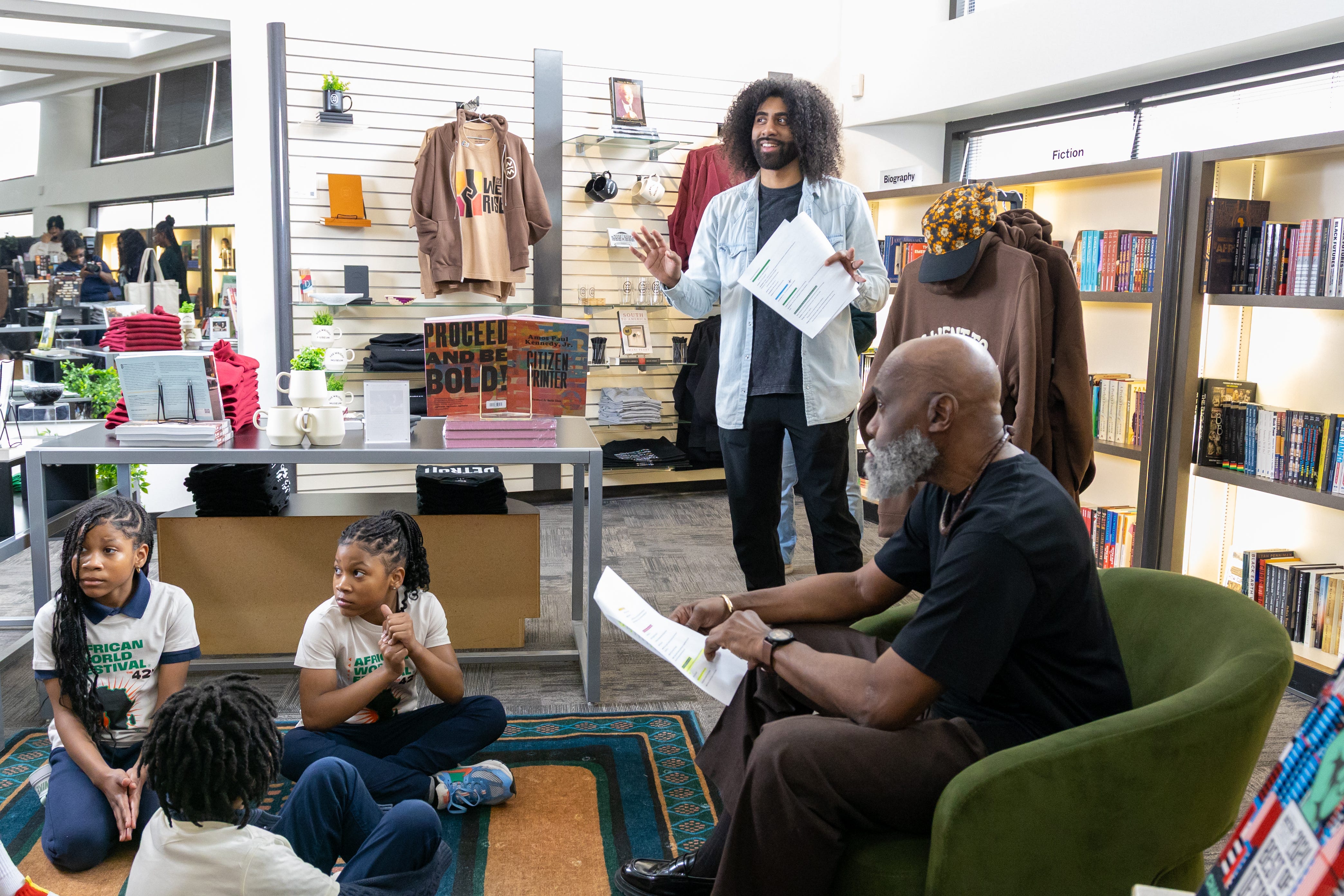
That was the idea at the heart of the museum’s most viral video in its new social media series, which spoofs what it is like to work at the historic Detroit institution—also known simply as The Wright—from a distinctly Black perspective.
Captioned “POV: You’re running and don’t know why,” the video shows museum employees running simply because they saw Lance Wheeler, the museum’s vice president for learning and engagement, running. Shot as a mockumentary, the hilarious videos have introduced the 60-year-old institution to an entirely new audience, desperate for authentic Black storytelling.
“Black people are looking for something to make them feel good in a time where there’s a lot happening in our country and also internationally. Videos like the running video ground us back into our culture,” explained Wheeler, who hails from New Jersey but has fallen in love with Detroit. “And there’s no faking it when it comes to an African American museum right now.”
When Charles H. Wright, a Detroit obstetrician and civil rights activist, visited Copenhagen in 1964, he came across a memorial for Danish World War II heroes. Encouraged by what he saw, he decided Black Americans needed a place to celebrate and learn about our history.
“I’d bring healthy babies into the world, and I’d see them later, and they’d be psychologically scarred,” he told the Detroit Free Press in a 1997 interview. “I saw we had to do something about society—and the museum was an effort to do that.”
Initially launched as the International Afro-American Museum in a house owned by Wright on West Grand Boulevard in 1966, the Wright Museum has grown to one of the largest museums dedicated to African American history in the United States.
With more than 35,000 artifacts and archival materials within its 125,000-square-foot building, The Wright was the largest in the world prior to the opening of the National Museum of African American History and Culture in Washington, D.C. (Note: The author’s grandfather was a docent at the museum’s previous location at 301 Frederick Street in Detroit.)
But the museum has faced obstacles in its 60-year history—from mounting financial pressures to the challenge of remaining relevant in a city that has undergone significant change since the 1960s.
Kyle Sammy, the creator of the video series and digital strategy specialist at The Wright, recognized that the museum needed a new voice. When he was first hired, he quickly grew weary of creating flyers as the primary means of promoting The Wright and its initiatives.
“A lot of people don’t really understand marketing,” he explained. “They think that if you just post something online, then all of a sudden, the event should be sold out. That was the mentality I saw across the board at the museum. And that’s not really how marketing works.”
Shot in a mockumentary style, the social media series has drawn comparisons to familiar hit series like The Office and Abbott Elementary. Sammy named the Quinta Brunson-led sitcom as a key inspiration.
“When I was a part of learning and engagement, we would have a lot of funny conversations at work, and I would think we can make a show out of this,” said Sammy, who once worked for a large YouTube channel. “And then Abbott Elementary got really popular, and we were just like, yo, we could be Abbott Elementary!”
Sammy is a one-man band: He comes up with the ideas, writes the scripts, creates the schedule, and films the videos. “I’m literally pulling people from their desks to be in these shoots. The people you see in the videos are actually working.”
There is no production budget for these videos, but Sammy hopes that will change soon.
“Currently, it is a $0 budget,” he said with a laugh. “I am working with what I have to make ends meet, if you will.”
Sammy understands the video series isn’t solely meant to keep audiences entertained; it’s reinvigorating the decades-old institution by marketing the museum’s educational and community events within the videos. When Wright Museum staff subtly promoted their talk with National Book Award winner Imani Perry in a February video, several people left comments noting they’d make the Wright a key stop on their next visit to Detroit.
“We’ve seen an uptick,” Wheeler said when asked if the viral response has brought people to the museum. “Locally, we’re up by 10% of people coming into the building from different parts of the city of Detroit and other parts of Michigan.”
Jonathan Jones, manager of youth and family programs at The Wright and one of the actors in the series, has seen the videos’ massive impact on the museum. He joined The Wright in 2013.
“I have seen an increase in engagement with the activities that we are doing, an increase in people who want tours, an increase in people who are registering for our events since these videos have gone out,” said Jones, who has years of acting experience.
“Getting the chance to showcase other aspects of our history and culture that are not trauma-based or trauma-filled, that are joyful, that are silly, that are informative, while still keeping our integrity is just a beautiful thing to watch unfold in real time,” he said.
For many viewers, the videos could not have come at a better time. As the Trump administration continues efforts to scrub Black history at national parks and federal sites, the work of independent Black history museums like The Wright is more important than ever.
Hundreds of commenters who found the content relatable are begging for more. Some have called the series “their favorite show” and are anticipating new episodes.
“This series has been the best usage of the internet in a very long time,” one person said in the comment section of the museum’s social media pages. The videos have even attracted the attention of figures like influencer Nimay Ndolo and Detroit native Jemele Hill. “This is so good, I’m actually jealous,” said rapper Trinidad James. “Great work.” Michigan Gov. Gretchen Whitmer will have a cameo in The Wright’s latest video.

Other museums and institutions dedicated to Black history have noticed how audiences engage with The Wright — and hope to replicate its viral success.
“The Blacksonian reached out to me, saying, ‘Hey, this is dynamic. How are y’all doing this?’ I had colleagues in California saying, ‘Yo, this is amazing,” said Wheeler. “The Association of African American Museums, which Dr. Wright co-founded with Dr. [Margaret] Burroughs, said our writers are on some cutting edge.”
But leadership at The Wright isn’t satisfied with just seeing their videos go viral. They’re already working on ways to protect their content.
“We are in the process from a leadership standpoint on figuring out how to get [the video series] copyrighted,” Wheeler said. “We’re expediting that very quickly to answer that question.”
Alongside the likes and shares, Wheeler hopes the videos will encourage people outside Detroit’s city limits to support The Wright’s mission to celebrate Black history and culture.
“I want people to know we are only as strong as our membership base. If you say you support Black institutions, support them not just locally, but outside of your region as well,” he explained. “There are people who support the Blacksonian who do not live in the DMV area. If you want to support The Wright, become a member. Send us emails telling us what you want to see.”
“If you physically can’t come to us, we can physically come to you with our videos via the phone or your computer to engage with you and remind you that there are museums and institutions that are still doing the work.”
Jones, who has starred in most of the videos so far, said people have stopped him while he was out and about to ask about the next videos.
“I was at the gym and people in the class were like, ‘When’s the next video? When’s the next video though? I need it now.’ And I was like, well, you can’t have it now,” he said with a laugh. “So back off and hit that kettlebell.”
But he called the pressure to create more videos “good problems,” a reference to a phrase used in the hit HBO series The Wire.
“[The series] is causing people to want to engage with everything that we’re doing,” he explained. “They want to come to our programs. They want to come to the African World Festival. They want to send their kids to our summer camp. We had to do a retraining at our front desk on memberships because people are coming in droves.”
“These are good problems. So I’m good with that.”


