


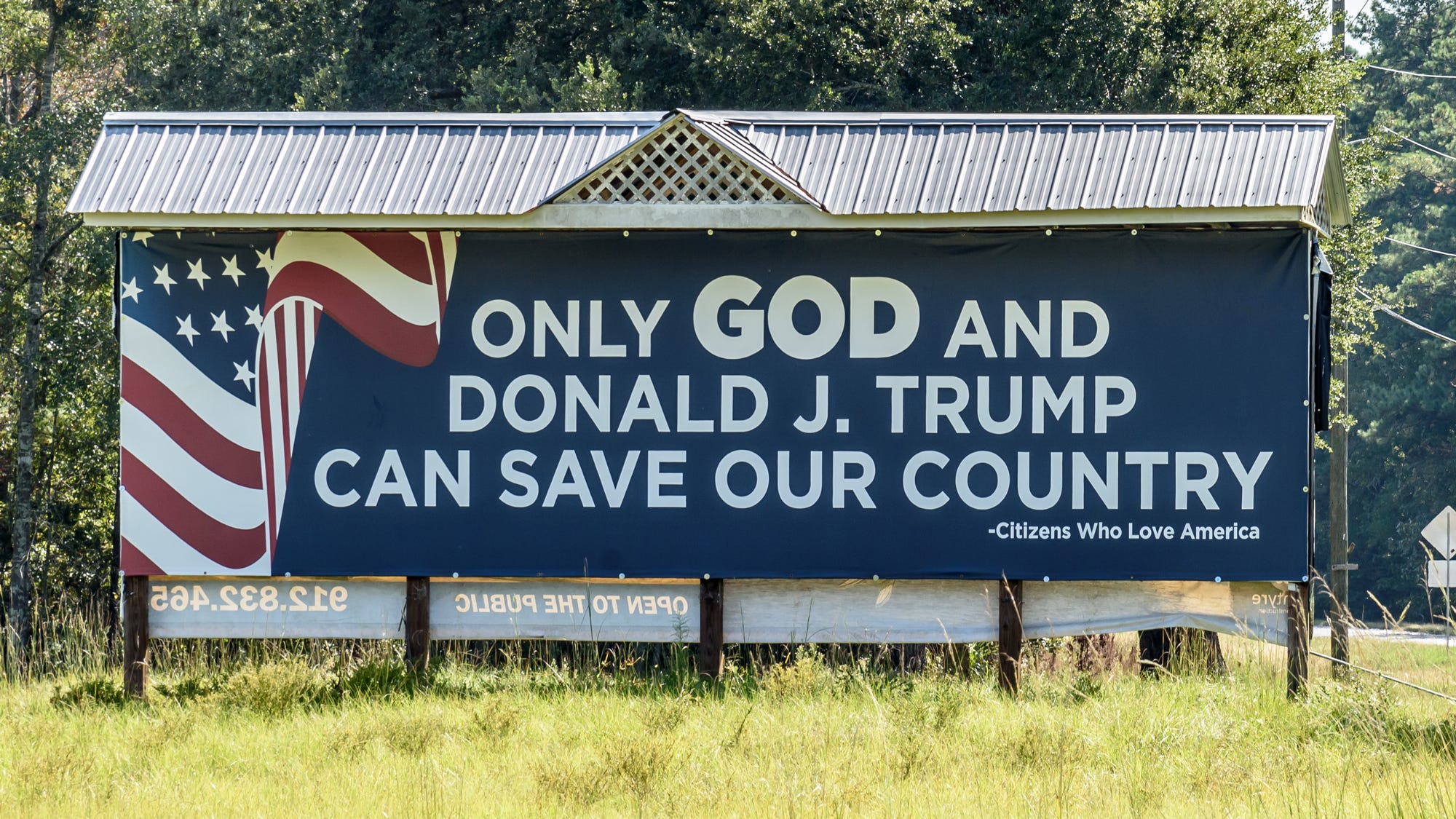
On July 30, 1967, an organized mob of conservative Christians gathered in Charleston, S.C., to hear from one of the most racially divisive religious activists in American history.
Speaking to a standing-room-only crowd, the controversial leader explained that racial disparities were caused by the community’s lack of family values, education and work ethic. He demonized government handouts and even suggested that welfare recipients were hamstrung by a mental defect because of their race.
“A lot of white folks have demonstrated eloquently that they don’t have no sense,” Martin Luther King Jr. explained. “There has never been a single solid determined commitment on the part of the vast majority of white Americans on the question of genuine equality for the Black man. It’s never been here. So for those who say there’s something new now in terms of a white backlash, go back and tell them that it’s always been here.”
King was in Charleston to advocate for “A Freedom Budget for All Americans”—a socially progressive economic agenda that included universal basic Income, access to housing, education reform and reparations. He explained that white people had received government assistance and recounted how they separated Black families and burned Black schools. The legendary activist ended his sermon by tying his “practical, step-by-step plan for wiping out poverty” to his faith with a quote from his favorite radical leftist:
Depart from me, you who are cursed, into the eternal fire prepared for the devil and his angels.
For I was hungry and you gave me nothing to eat, I was thirsty and you gave me nothing to drink, I was a stranger and you did not invite me in, I needed clothes and you did not clothe me, I was sick and in prison and you did not look after me.
— The original evangelical Christian
By any definition, Martin Luther King Jr. was a Christian.
His strategy for nonviolent protest and his philosophy on social change were based on the teachings of Jesus Christ. Most of his followers were socially conservative, politically active and overwhelmingly Protestant. In fact, one could argue that the entire Civil Rights Movement was just a bunch of Christians evangelizing the biblical principle of “doing unto others…”
But they were not “evangelical Christians.”
Any pundit, politician or pollster worth their salt would tell you what the word “evangelical” actually means.
“White people.”
What Is an Evangelical Christian?
If you’re waiting for a concise definition of evangelical Christianity, you’re in the wrong place. We searched everywhere and kept coming up empty.
According to Merriam-Webster, “evangelical” is an adjective that describes the Christian gospel, the Protestant denomination or “salvation by faith in the atoning death of Jesus Christ.” As a noun, the term describes people who hold those beliefs.
The National Association of Evangelicals’ definition of “evangelical” is similarly obtuse. As long as someone believes in the Bible, accepts Jesus Christ as their savior and encourages people to do the same, they can call themselves an evangelical Christian.
The bastions of American journalism offer less clarity. According to the most trusted reporters in the country’s greatest media outlets, “evangelical Christians” include scammers like Tim Tebow, racists like Charlie Kirk and the people who cast a presidential vote for a lying, adulterous, rapist, warmonger who doesn’t seem to know what his lord and savior actually said in the best-selling book in the history of the world.
By every metric, “evangelical” can describe anyone, including the devil (While the devil did not respond to ContrabandCamp’s request for comment, his spokesperson Lou C. Furr pointed to a previous statement about his belief in God).
The scholars at the Public Religion Research Institute essentially define “evangelicals” as Christians who identify as evangelical. However, one of America’s most trusted nonpartisan organizations detailed the rationale for using the term:
Pew Research’s 2023-2024 Religious Landscape Study reports:
Pew Research Center researchers then take the most specific information respondents provide about their denominational identity and use it to group Protestants into one of three major traditions – the evangelical Protestant tradition, mainline Protestant tradition, or the historically Black Protestant tradition…
Respondents are categorized into one of the three Protestant traditions based on their answers to a question asking whether they think of themselves as born-again or evangelical Christians, and/or a question asking about their race.” [Emphasis added]
And there it is. Evangelical is not a religious denomination or a belief system. It has no doctrinal basis or historical connection. The term does not describe a distinct sect of Christianity with a separate belief system.
Evangelical Christians are just white people.
While whites represent 60% of the U.S. population, they make up 70% of the people who identify as “evangelical,” according to Pew Research. No other denomination is even close.
Besides preferring a strawberry-blond savior to the more biblically accurate Christ, the only remarkable thing about these Caucasian Christ lovers is whiteness itself. Their congregations are overwhelmingly white. Their pastors are disproportionately white. I don’t know if white churches have usher boards, but one of my favorite facts (and perhaps the most revealing) about the evangelical movement is this:
You’re more likely to find a white senior leader at a “historically Black” church than a Black person in an “evangelical” congregation.
In all fairness, both Pew and PRRI note one characteristic that sets white Christians apart from Black and Hispanic worshipers:
They’re not very religious.
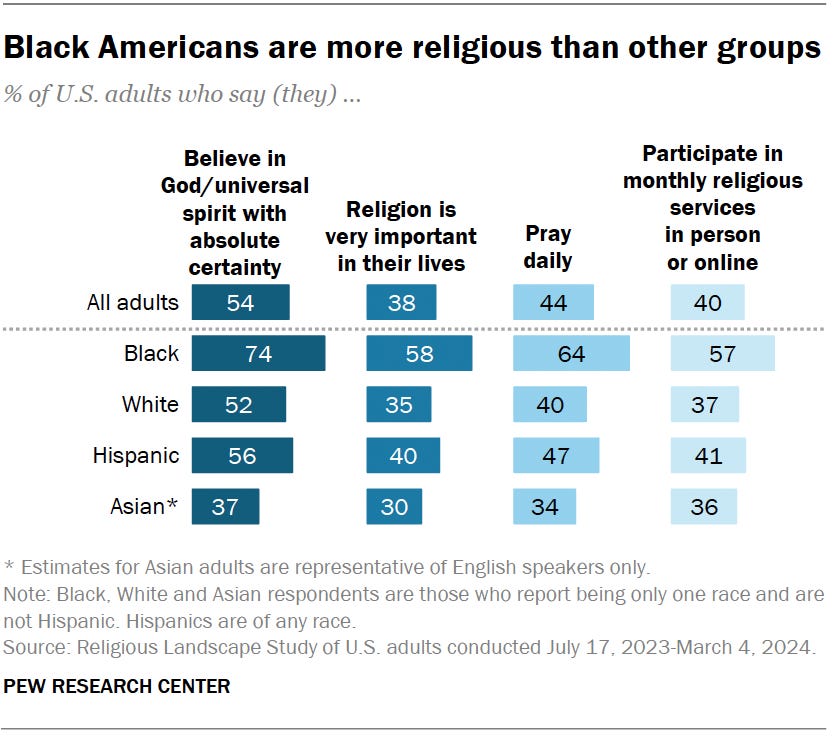
Despite their name and the mythology that surrounds them, white evangelicals are no more likely to believe in a higher power than Black Protestants or Hispanic Christians. They don’t read scripture or pray more than other Christians. White evangelicals actually evangelize less than other Protestants and are less Christian than other racial groups. It is a manufactured term that the media uses as a euphemism for white identity politics.
“White evangelical Protestant” is a political designation.
While most Black Protestants consider themselves “moderate,” white evangelicals are twice as likely to identify as conservative. Even though the term “Black voters” has become synonymous with “Democrat,” white evangelicals are more likely to vote Republican than any other racial, ethnic or religious demographic. This non-religious religious group is the best predictor of who votes for the GOP.
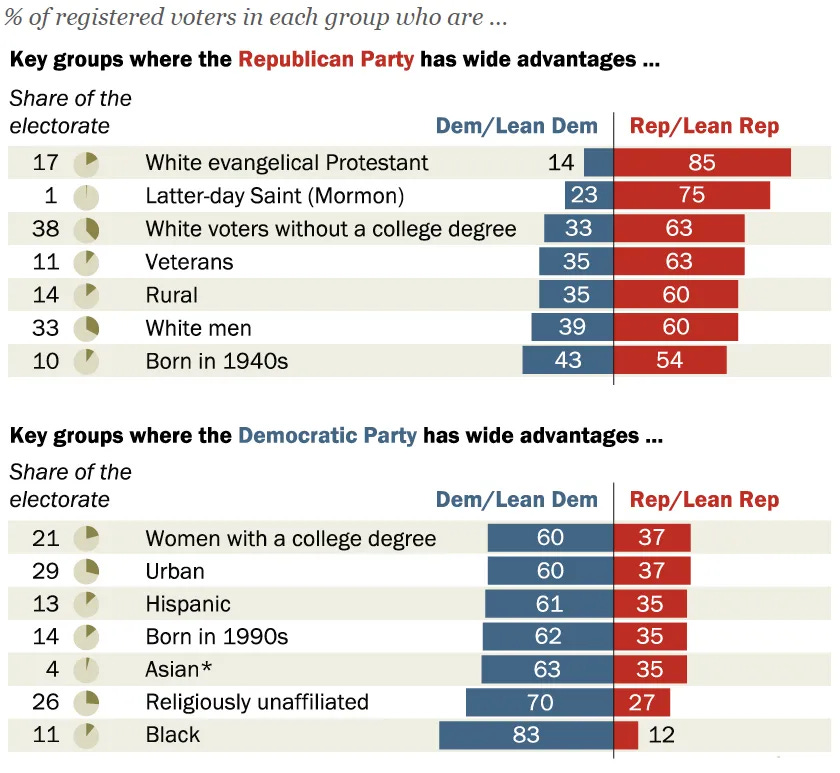
But for some reason, no one ever asks why white evangelicals won’t leave the Republican plantation.
Because there is no such thing as an “evangelical Christian.”
It is just something that white people made up.
How evangelical became white
Politicians, monarchs and movement leaders around the world have weaponized religion to gain political power since the beginning of time. But when it comes to using Christian doctrine to whitesplain political ideology, America is the undisputed GOAT.
King James (yes, that one) justified America’s first white evangelicals by claiming the Jamestown settlers’ mission was only interested in “propagating [the] Christian religion.” The evangelical architects of the Confederate States of America used the Biblical “curse of Ham” and quotes from Paul’s Gospel to the Corinthians as the rationale for their slaveholding empire. Alabama Gov. George Wallace said the Lord’s name 22 times in his vain inauguration speech; he only mentioned “segregation” four times.
And Caucasian Christ failed every time.
Most of the Jamestown missionaries starved to death. England eventually lost its evangelical colony. The Confederates got their asses kicked. Alabama’s segregationists resorted to bombing a Birmingham church filled with Bible-believing Black Christians.
So after a generation of “woke” civil rights activists dismantled school segregation, racial voter suppression and white supremacy’s dominance in Southern politics, a group of young white conservatives found a lord and savior who could wrest back control of their political agenda:
Jerry Falwell.
Aside from founding Bob Jones University as “a private school for white students,” the staunch segregationist pastor’s long-running radio show arguably made him America's most famous white preacher (King was still alive). But in 1971, the U.S. Supreme Court ruled that racially segregated private schools could not have tax-exempt status.
Falwell was livid. White people were furious. And because many of these segregation academies were founded by Southern churches, the decision threatened the economic foundation of white Southern Christian ministries. Something had to be done. And when the U.S. Supreme Court’s Roe v. Wade made abortion legal in 1973, white churchgoers were…
Actually, they didn’t care.
Back then, abortion was considered a Catholic issue. Most white Protestants didn’t mess with Catholics or consider Catholics “real Christians” (partly because of the Catholic Church’s integrated congregations). Even before the Roe v. Wade decision, Protestant theologians didn’t even agree that “the performance of an induced abortion” was sinful.
“White evangelicals in the 1970s did not mobilize against Roe v. Wade, which they considered a Catholic issue,” notes Dartmouth religion professor Randall Balmer. “They organized instead to defend racial segregation in evangelical institutions, including Bob Jones University.”
So how did abortion become a Protestant cause? And what does any of this have to do with segregation academies?
Well, when Roe v. Wade legalized abortion, Heritage Foundation co-founder Paul Weyrich and right-wing direct-mail pioneer Richard Viguerie were just as livid as Falwell was about segregation academies. Aside from being “one of the far right’s most unbending ideologues,” Weyrich was a Catholic and anti-abortion. So was Viguerie, who had already curated a mailing list of conservative donors. Starting in the 1970s, they had breakfast every Wednesday with Howard Phillips, an anti-abortion Democrat who was embraced by the Ku Klux Klan. Together, this ragtag group of right-wing allies recruited Falwell to lead a “religion-based political organization” named after a white supremacist dog whistle that Weyrich coined.
“The Moral Majority.”
Although one influential Baptist preacher called the organization a “sham… controlled by three Catholics and a Jew,” Falwell was a wizard at using race to galvanize the right under the umbrella of Christianity. Suddenly, the Southern segregationists who historically didn’t care about abortion became pro-lifers. Confederate flag-waving conservatives fled the Democratic Party and became Republicans. So did Catholics. In remaking the Christian right, Falwell added one last piece to his Jesus-based movement:
“In the 1980s, the conservative Christian organization Moral Majority grew more involved in high-level Republican politics,” writes NPR’s Danielle Kurtzleben. “That organization also considered Israel one of its key issues, and founder Rev. Jerry Falwell also had access to Israeli prime ministers.”
While Baptists refer to this period as the “conservative resurgence,” this rebirth of the New Right had nothing to do with religion or the Bible. The Catholics were not “saved”; they were just white. Protestants hated the Jews before Falwell embraced them. Fortunately, pollsters and pundits still found a way to describe this disparate coalition of voters who united under the banner of anti-Blackness.
An “evangelical Christian” is just a term that white people made up.
The members of this disparate coalition don’t share a common religious, scriptural or historical origin story. It doesn’t even include all white people. According to PRRI, white Catholics, white Christians and even white, mainline, non-evangelical Protestants are only slightly more likely to vote Republican. But when it comes to politics, white evangelical Christianity is essentially a one-party religion.
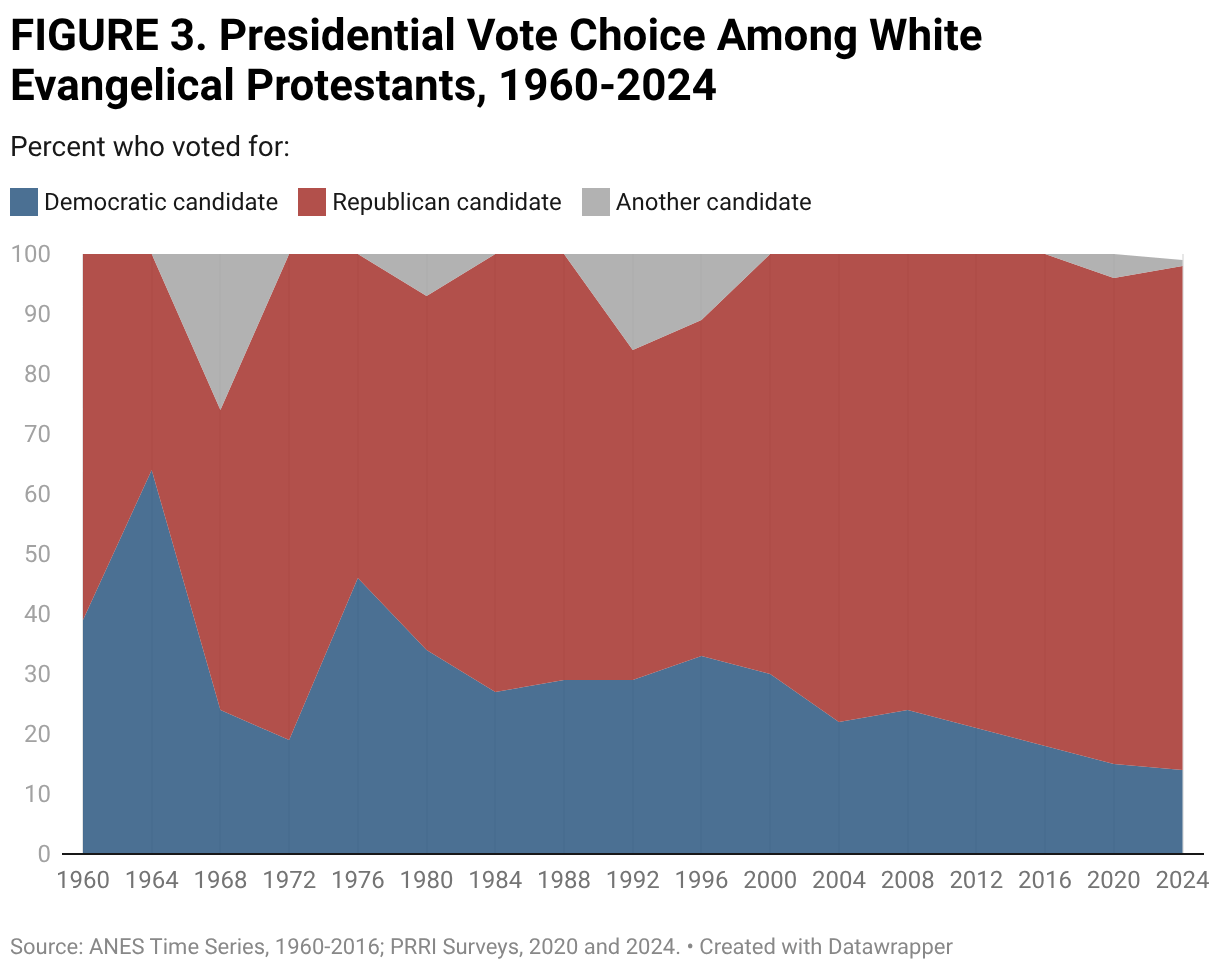
Notice the huge shift after the passage of the Civil Rights Act of 1964 and the Voting Rights Act of 1965? Perhaps that dip in support correlates to George Wallace’s 1968 pro-segregation third-party run. I can’t remember who was elected in the 2008 presidential election, but white evangelicals clearly didn’t like that president.
I wonder why?
It’s because evangelical Christians are the original colonizers. They are the Lost Cause Confederates of yesteryear. They are the amoral majority who wanted segregation today and segregation forever.
But they are not new.
On July 29, 1967, a standing-room-only crowd of Bible-believing white protestants gathered in Charleston, S.C., to hear from one of the most racially unified organizations in American history.
Speaking to a standing-room-only crowd, the widely admired leader explained why helping the poor, feeding the hungry and wiping out poverty in his community was antithetical to the principles of his faith.
“Now them niggers know all about the devil. Now this might be the last time that Martin Luther Coon ever comes to Charleston,” the Klan leader explained as the audience applauded and honked their car horn. “He come for the money. That’s what he come for, and to sow his poisonous seeds. For God help that nigger. He ought to be shot.”
The organization was open to “native born white gentile protestant American citizens of at least eighteen years of age who believed in the Christian religion.” After calling for King’s murder, the speaker justified his hate by introducing his congregation.
The United Klans of America were evangelical Christians, too.