
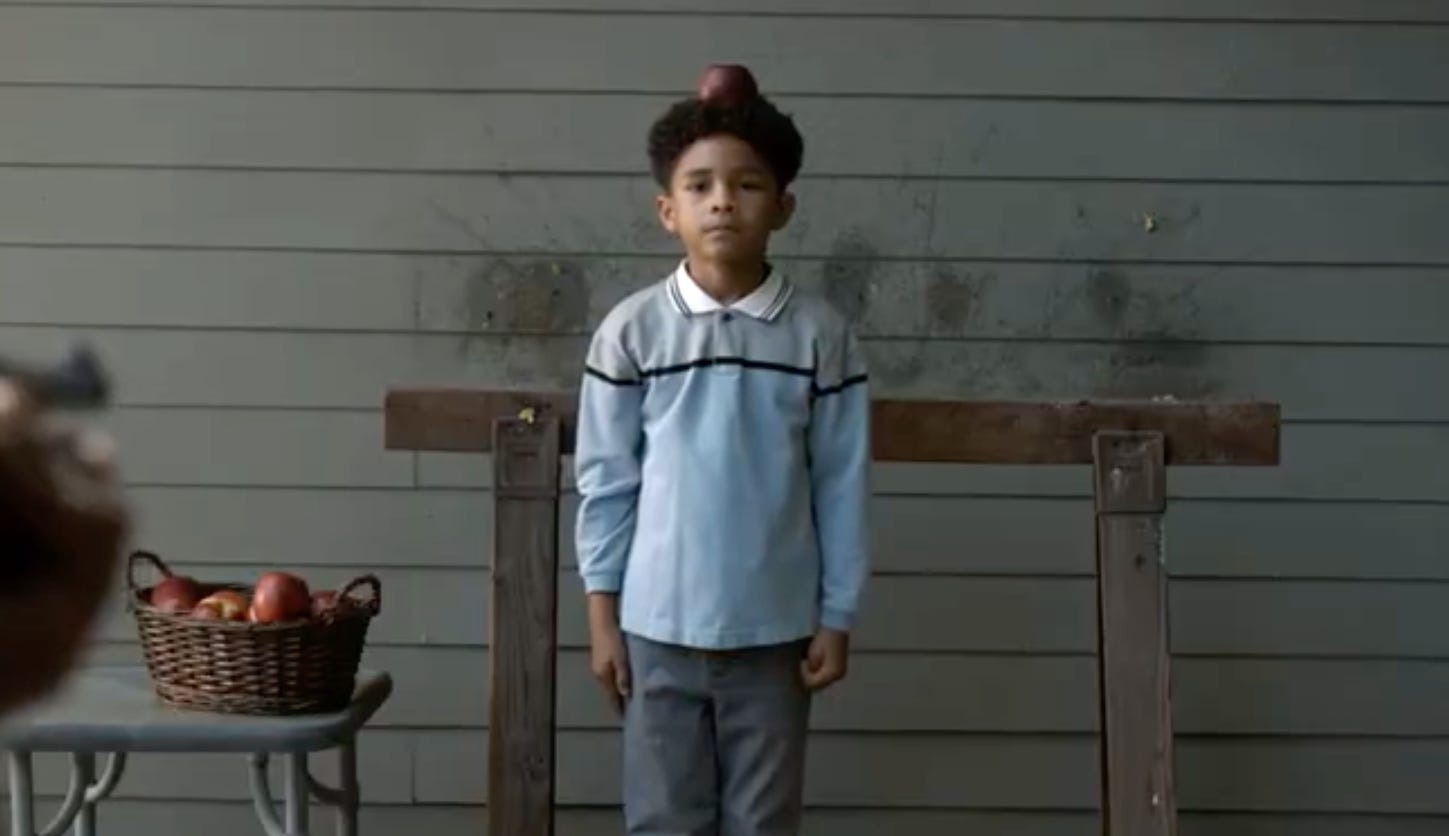
They’re ruthless, Junior.
They assimilate into communities by attaching to weak spots. It’s what they’re programmed to do. They find a path to power every time. And if they identify a threat to that power, they’ll manipulate that threat into believing anything they want them to.
Remind you of anyone we know?
—HBO’s “Lanterns,” Season 1, Episode 4
Contrary to popular belief, the Green Lantern is neither super nor heroic.
According to the 86-year-old DC Comics series, Green Lanterns are tasked with protecting Earth from extraterrestrial threats. Armed only with an emerald-colored ring that grants magical abilities to the wearer, these intergalactic police officers are appointed by an interplanetary oversight committee, the Guardians of the Universe. And because the superpowers come with the ring, technically anyone can be a Green Lantern—as long as they possess one essential quality that qualifies them for hero status:
“The ability to overcome great fear.”
In Lanterns, HBO’s reboot of the classic tale, Aaron Pierre stars as John Stewart (not that one), the character who made comic book history as the first Black Green Lantern. But HBO’s adaptation is more than just a show about a Black man training to become an interstellar ICE agent. It’s social commentary masquerading as a comic book series, ranking right up there with previous superhero genre standouts like Watchmen and The Penguin.
Then it became great.
Written by Vanessa Baden Kelly and directed by Stephen Williams—two Black American TV veterans—the third episode of Lanterns essentially serves as the Black Green Lantern’s origin story. Titled “Outkast,” the hourlong episode unfolds through a series of flashbacks that trace how Stewart’s parents prepared him for his destiny. To illustrate the impossibility of raising a Black boy who would replace the most privileged white man on Earth, show co-creator and executive producer Damon Lindelof, Kelly and Williams condensed “the ability to overcome great fear” down to one essential question that every aspiring Green Lantern and every Black child in America must eventually answer:
“Are you afraid?”
Fox News, white Twitter and people who view caucasity as a superpower immediately accused the series of being “woke.”
With a Black lead character, a magenta supervillain and an extraterrestrial Karen calling the shots, Lanterns may never beat the allegations of being anti-white. Still, the reason the show angered so many white people and thrilled Black viewers has nothing to do with politics, DEI or Laura Linney’s role as an extraterrestrial Karen.
Kelly and Williams’ masterpiece in Black storytelling was based on an age-old template:
The truth.
There is a now-viral clip of a reporter posing the question at the heart of Lanterns to a 14-year-old future superhero-in-training.
In the outtake, a reporter questions teenage Venus Williams about her brazen lack of fear of her more experienced opponents. Halfway through her response, Venus’ father, Richard Williams, interrupts the interview. “You’re dealing with the image of a 14-year-old child,” Williams bellows. “You're dealing with a little Black kid. Let her be a kid!”
“We would talk a lot about Richard Williams. We would talk a lot about Tiger Woods’ father and what it means to create somebody who is like a Green Lantern,” explained Kelly, who wrote the episode. “It’s not like I’m pro-Richard Williams, but...”
If you are not Black, it is impossible to completely understand the complexity of Kelly’s “but.” Conversely, every Black parent understands why “the ability to overcome great fear” and “are you afraid?” are two separate and co-equal parts of raising a Black child in America.
Every white child is a potential superhero. Once the Guardians of America’s cinematic universe have bestowed the superpower of privilege upon you, the path to greatness is a matter of personal choice, hard work and sacrifice—even if they are attacked by failure, mediocrity or some other existential threat. For what is white privilege if not the ability to overcome these great fears?
But if Black children have any hope of surviving white supremacy, we are forced to instill a healthy dose of fear in them. For our offspring, fumbling for a wallet during a traffic stop, wandering into a white neighborhood, looking “suspicious” or just being mediocre could spell their demise. Ask Trayvon Martin. Or Tamir Rice. Or Kohen Wiley. Or Nolan Wells. Or Ralph Yarl.
Still, if we want our children to flourish, we must also prepare them to overcome the greatest, most fear-inducing supervillain that has ever invaded this galaxy. We would be derelict in our duties not to teach them what it means to run twice as hard to get half as far. We must make them understand that racism is an omnipresent obstacle they will eventually have to fight. They must understand that they are worthy. That whiteness is a superpower that can be defeated. That their Blackness is a superpower, too. That their ancestors have never been defeated.
Can you imagine being impervious to white supremacy and being upset that people know you are a superhero?
Perhaps the most interesting part of the bellyaching about Lanterns is that HBO’s adaptation doesn’t actually deviate far from the comic book version. While Stewart’s family backstory isn’t detailed in the comic books, how else could any writer, Black or white, credibly explain how a Black man in America became a superhero without mentioning racism?
Or maybe white people are upset because they know John Stewart’s secret.
(If you’re afraid of possible spoilers, you should stop reading right now.)
According to the comic book lore, when the Guardians select John Stewart, he doesn’t inherit a special piece of jewelry. That’s because, unlike his ring-wearing white colleagues, the powers come from inside Stewart’s body. And when he becomes the full-time Green Lantern, he informs his Board of Trustees that the Black Lantern will not be wearing a mask
John Stewart wanted to be seen. He was not afraid. Like his white predecessors, he also had the ability to overcome great fear. But before he came along, Green Lanterns were not superheroes. They were just white men with a magic ring.
The Black man was a superhero who became a Green Lantern.
Perhaps the part that is impossible for a white man to understand is what the most powerful man on the planet did after the most powerful people in the entire universe gave him the ability to become his ancestors' wildest dreams:
He still wanted to be a Black man.
In every other universe.
In every single lifetime.
Apparently, Lanterns is based on a true story.


LOL 🤭
All the way down to how Hal keeps trying to kill him, maybe even
They mad
Just as mad as they were about Watchmen
They can stay mad
https://youtu.be/ks6FQNo39Wc?is=VAxA8QrVI2Po6LJi
I may maintain my Disney subscription just a bit longer....