


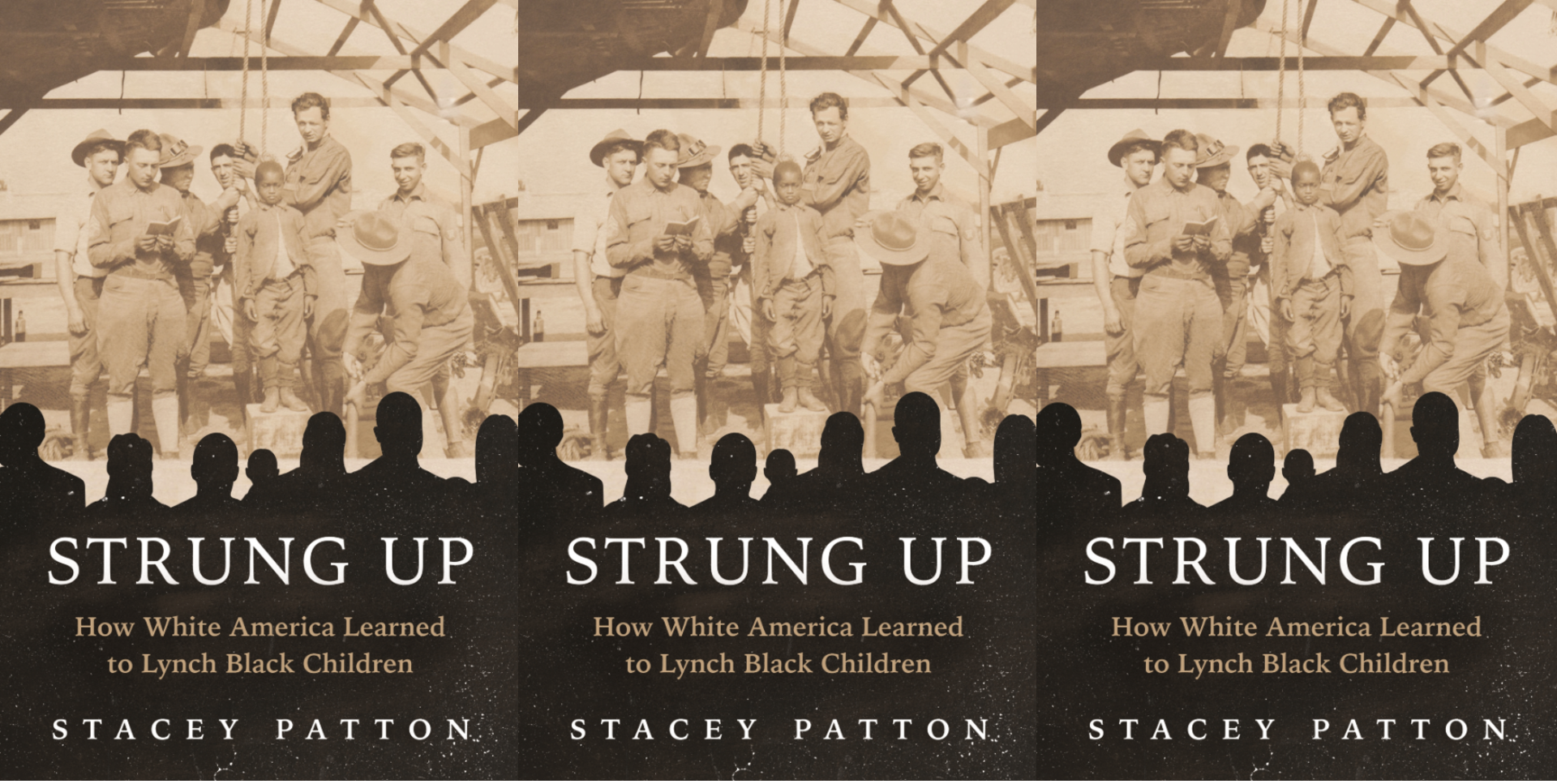
Excerpted from “Strung Up: How White America Learned to Lynch Black Children” by Stacey Patton (Beacon Press, 2026). Reprinted with permission from Beacon Press. The book is available now, and we encourage you to buy from Black-owned and independent bookstores.
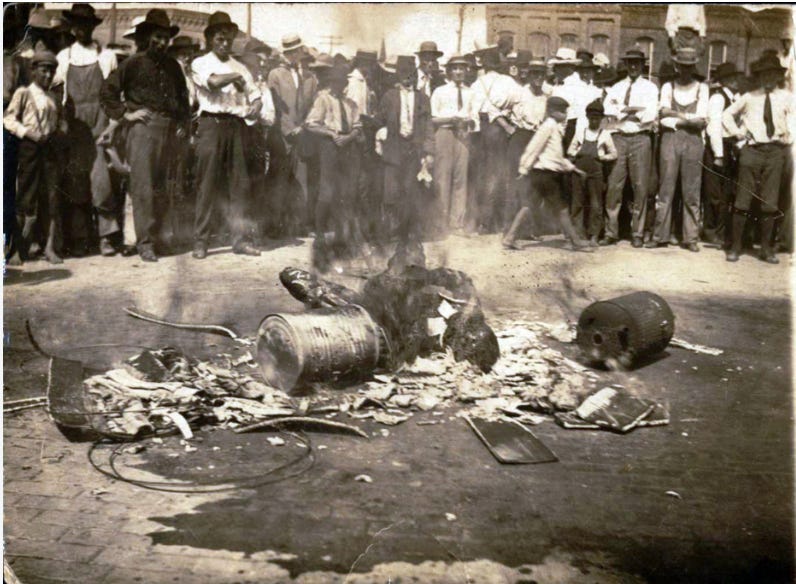
It’s July 28, 1908. Greenville, Texas. A crowd of 2,500 white adults and children stand shoulder to shoulder in the sun. Shirtsleeves rolled up. Straw hats tilted. Some with arms crossed in smug satisfaction. Others with hands on hips or shoved in pockets. The scene is casual, almost businesslike.
At the front of the circle, closest to the fire, are white boys. At least four of them, clearly visible. Not tucked behind parents. Not shielded from the sight. One, maybe twelve years old, struts through the inner ring, studying the flames with the detached interest he might give a campfire or hog roast. Their postures are relaxed. Their expressions curious. As if they’ve seen this before. And will see it again.
This wasn’t just memory-making. It was indoctrination. A baptism by fire in the church of white supremacy. The children weren’t bystanders. They were acolytes. Because in Jim Crow America, this is how white children became white adults, by watching Black children die.
In the center of the frame is what’s left of eighteen-year-old Ted Smith. His bones are charred black. Flesh melted. Legs crumpled inward like collapsed scaffolding. His body smolders atop an impromptu pyre, scraps of wood, kerosene canisters, scorched cloth. Flames lick the twisted metal. The stench of burning human remains cuts through the heat, mixing with the acrid tang of iron and smoke. You can almost taste it in the back of your throat.
Ted Smith was accused of raping the daughter of R. H. Delancey, the white farmer his family worked for. The teens had been secretly involved with each other. When her parents discovered them, she accused him. The sheriff brought Smith before her. “That’s the nigger that did the deed,” she said, leaving him in shock. The sheriff expressed doubts about the allegation. She later recanted. But the truth didn’t matter.
This is what I mean when I say: Childhood is about surviving adults. Ted Smith didn’t survive them. And neither did the white boys in that photograph—not fully. Because white supremacy destroys all children. It kills Black children outright. And it hollows out white children from within. It teaches them to cheer at death. To call violence tradition. To mistake silence for safety. It trains them to inherit power without empathy, and to wield that power without question.
Somewhere nearby, Ted’s mother and father, if they weren’t already dead inside, were crying and screaming into silence. Maybe they had to explain to other children in the family why Ted would never come home. Somewhere in the crowd, a white parent was squeezing their child’s shoulder and saying, Watch carefully. This is how we keep niggers in their place. Whether or not those exact words were spoken, the lesson was unmistakable and repeatedly documented in the historical record.
Some of those children in the large crowd likely went home that night, ate dinner, and slept soundly. Some likely remembered the smell of burning hair and the sound of skin blistering. Maybe years later some of them brought their own children to such an event. Because this is how whiteness reproduces itself: not through blood alone, but through ritual and numbing children to Black suffering.
In July 2023, 115 years after Ted Smith’s murder, eight of his family members gathered at a memorial service in the same courthouse where justice had been denied. His first and second cousins came to honor a relative whose death had haunted their family for more than a century.
“A lot of family didn’t want to come because they didn’t want to rehash this horrific thing that happened to him,” said Audry Ashford Rester, whose mother is Smith’s first cousin. “When I did research, I cried. When I talked to my mother, she cried. She cried today.” The grief, still fresh. The wound, still open.
Imagine the weight of living in chronic fear, where a glance, a word, being in the wrong place at the wrong time could unleash horror: a shooting, a mutilation, a burning, a hanging. Imagine raising your child in a country where one misstep, or doing nothing wrong at all, can get them shot down, hanged, or burned in the street while other people’s children watch and learn.
Imagine the soul-wrecking agony of having your child snatched from the future, and their murder not only unpunished, but mocked in newspapers, printed on postcards, etched into local lore.
Imagine watching your child’s killers go on about their lives, promoted to sheriff, elected to office, celebrated as pillars of the community, tucking their own children into bed at night, untouched by consequence or conscience.
Imagine trying to explain to your child that their innocence is invisible. That the world sees them as a threat before they’ve even learned how to tie their shoes. That their very breath is a provocation. Imagine having to say: Be small. Be silent. Come home alive. And knowing, deep in your bones, that even that might not be enough.
Ted Smith’s parents may have said those things to him. May have prayed them. May have begged the sky to make their son invisible to the racist gaze. And yet his charred remains lay in the town square while white children giggled in the sun.
Black parents will feel this truth deep in the marrow of their bones. In their breath. In the quiet dread that settles into the body every time a child walks out the door. That truth rarely makes it into words. But it lives in the trembling breath of goodbye. In the whispered prayers. In the breath held until the front door reopens. It lives in the impossible task of teaching children how to survive adults. How do you promise them safety when history has shown, time and again, that Black parents can’t always protect their own lives?
The horror didn’t end in 1908. The grief isn’t over. It’s ancient now, fossilized in the cells of Black families. It moves through our blood like memory. It lives in our parenting. It lives in our whispers and our silence. It’s so old it feels like inheritance.
It haunts.
It festers.
It still hurts in places where language can’t reach.

And we're still being hunted to this very day, while listening to these racist scumbags complain about DEI and CRT as they chastise us for "blaming" slavery for the state we find ourselves in.
I can only imagine what researching this book took from you. I will buy it and read it because of that and because every American needs to face the reality of our country’s past so we can do better. We have to do better.