
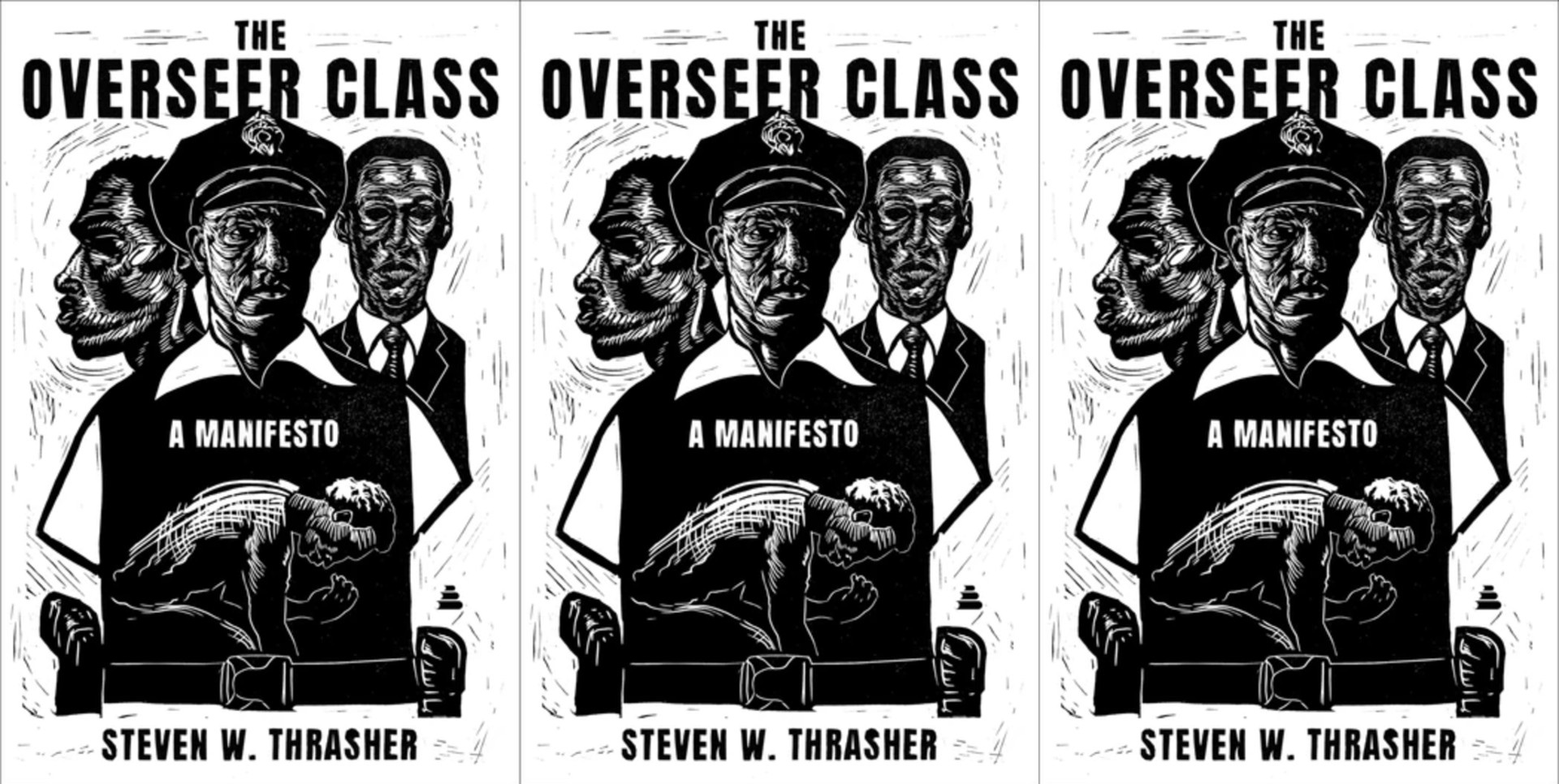
Excerpt: In Defense of Uncle Tom
In his new book “The Overseer Class: A Manifesto,” Steven W. Thrasher rehabilitates the character "Uncle Tom," and encourages Black people in white spaces to be "Tonis"—in honor of Toni Morrison.
Excerpted from “The Overseer Class: A Manifesto.” Reprinted with the permission of the publisher, Amistad, an imprint of HarperCollins. Copyrighted 2026 by Steven W. Thrasher. Available now where all books are sold. We encourage you to buy from Black-owned or independent bookstores.
As an undergraduate film student, I took a class with cinema scholar Donald Bogle, whose seminal 1973 book Toms, Coons, Mulattoes, Mammies, and Bucks: An Interpretive History of Blacks in American Films had an enormous impact on me. It has helped me to develop a framework about how there are, broadly speaking, four types of marginalized people who advance into positions of power in government, business, media, and various workplaces: “Uncle Toms,” “Tokens,” “Overseers,” and “Tonis.”
Each category is distinct, and it is helpful to understand the particular characteristics of each in order to understand how an overseer class is established, why it is the most dangerous class for marginalized folx in society, and how there are other ways of being which promote wellbeing for everyone moving, as bell hooks put it, from margin to center.
Overseers are often conflated with or confused for Toms, which is unfair to the original Uncle Tom—literally named “Uncle Tom” in Harriet Beecher Stowe’s 1851–1852 novel named for his cabin. That Tom was nothing like the literal overseers of his time, nor did he share almost any traits with modern members of the overseer class.
It is hard to overstate the influence of Uncle Tom’s Cabin; or, Life Among the Lowly on politics and culture in the United States. As Alfred Kazin writes in the introduction to the 2006 Everyman’s Library edition, the book, “a central event in American history,” was “the biggest best-seller of the nineteenth century after the Bible.” Despite how it now reads crudely and often cartoonishly, it is widely credited as informing white readers about the horrors of slavery and a catalyst of the eventual state emancipation of Black people who were enslaved. Upon meeting Beecher Stowe, a staunch abolitionist, in 1862, Abraham Lincoln is reported to have said to her, “So you’re the little woman who wrote the book that made this great war!”
Perhaps more importantly, Beecher Stowe gave the American people the language to describe an archetype: an “Uncle Tom” quickly came to mean an enslaved man who is dedicated to his white master and sells out other enslaved people to prove his loyalty. This has become a shorthand for describing Black or other marginalized people who will sell out their own to prove their loyalty to their employers or other power brokers in their life who are white, male, straight, and cisgender. (Think about how Clarence Thomas rules on the Supreme Court; how Don Lemon demonized Black people on CNN but wanted their support when he was fired; or how some wealthy people who are members of L.G.B.T.Q. communities, like Peter Thiel or Caitlin Jenner, suck up to Donald Trump.)
But this stereotype of an “Uncle Tom” is unfair to Beecher Stowe’s Uncle Tom, who has been slandered by history.
Her Tom was no overseer on the plantation owned by Simon Legree, but an enslaved martyr whose power came from his attempt to protect other people even at the cost of his own suffering and life. In Uncle Tom’s Cabin, Simon Legree compels Tom to divulge the whereabouts of enslaved Black people who have escaped the plantation. When Tom refuses, Simon whips him to death. Though the term “Uncle Tom” has come to stand in for institutional servility, there is a strength in Tom’s ability to protect his fellow enslaved Black people. He was not loyal to Simon Legree, or even to his own fate, but to his fellow kin living in enslaved Black skin—and, as a man of faith, Tom was faithful to Jesus Christ. As Kazin wrote, “No one in history had ever suffered as Jesus had suffered for trying to do absolute good—except the black slave, who, suffering under our indifferent and even hostile eyes, had no one to appeal to but Jesus. And Stowe’s Uncle Tom so loved and impersonated Him that, robbed of his wife and children, fated to be beaten to death for refusing to become ‘hard’ toward Simon Legree’s five other slaves, he became a figure of absolute good. Like Jesus.”
There is a lot to critique about Beecher Stowe’s depiction of Uncle Tom (not to mention Kazin’s use of the word “our” in “our indifferent and even hostile eyes”), including making him so docile in the mold of Christianity. This colonial religion was forced upon Black Africans and their descendants in the transatlantic slave trade, robbed them of their indigenous religions, and was used as a kind of justification for the suffering of Black people in itself. Regardless, it is wrong to say Tom sought to become an overseer, or that he sold out his kin to amass power, when he did quite the opposite. In Chapter 40 of Uncle Tom’s Cabin, entitled “The Martyr,” Beecher Stowe wrote about two enslaved people, Cassy and Emmeline, who had escaped the Legree Plantation. The overseer, Sambo (who was white, even though that has become a derogatory name for Black people in the decades since), led a group of enslaved Black people to catch them. Tom was among those who refused to go; “Tom, therefore, remained behind, and with a few who had learned of him [to pray], and offered up prayers for the escape of the fugitives.”
To move the analogy of an Uncle Tom into, say, a modern workplace, an Uncle Tom would have more in common with Aaron Bushnell, a white United States Air Force serviceman who self-immolated to try to stop the genocide in Gaza, than he would have in common with an overseer like the African-American four- star-general-corporatist-turned-Secretary-of-Defense-turned-consultant Lloyd Austin. If one of his co-workers did something that would get them in trouble, and Human Resources asked Tom about it, he’d take the blame to cover for his co-worker. (This is a highly unusual archetype in modern institutions and, thus, should be invoked very infrequently.)
A token (which derives from a theory of tokenism developed by sociologist Rosabeth Moss Kanter, which we will explore more in Chapter 4) is a more common archetype in contemporary organizations, but is distinct from an Uncle Tom. A token is someone who is placed in a figurehead position for public relations (and little else), and who has no real power. They may even rise to their position unwittingly. They often lack the power to punish, support, or help anyone else in their organization (and possibly even lack the power to help themselves). The position they hold—be that Secretary of the Interior, assistant principal, the head of a DEI committee which has no budget, or even the president of a nonprofit where the board calls the shots—is often set up structurally to have little power and to only be for show. Sometimes, a token is given their job as a testing ground to see if they will be allowed to advance to being an overseer.
An overseer might be a historic first—the first of their group to hold such a position, such as Charles Whitaker, the first Black dean of the Medill School of Journalism—but they are unwilling, and sometimes unable, to expand the number of people like them in their organization.
An overseer is also not an Uncle Tom, as they have no interest in self-sacrifice, nor are they a token, because they do have some material power, even if it is limited. If an Uncle Tom asserts power by sacrificing themselves to save others, an overseer asserts power by sacrificing others in order to benefit themselves. For instance, to refer back to Uncle Tom’s Cabin, an overseer is like Sambo or the enslaved Black people who chased down those who dared to escape. In exchange for taking others’ freedom, Sambo and crew got a few more crumbs and the privilege of carrying a whip to harm others; but, white or Black, they will never have the power of Simon Legree, let alone the power to dismantle the plantation or be free from it. (As we will explore in Chapter 3, the most annoying overseers in my life have been Phillip Brian Harper, my professor and former dean of the Graduate School at New York University; Bruce A. Lewis, “Associate Vice President” and chief of police at Northwestern University; and Charles Whitaker, dean of the Medill School of Journalism—three Black men whom I witnessed execute the white power of their primarily white institutions.)
In addition to beating people on behalf of their master, another major power an overseer has is the right of refusal or to say “no.” This is akin to the power of Uncle Tom, who refused to rat out his friends. Alas, the Sambo overseers of the world rarely say “no, I will not do that” when they are asked to whip, kidnap, or even kill their friends. And like Sambo, any overseer will have to live with the opprobrium and lack of respect of the people they oversee.
Finally, there’s my personal favorite model for how to be as a person from a marginalized background in almost any institution: a Toni, which I have named for Toni Morrison.
In 2003, the Nobel laureate told Oprah magazine, “I tell my students, ‘When you get these jobs that you have been so brilliantly trained for, just remember that your real job is that if you are free, you need to free somebody else. If you have some power, then your job is to empower somebody else. This is not just a grab-bag candy game.’”
A Toni can be a historic first, but—unlike many tokens and most overseers—a Toni does not want to be the “first and only,” and works their ass off to push open the door for other people who have not been welcomed inside. (They may also work to make a world where there isn’t a door keeping people out in the first place.)
A Toni can make sacrifices but—unlike an Uncle Tom—they do not seek to be a self-defeating martyr for the sake of martyrdom itself. Rather, they assert power on behalf of challenging root causes and advancing the collective good.
A Toni rejects the solitude of being the first and only, in favor of unionizing, collective struggle, and knowing, as Mariame Kaba puts it, that “Everything worthwhile is done with other people.”
A Toni has a commitment, as my friend Samhita Mukhopadhyay wrote in The Myth of Making It: A Workplace Reckoning, to “working with integrity, even if I am not met with integrity.”
A Toni says to themselves, I came up on the shoulders of others. I can’t expect others alongside me or those coming after me to pull themselves by their bootstraps, alone. Our fates are dependent upon each other.
So, when it comes to being a Tom, token, Toni, or overseer in any setting, the choice (mine, anyway) is clear:
Always strive to be a Toni.
It’s not just, as Hannah Arendt wrote, that “Totalitarianism in power invariably replaces all first-rate talents, regardless of their sympathies, with those crackpots and fools whose lack of intelligence and creativity is still the best guarantee of their loyalty.” It’s also that “Authoritarian movements,” as my sociologist friend Victor Ray wrote, “always target ideas and intellectuals that question the legitimacy of the social hierarchy upon which their worldview is built.” Critical race theorists and various other political dissidents from historically marginalized groups inside academia—Black Marxists, Indigenous scholars, Palestinian historians, or queer theorists—can actually challenge social hierarchies. But infiltrated near or even amongst our ranks are members of the overseer class, who are the eyes, ears, and intellectual knee-cap breakers of authoritarian movements.
If, as Victor wrote, “Critical race theory is an intellectual bulwark against the propaganda of history,” a theory of the overseer class can be a bulwark against the propaganda of the present, particularly inside various workplaces.
Steven W. Thrasher, Ph.D., is the author of the award-winning book “The Viral Underclass: The Human Toll When Inequality and Disease Collide,” which was a New York Times's Paperback Row Editors' Pick, named one of the Best Nonfiction Books of 2022 by Kirkus Reviews, was longlisted for both the PEN/John Kenneth Galbraith Award for Nonfiction and the Carnegie Medal for Excellence in Nonfiction Literature, and won the 2023 POZ Award for Best in Literature.


Don Lemon catching strays.
Sambo wasn't white. From the book itself, he's described as "a full black, of great size, very lively, voluble, and full of trick and grimace."