
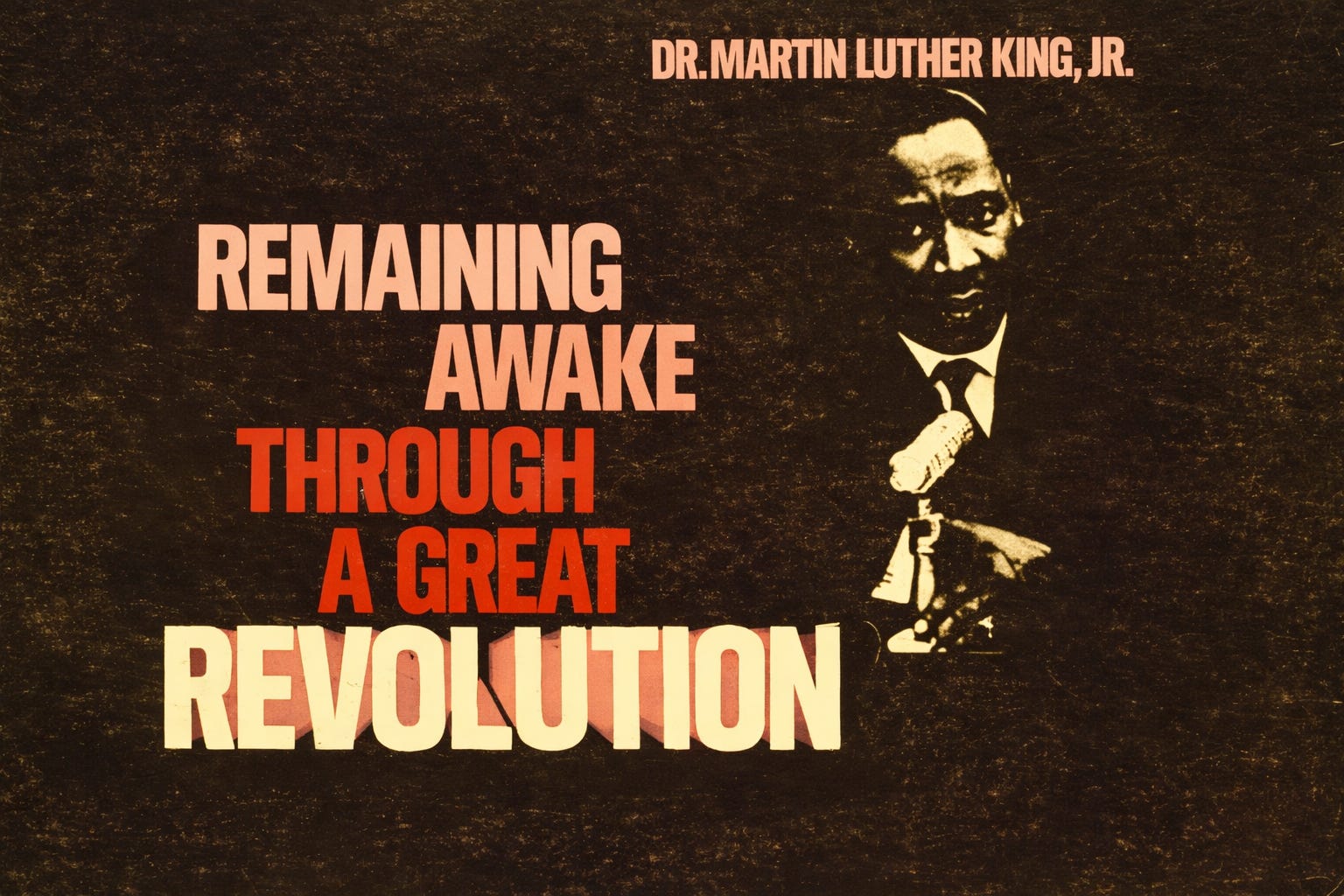
Everyone Claims to Know 'What MLK Would Have Wanted.' He Actually Told Black People.
What if I told you that Martin Luther King Jr. talked about diversity, critical race theory and staying "woke" more than anything else?
When Morehouse College President Benjamin Mays introduced the speaker for the historically Black college’s graduation ceremony on June 2, 1959, many of the attendees already knew the thesis of the commencement address.
As expected, the speaker opened with Washington Irving’s tale of Rip Van Winkle falling asleep beneath a portrait of King George and waking up after the Revolutionary War beneath a portrait of George Washington. After telling the graduates how their “oppressors” loved to paint them as violent and uneducated, he described the white backlash they would experience. “Let nobody fool you; all of the loud noises that we hear today in terms of ‘nullification’ and 'interposition' and ‘massive resistance’ are merely the death groans from a dying system,” he explained. “The great challenge facing every member of this graduating class is to remain awake.”
Everyone knew Martin Luther King Jr.’s “stay woke” speech.
By the time King delivered the Morehouse edition of “Remaining Awake Through a Great Revolution,” he had been giving versions of the speech as a sermon, a lecture and a keynote address for years. Not only was it unquestionably King’s most frequently used speech, but it served as his default address to Black people. “The text of this address resembles one that King gave at a … NAACP Emancipation Day Rally, January 1, 1957,” notes Stanford University’s King Institute. “A month prior to the Morehouse speech, King had delivered a sermon at Dexter titled ‘Sleeping Through a Revolution’ that contained similar allusions.”
Time and time again, King told Black audiences exactly what he wanted.
Few white people were around when King delivered an early version of the speech on Dec. 3, 1956—exactly 364 days after the Montgomery Improvement Association bus boycott began. Although he was surrounded by Black people, King still told the audience that most white people were not violent. “It is only the fringe element, the hoodlum element, which constitutes a numerical minority, that would resort to the use of violence,” King noted.
Despite newspapers publishing copies of the speech, white America refused to believe King’s actual words. Two days after King’s 1956 speech to nonviolent protesters, the Alabama Journal published a quote from Sen. Sam Engelhardt summarizing King’s speech as an attack on white people.
Today’s MAGA Republicans are no more racist than the members of Alabama’s White Citizens Council. The people who hate Nikole Hannah-Jones’ The 1619 Project would’ve described King’s rhetoric as divisive, woke and anti-American. In fact, King’s history of segregation would have violated Alabama state laws against “divisive concepts,” which outlaws anyone from teaching that people “should accept, acknowledge, affirm, or assent to a sense of guilt, complicity, or a need to apologize on the basis of his or her race, color, religion, sex, ethnicity, or national origin.”
“It had its beginning in the year 1619 when the first Negro slaves landed on the shores of this nation,” King told the activists at the first annual Institute on Nonviolence and Social Change. “But we must remember as we boycott that a boycott is not an end within itself; it is merely a means to awaken a sense of shame within the oppressor and challenge his false sense of superiority.”
Two weeks after King recorded “Remaining Awake” as a sermon during the 1964 A.M.E. Church Convention, 74% of Americans believed the Civil Rights Movement “hurt the Negro Cause,” according to Gallup. When he delivered “Remaining Awake” as a lecture in 1965, King described America as “a great world house in which we have to live together—black and white, Easterners and Westerners, Gentiles and Jews, Protestants and Catholics, [Muslims] and Hindu.”
Sounds a lot like DEI.
When King gave that speech, 94% of Blacks had a positive view of King. But for the majority of Americans, FBI Director J. Edgar Hoover was three times more popular than King. Then again, Hoover didn’t sound like one of those woke anti-communists who said: “As long as there is poverty in the world, I can never be rich, even if I possess a billion dollars.”
An estimated 75-80% of the attendees at the March on Washington were Black, so it’s not hard to understand why people representing “Caucasian and other ethnic groups” think protesting police brutality is “woke.” Somehow, they can recite the “content of their character” part of King’s “I Have a Dream” speech verbatim, but can’t recall exactly when King said devotees of civil rights “can never be satisfied as long as the Negro is the victim of the unspeakable horrors of police brutality.”
And if you doubt that King would have been demonized by white America, here are a few more excerpts from this one speech he gave over the years:
Now there is another myth that still gets around: It is a kind of over-reliance on the bootstrap philosophy. There are those who still feel that if the Negro is to rise out of poverty, if the Negro is to rise out of the slum conditions, if he is to rise out of discrimination and segregation, he must do it all by himself. And so they say the Negro must lift himself by his own bootstraps.
“Remaining Awake Through a Great Revolution” — March 31, 1968
I'm absolutely convinced that the people of ill will in our nation—the extreme rightists—the forces committed to negative ends—have used time much more effectively than the people of good will. It may well be that we will have to repent in this generation, not merely for the vitriolic works and violent actions of the bad people who bomb a church in Birmingham, Alabama, or shoot down a civil rights worker in Selma, but for the appalling silence and indifference of the good people who sit around and say, "Wait on time."
“Remaining Awake Through a Great Revolution” – June 1965
They never stop to realize that no other ethnic group has been a slave on American soil. The people who say this never stop to realize that the nation made the Black man’s color a stigma. But beyond this, they never stop to realize the debt that they owe a people who were kept in slavery two hundred and forty-four years.
“Remaining Awake Through a Great Revolution” — May 8, 1964
You will hear a lot about King Jr. today, but don’t let any of it fool you. You can embrace the warm and fuzzy negro fairytale of the Baptist preacher who changed America with peace, love and a few sermon-like speeches, or you can see the truth:
Martin Luther King Jr. was a woke, critical race theorist who fought against wealth inequality while demanding reparations and DEI.
In the last Sunday sermon he would ever preach, King gave the most complete version of “Remaining Awake Through a Revolution.” It was longer than “I Have a Dream” and the “Mountaintop” speeches combined. He didn’t preach about little Black boys and girls holding hands with little white kids. He didn’t mention the content of white people’s character. Standing in the pulpit of the National Cathedral, Martin Luther King Jr. delivered a speech that Black people had heard a million times. Instead, the freedom fighter who had spent his entire life trying to wake his country up told the nation what he wanted.
Today, America loves Martin Luther King Jr. …
But they hate what he wanted.


When someone asks a silly question on MLK Day:
Question: What would Dr King be doing if he were alive today?
Answer: I think you know...that’s why you killed him.
"White isn't a race, it's an idea. People who still cling to it, they're here"
"See you don't get it. The world has already changed - yanked right out of the hands of anybody trying to go backward - be backward. It changed. Period and forever. What you're scared of is the burden of changing yourself along with it. And that's your problem,"
From , "Sky Full Of Elephants", by Cebo Campbell
Thank you Michael Harriot for recommending this book. I binged read it.