


In February 1914, a group of white journalists tasked with covering President Woodrow Wilson launched an organization that is credited with saving their industry, protecting the freedom of the press and making democracy accessible.
“By the Wilson administration, White House press conferences had turned into Washington free-for-alls, including hangers-on who competed with one another for attention and for “scoops,” wrote author Stephen Ponder. “The president demanded some sort of self-regulation, which led to the founding of the White House Correspondents’ Association…The regulations also restricted access to the press conferences to accredited reporters, a significant step in the establishment of an organized White House Press Corps.”
This exclusive group required its members to ignore two things:
The rules of journalism
Black people
To become a member of the WHCA, reporters had to swear that they wouldn’t publish the president’s actual words without his permission. The group also capitulated to Wilson’s racism and excluded Black people. Ponder notes that even after Wilson ended his regular press briefings in June 1915, the all-white, all-male organization “continued to meet as a social group until…”
Wait…what happened?
Why couldn’t the WHCA actually prevent Wilson from ending his press briefings? Did one of the white boys refuse to violate the rules of his profession? Was one of those celebrated journalists more concerned with telling the truth than access and proximity to power? Why did the man who invented the tradition of presidential press conferences end them?
Black people.
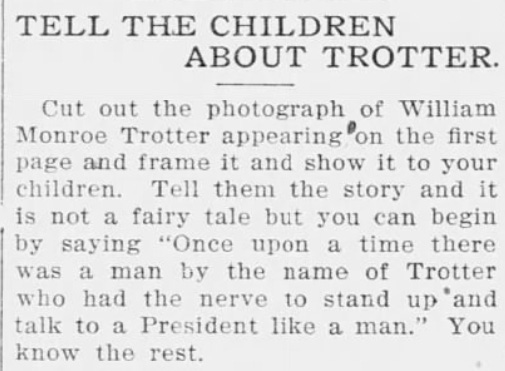
In November 1914, William Monroe Trotter, a Black newspaper editor, organized a meeting in the Oval Office between Wilson and a group of Black activists, reporters and truth-tellers about the resegregation of the federal government after Black voters helped him become president. After Wilson whitesplained that his administration only questioned “whether the Afro-American race could do the same things that the white race could do with equal efficiency,” Trotter essentially told the president to stop playing in Black America’s face. But what annoyed Wilson more than anything is that—unlike their white counterparts—the Black reporters reported the truth.
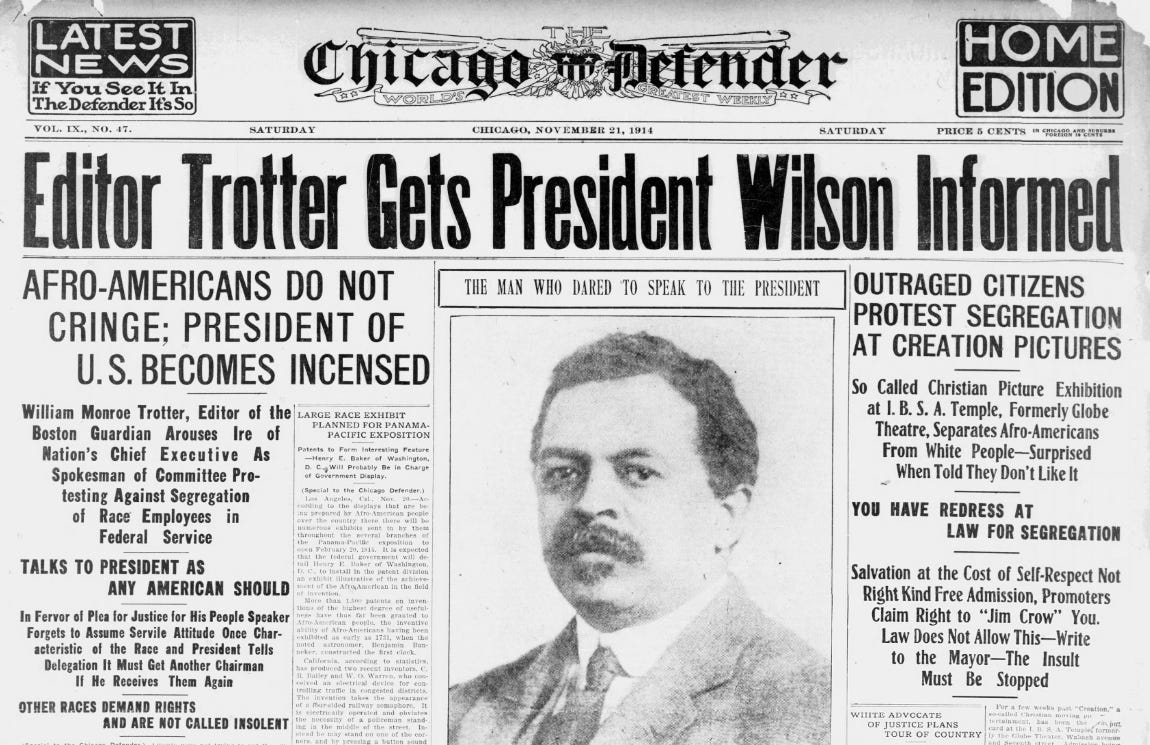
Woodrow Wilson stopped holding press conferences altogether.
The White House Correspondents’ Association wouldn’t admit a Black journalist into its ranks until 1951.
Black journalists have always been willing to tell America about itself.
As Martin Luther King Jr. said:
[P]erhaps the greatest contribution of the Negro press is this: it is one major voice of the conscience of our nation. The 205 journals of Negro opinions say every day to the American people “the struggle for democracy is not yet done. America is not yet America.” And this is of vital importance for there are millions of Americans who know American Negroes only through their press.
To the degree that the Negro Press can continue to play this role, its greatest contribution is not to the Negro really, but rather to America which cannot be at peace with itself until all men are free.
On Jan. 16, 2025, as the nation prepared for the inauguration of the 47th president of the United States of America, a group of Black journalists, activists and thinkers gathered at a top-secret location to launch a project they called “ContrabandCamp.”
Just as this publication was intended to be a reflection of the unique voices and perspectives of the Black diaspora, the Day One ContrabandCampers included people whose ancestors were enslaved, immigrants and second-generation Americans. In addition to planning sessions, workshops and a few games of spades, we held an on-the-record dinner party.
Instead of hot takes and uniformed opinions, Blacksplained asks experts, scholars and people who know what they’re talking about to discuss one issue or question.
If you’ve ever wondered what it sounds like when Black people discuss “kitchen table issues,” it sounds like:
How a Haitian family got to America after a coup d'etat.
Why being a Supreme Court justice or military hero doesn’t prevent you from being a “DEI hire.”
Who’d win a Verzuz battle between Luther Vandross and Taylor Swift.
How raising Black children in America inspired a proposal for a constitutional amendment.
Which worries Black parents more: school shooters or cops?
You’ll find the answer to these questions and more this week as the attendees at ContrabandCamp’s inaugural Black Folks’ Correspondents’ Dinner Blacksplain…
America.
And one more thing:
Before you go, please subscribe to our YouTube channel. It’s free! Plus, it’s a great way to boost ContrabandCamp’s content in the YouTube algorithm.


