

All Roads Lead to Alabama
The Supreme Court just allowed the state to use a map that had been ruled discriminatory against Black voters. It's part of the same white supremacist playbook Alabama has always used.

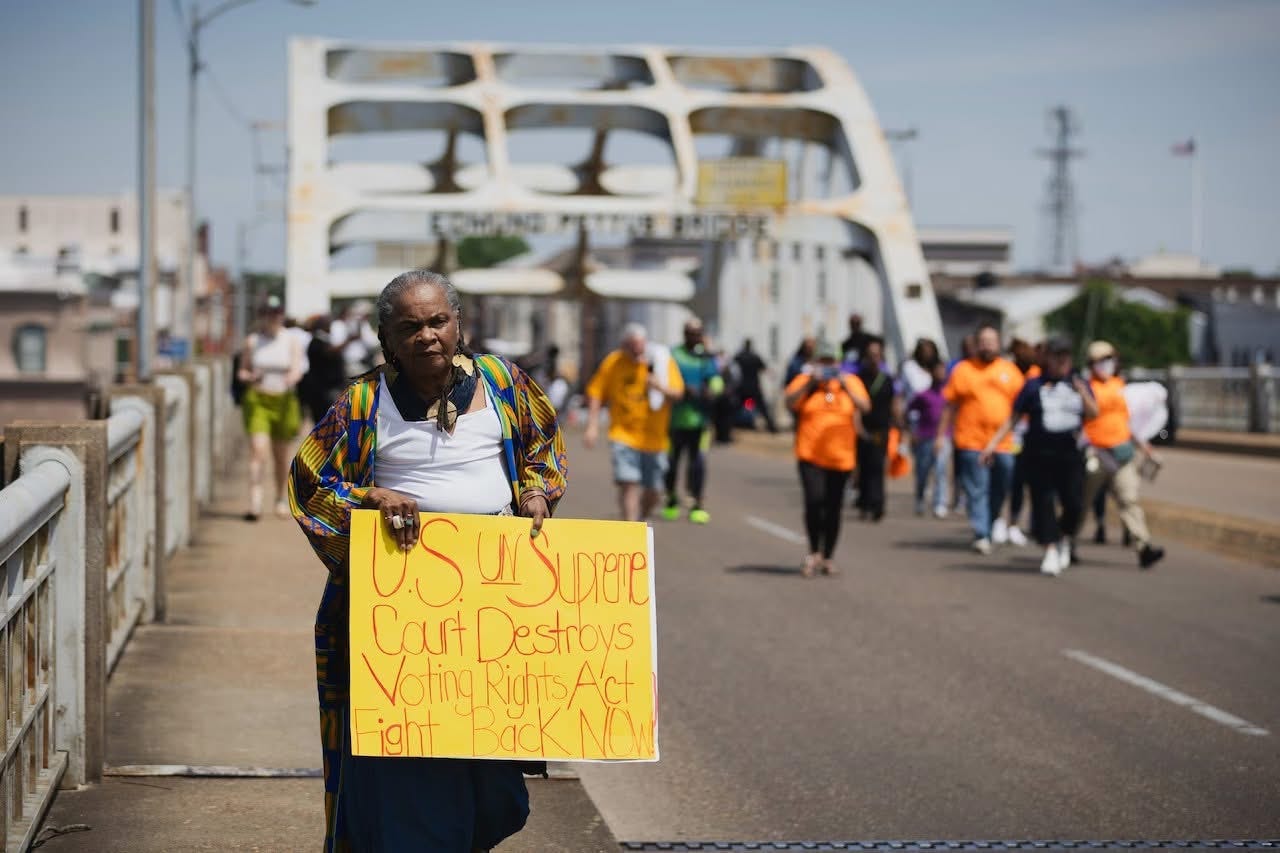
There is a card game we play in the South called Spades. You partner up, you bid your hand, you play it out, and when you take the books, you bid, you win. Everybody at the table agrees to that before the first card is dealt. Now imagine you win that hand fair and square, and the person across the table, the one who lost, reaches over, scoops up your books and declares the game over. No new rules. No new cards. Just a loser who decided, after the fact, that losing was unacceptable.
That is what the Supreme Court of the United States did to Black voters in Alabama this week.
On Tuesday night, in a 6-3 order, the court allowed Alabama to throw out a congressional map that a lower federal court had already ruled was intentionally discriminatory against Black people, and run the 2026 elections under the very map that court rejected. The seat at its center belongs to Congressman Shomari Figures, a Black Democrat elected in 2024 in a district that civil rights plaintiffs fought for more than three years to create. Understand what just happened: An election has already taken place in Alabama. Voters in that district chose their representative. And now the highest court in the land has blessed a do-over, a do-over designed to take that seat away.
I am a daughter of Alabama. I am not writing about this state from a distance, from some studio in another city, reading off a map I have never walked. This is home. I learned what I know about power in Alabama, and I learned how to be an organizer here, on this red clay, knocking on doors and counting votes and watching how the game gets rigged in real time. So when I tell you how white supremacy operates in this state, understand that I am not theorizing. I am testifying.
I want to be precise, because precision matters when you are telling the truth about power. The district in question, Alabama’s 2nd Congressional District, was never even a majority-Black district. The federal court drew it with a Black voting-age population of roughly 48.7%. Less than half. It was not a gift. It was not a guarantee. It was simply an opportunity, a district where Black voters finally had a fighting chance to elect a candidate of their choice in a state that is more than a quarter Black but for decades drew only one Black district out of seven. That is the thing they could not abide. Not Black control. Just Black possibility.
How we got here
This is not a story that started this week. It started in 2021, when Alabama drew a new map after the census with a single majority-Black district in a state that is 27% Black. Voters sued. They said the map diluted Black voting power in violation of the Voting Rights Act. A three-judge federal panel agreed. And in 2023, in a case called Allen v. Milligan, the U.S. Supreme Court upheld that finding and ordered Alabama to draw a map with two districts where Black voters had a real chance to elect their candidate of choice.

 | A guest post by
|