
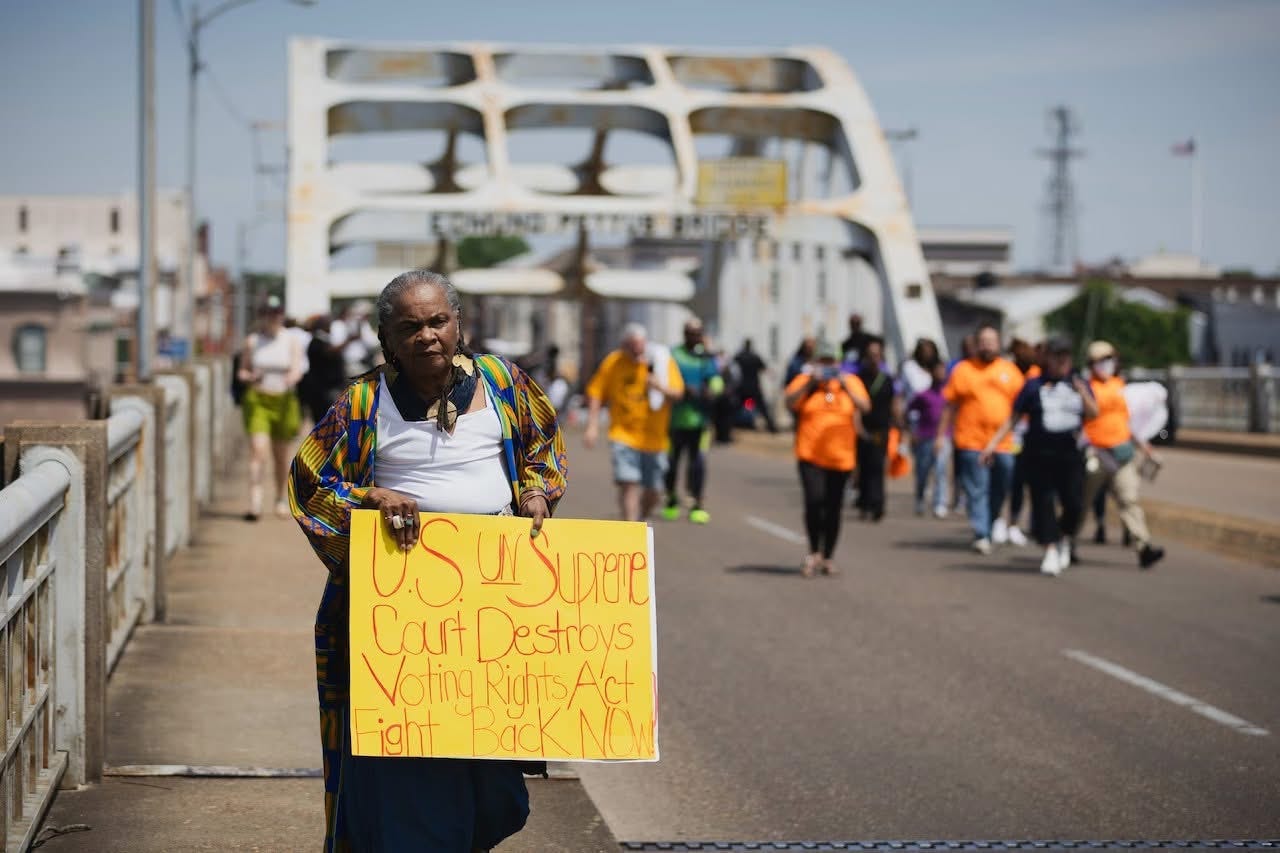
All Roads Lead to Alabama
The Supreme Court just allowed the state to use a map that had been ruled discriminatory against Black voters. It's part of the same white supremacist playbook Alabama has always used.
There is a card game we play in the South called Spades. You partner up, you bid your hand, you play it out, and when you take the books, you bid, you win. Everybody at the table agrees to that before the first card is dealt. Now imagine you win that hand fair and square, and the person across the table, the one who lost, reaches over, scoops up your books and declares the game over. No new rules. No new cards. Just a loser who decided, after the fact, that losing was unacceptable.
That is what the Supreme Court of the United States did to Black voters in Alabama this week.
On Tuesday night, in a 6-3 order, the court allowed Alabama to throw out a congressional map that a lower federal court had already ruled was intentionally discriminatory against Black people, and run the 2026 elections under the very map that court rejected. The seat at its center belongs to Congressman Shomari Figures, a Black Democrat elected in 2024 in a district that civil rights plaintiffs fought for more than three years to create. Understand what just happened: An election has already taken place in Alabama. Voters in that district chose their representative. And now the highest court in the land has blessed a do-over, a do-over designed to take that seat away.
I am a daughter of Alabama. I am not writing about this state from a distance, from some studio in another city, reading off a map I have never walked. This is home. I learned what I know about power in Alabama, and I learned how to be an organizer here, on this red clay, knocking on doors and counting votes and watching how the game gets rigged in real time. So when I tell you how white supremacy operates in this state, understand that I am not theorizing. I am testifying.
I want to be precise, because precision matters when you are telling the truth about power. The district in question, Alabama’s 2nd Congressional District, was never even a majority-Black district. The federal court drew it with a Black voting-age population of roughly 48.7%. Less than half. It was not a gift. It was not a guarantee. It was simply an opportunity, a district where Black voters finally had a fighting chance to elect a candidate of their choice in a state that is more than a quarter Black but for decades drew only one Black district out of seven. That is the thing they could not abide. Not Black control. Just Black possibility.
How we got here
This is not a story that started this week. It started in 2021, when Alabama drew a new map after the census with a single majority-Black district in a state that is 27% Black. Voters sued. They said the map diluted Black voting power in violation of the Voting Rights Act. A three-judge federal panel agreed. And in 2023, in a case called Allen v. Milligan, the U.S. Supreme Court upheld that finding and ordered Alabama to draw a map with two districts where Black voters had a real chance to elect their candidate of choice.
Sit with that. The same institution that just gutted Black representation in Alabama is the one that, two years ago, ordered it created. Alabama defied that order. The legislature came back with a map that nudged the numbers but refused to draw the second opportunity district the court demanded. The court rejected it again and appointed a special master to draw a fair one. That is the map that elected Shomari Figures.
So what changed in two years? Not the Constitution. Not the facts on the ground. Not the demographics of Alabama. One thing changed. The country elected a new president who needs to hold onto a razor-thin Republican majority in the House and who has launched a coast-to-coast redistricting campaign to manufacture the seats he cannot win honestly. That is the only variable. The law did not evolve. The pressure did.
And Alabama folded. I do not believe Gov. Kay Ivey woke up hungry for this fight; she had already extended the state’s own deadlines. But when the pressure came down from the top, the state succumbed, the way Alabama has always succumbed when white power needed a foot soldier. Its leadership ran to the Supreme Court on an emergency appeal, and the court, which had spent years lecturing everyone about not changing election rules too close to an election, suddenly discovered the rules could change after the primaries had already been held. Justice Sonia Sotomayor said it plainly in dissent: Alabama doubled down on racial discrimination, and the court doubled down on chaos.
The door for this was opened earlier this year in Louisiana v. Callais, where the court weakened Section 2 of the Voting Rights Act and raised the bar for proving discrimination from showing discriminatory effect to proving discriminatory intent (a nearly impossible standard, by design). Let me be clear, because my position is being twisted everywhere: They have essentially killed the Voting Rights Act as we have known it. They have rendered it impotent. The law is still on the books, and until we have something stronger, we have to keep defending it, but we cannot keep going back and forth like this every few years. We need real reform, full protection of the right to vote, so that our rights do not hang on the mood of nine people in robes. We defend what is left AND build what comes next, at the same time. We do not get to mourn. We get to organize.
A shell game older than the state
Here is what I need this nation to understand. This is not a glitch. It is the operating system.
White supremacy in this country does not hold one shape. It is not the hood, and it is not the burning cross—not anymore. It is a shape-shifter. It morphs into whatever it needs to be to keep the outcome the same. When the rules favored Black people, the rules were reinterpreted. When the courts ordered fairness, the courts got captured. When an election produced the wrong winner, the election got a do-over. That is structural racism in the South: The people in power write the rules, referee the game and change them in the middle of the hand when they start to lose. It is a shell game. The ball is never under the cup you picked. It was never going to be.
And nowhere has this game been played longer, or more openly, than in Alabama.
People want to believe this is about one party. It is not. Both parties in this state carry a long, ugly racial history. From 1904 until 1966, the official emblem of the Alabama Democratic Party (printed right there on the ballot) was a crowing rooster banded with the words “White Supremacy, For the Right.” That was not a fringe symbol. That was the brand. So when Black people in Alabama say we have never been able to simply trust either party to protect us, we are not being cynical. We are being historians. That is why it is so egregious for the Supreme Court to wave its hand and call the drawing of district lines just ordinary partisan politics, in a state where partisanship and white supremacy have been the same animal wearing different colors for more than a century. To call this “just politics” in Alabama is to hand Black people’s fate to the very machine built to crush it.
Ground zero
I keep coming back to one truth, and I want to say it like a refrain, because it is one: All roads lead to Alabama.
Trace any road in the long American story of racial power, and it runs through this state. When the South seceded from the Union, it set the first capital of the Confederacy in Montgomery, where Jefferson Davis took his oath on the steps of the Alabama Capitol. The first capital of the Confederacy was Alabama. The road of secession led to Alabama.
When the modern voting rights movement needed a stage to show the nation the cost of suppression, it found one on the Edmund Pettus Bridge in Selma, where John Lewis and so many others gave their blood so that the Voting Rights Act of 1965 could be born. The road of voting rights led to Alabama.
When the Supreme Court wanted to gut Section 5 of that same Voting Rights Act, the case that did it, Shelby County v. Holder, came out of Alabama. The road of retreat led to Alabama.
When the court, for one brief season, reaffirmed Black representation in Allen v. Milligan, that case came out of Alabama. The road of hope led to Alabama.
When this country wanted to understand the movement that would put Donald Trump in the White House, the first real proof of it came out of Alabama. In August 2015, early in that first campaign, Trump filled a football stadium in Mobile (Ladd-Peebles Stadium, a high school and college football venue) with tens of thousands of people, and that night told the nation his movement was real. It was the moment the doubters stopped laughing. He launched the modern era of his rallies right here, in a football stadium, in Alabama, and it did not take long for “white power” to ring out from a crowd at one of them. The road of this very administration, the one squeezing Alabama right now, started in Alabama. That is not a coincidence. That is the pattern.
And now, when the court wants to show the country just how far it will go to unmake what little progress was made, the case is, again, Alabama. The Figures seat. The road of betrayal leads to Alabama.
What happens to Black voters in Alabama is never just an Alabama story. As Alabama goes, so goes the franchise.
I will not pretend the rot is subtle. This is a state preparing to hand its governance to Sen. Tommy Tuberville, a man whose chief qualification for public life was coaching the Auburn football team, who had never held a single public office before he rode that fame and his loyalty to Donald Trump into the U.S. Senate in 2020, and who now wants to be governor. This is a man who, in office, struggled with the basic civil rights history of the nation he wishes to help lead. That tells you everything about how comfortable mediocrity gets when its skin is white. Football is sacred here and competence is optional, as long as the right people stay on top. Alabama is on a fast train, and it knows exactly which direction it is headed.
Let me be honest about that football, because Alabama loves to hold it up like a crown. Understand what it actually is. On every real measure of human progress (poverty, health, education, infant mortality, the franchise itself) Alabama has spent generations at the bottom. The one thing it is celebrated for is football. And the modern dynasty everyone worships was built on Black bodies. The Crimson Tide was the last holdout in the SEC, all-white under Bear Bryant, and by the late 1960s, the program had fallen off. Then USC came to Birmingham in 1970 with an all-Black backfield and ran them off the field. The next year Bryant put Black players in crimson, and the dynasty came roaring back, three more national titles before the decade was out. They will tell you that as a story about Bear Bryant’s genius. It is really a story about what Black talent and excellence did for a state that did not want it in the building.
It is the same story as the wealth of this state, built by the stolen labor of enslaved Black people. Those are my people. My family’s history in this nation begins in Alabama, with a great-great-great-grandmother bought and sold less than 30 minutes from where I grew up. That is not distant history to me. That is my bloodline and the bloodline of millions of Black folks whose unpaid labor made this state rich. It is the same story as this congressional seat. Black folks are the engine that keeps Alabama relevant, and Alabama keeps finding new ways to deny us the wheel. Look at where power gets made in this state. The movement that became this administration was born in a football stadium in Mobile. The man who would govern Alabama got his power from a football sideline in Auburn. Football is where this state hid its racism, then hid behind its Black players, then handed the credit to white men. That is the whole state in one game.
This is exactly why I stand with the NAACP’s call to boycott. Their Out of Bounds campaign asks Black athletes, families and fans to withhold their talent and their dollars from the flagship programs of states like Alabama that have moved to weaken or erase Black voting power. The logic is unanswerable. Black athletes generate hundreds of millions of dollars in revenue, television value and prestige for these schools, and the states that bank that wealth turn around and strip Black communities of political power. You cannot ask Black bodies to fill your stadium on Saturday and then gut Black representation in court on Tuesday. What happened to the Figures seat is the cleanest case anyone could make for why that boycott is righteous. A state that lifts up Black talent on the field while undermining Black power at the ballot box has told you exactly what it values, and it is not us. So withhold the thing they want most.
But hear me clearly: The boycott is one tool, not the whole fight, because what is being tested in Alabama is far bigger than one seat or one state. Alabama is the seat of power for white supremacy in this country, the place where it hides itself, girds itself and sinks its roots down deep so the rest of the nation forgets it is there. And the only way you deal with a root system is you uproot it. You do not prune it back and call it progress. You pull it up. So this is not Alabama’s fight to carry alone. It is all of our fight. If they can erase Black political power here, in the state where the movement was born, they will run the same play everywhere Black people threaten to be counted. What happens to the Figures seat does not stay in Alabama. It is the blueprint. That is what “all roads lead to Alabama” really means; the rest of the nation’s freedom is tied to what we are willing to do about it. So bring all of it (our time, our attention, our dollars, our organizing) to building a resistance movement equal to the moment. Because they are building. And we cannot afford to be the only ones standing still.
Why this is the address
So here is the other half of the refrain, the half they never expect us to say. If all roads of racism lead to Alabama, then all roads of resistance must lead there, too. That is not poetry. It is strategy. This is why we did not gather in Washington, D.C. This is why All Roads Lead to the South was held in Montgomery and in Selma, on the ground where the movement was born, because you fight the fire at its source. You do not negotiate with a shell game by asking it to be fair. You flip the table. You build a new one. You bring your own deck.
The Confederacy made its capital here, but the resistance made its home here. The same soil that grew Jefferson Davis grew the Montgomery Bus Boycott, the Selma march, the Lowndes County organizers who looked at the white rooster of supremacy and answered it with a black panther of their own. The oppression and the answer to it have always shared an address. If white supremacy sank its roots into this ground, so did we. Our roots of resistance and resiliency run just as deep, fed by the same red clay, older and stronger than they want to admit. That is why the uprooting can happen here. You cannot pull up their roots without ours already holding the soil.
So let me say what this moment requires. We are not the inheritors of a finished democracy. We are its architects, still building, because it was never finished, because it was never meant to include us, and because every right we hold was taken by force of organizing, not granted by grace of the powerful. The court can throw out a map. It cannot throw out a movement. It can void an election. It cannot void a people determined to be counted.
They want us to believe the hand is over. It is not. We bid this hand. We played it true. And we are not getting up from the table. We are going to put this game to bed, because our lives and our power were never a game to begin with.
A new South is rising, and a new generation is ready to lead this fight. We ain’t going back. We are only going forward.
All roads lead to Alabama, because we have got work to do. Let’s go.


Thank you for this important perspective on this alarming development. I really appreciate your taking the time to share your take on this with all of us.
Thank you LaTosha Brown for showing this from the Alabama perspective, for those of us who were not born and raised in Alabama, but have been affected by what has happened and continues to happen there. We needed this lesson and the action items suggested to move forward and counteract this white supremacy resurgence, updated for 2026 and beyond.