


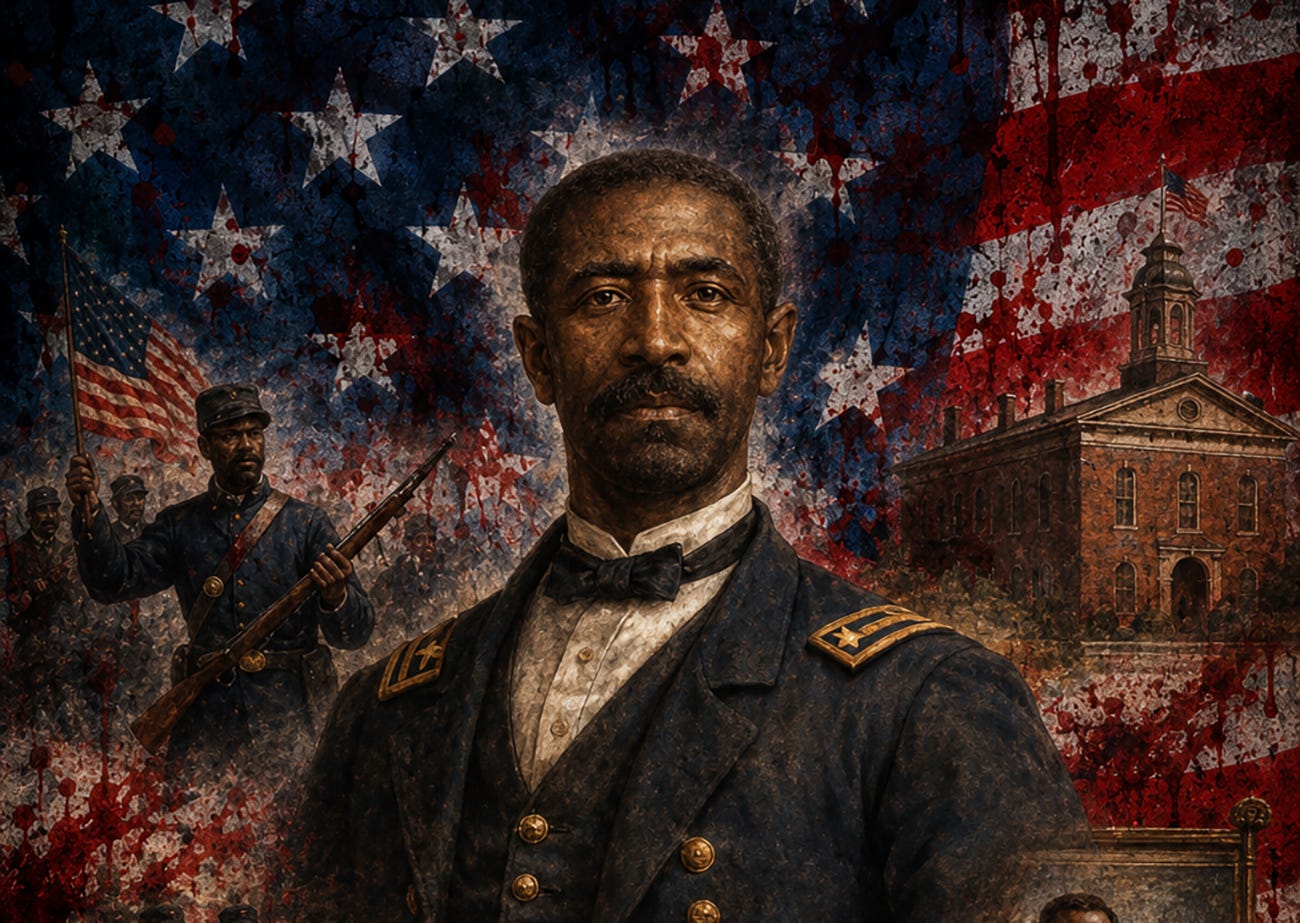
On Feb. 24, 1865, The Liberator published a letter from a white Union Army officer describing the bravest, handsomest warrior he had ever met:
…the only question I ever hear debated among the [white] officers is, whether [Black soldiers] are equal or superior to whites. I have never heard it suggested that they were inferior. …They tell me that [Prince Rivers] was once allowed to present a petition to the Governor of South Carolina in behalf of slaves, for the redress of certain grievances; and that a placard, offering two thousand dollars for his recapture, is still to be seen by the wayside between here and Charleston. He was a sergeant in the old "Hunter Regiment”… There is not a white officer in this regiment who has more administrative ability, or more absolute authority over the men. ... He is jet-black, or rather, I should say, wine-black; his complexion, like that of others of my darkest men, having a sort of rich, clear depth, without a trace of sootiness, and to my eye very handsome. His features are tolerably regular and full of command, and his figure superior to that of any of our white officers, being six feet high, perfectly proportioned, and of apparently inexhaustible strength and activity. His gait is like a panther’s; I never saw such a tread. …No anti-slavery novel has described a man of such marked ability. He makes Toussaint perfectly intelligible; and if there should ever be a black monarchy in South Carolina, he will be its king.
Prince Rivers was Him.
Born in a Beaufort, S.C., forced labor camp in 1824, Rivers taught himself to read at a young age. When his enslaver moved his entire portfolio of human chattel to Edgefield, S.C., to avoid the threat of emancipation, Rivers stole his master’s best horse and fled to the Saxton Contraband Camp in Beaufort. There, he joined South Carolina’s 1st Volunteers, a team of Gullah warriors who had been declared free by Union General David Hunter. Lincoln disbanded the unit after learning of the general’s “emancipation proclamation,” but Hunter secretly kept 100 of the best fighters. “Hunter’s Regiment” included Rivers, future S.C. Secretary of State Henry Hayne and a spy named Harriet Tubman.
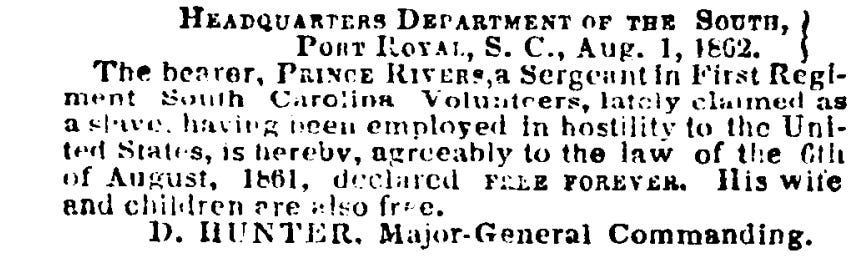
When Lincoln realized the error of his decision, Hunter’s Regiment became part of the U.S. Army’s 33rd U.S. Colored Troops, and Rivers was the de facto leader. When Lincoln issued the Emancipation Proclamation, newspapers published illustrations of white officers giving the regimental flag to Rivers. Rivers’ freedom papers appeared in the New York Times.
During his time in the 33rd, Rivers collected money for a real estate fund to purchase property abandoned by whites slave owners. In 1863, he gave a speech telling his fellow soldiers what he intended to do with the money
“My brethren, I don’t intend to lay down my gun till the war is done and our brethren all get their freedom,” he explained. “And then, if I be alive, I will come home and enjoy my family and my land. We mens, fifty of us in the 1st S.C. have got $1,000 for land, and I won’t say how much more, but if any man bids against us, he will find we got another dollar more. So just remember that.”
After the race war, he returned to the county where he emancipated himself from slavery and purchased land in Hamburg, S.C.—an abandoned town in Edgefield County that was built “for the purpose of furnishing slaves to the planters of Georgia.” In 1868, he represented the county in South Carolina’s constitutional convention. And in 1871, months after the passage of the 15th Amendment, Rivers and six Black state representatives separated Hamburg from Edgefield County, founding Aiken County.
Not only did the residents send him to represent the county he founded in the South Carolina legislature, but Congressman Rivers also served as the mayor of Hamburg, Aiken County Coroner, Justice of the Peace and district registrar.
Prince Rivers was one of the greatest men America has ever produced. He accomplished something that George Washington, Thomas Jefferson and all of the Founding Fathers combined could not do. He was not just a free Black man living in America. He freed himself.
And on July 4, 1876, one of the greatest men America had ever produced prepared to celebrate something America had never seen…
A democracy.
His democracy.
Is America a Democracy?
We hold these truths to be self-evident, that all men are created equal, that they are endowed by their Creator with certain unalienable Rights, that among these are Life, Liberty and the pursuit of Happiness. That to secure these rights, Governments are instituted among Men, deriving their just powers from the consent of the governed.
Some people (including the least educated member of Congress) love to claim that “America is a Constitutional Republic, not a Democracy.”
Those people are wrong.
