


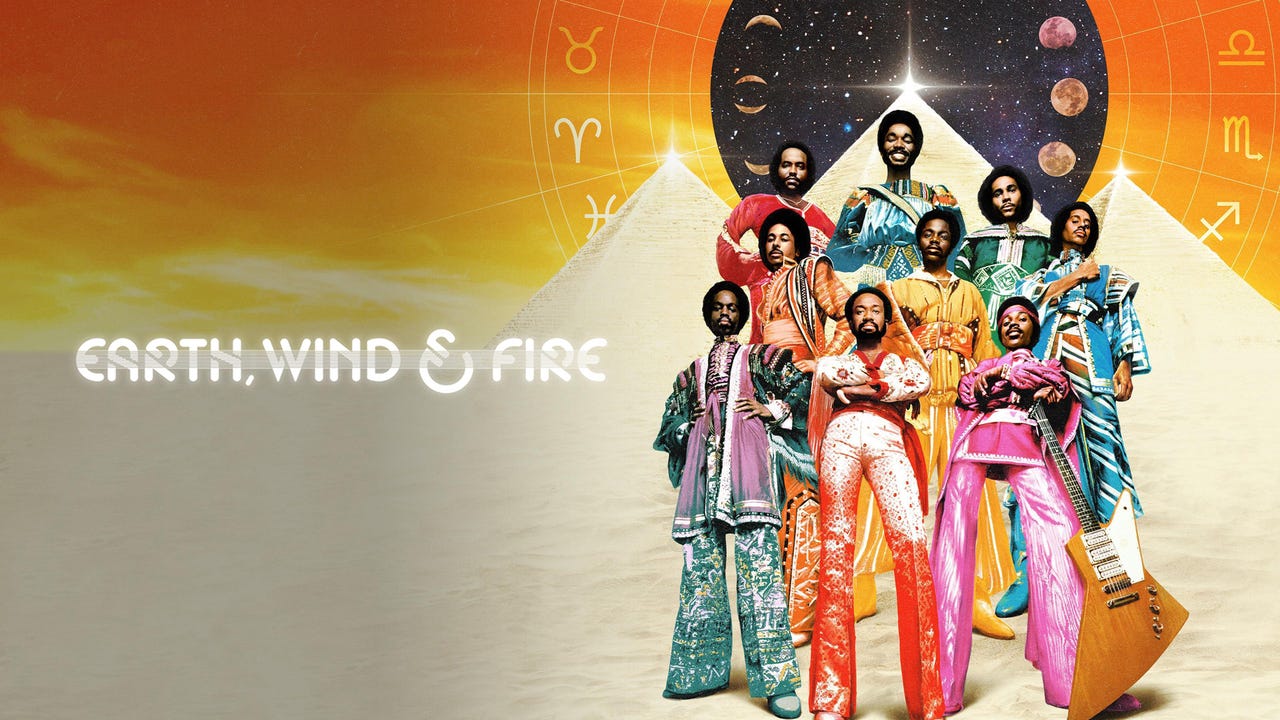
The reviews are in for HBO’s latest doc, Earth, Wind & Fire: To Be Celestial vs. the Weight of the World.
“Questlove’s newest documentary is a rare instance of an artist capturing lightning in a bottle twice,” writes Salon’s Melanie McFarland. “Movies like this one reassure us that their spirit is timeless, and here to stay for all time. The music wins eventually.”
The New York Times called the film “an astonishing movie that fully lives up to its deliberately unwieldy title.” According to Metacritic’s rating system, the movie has “universal acclaim.” My uncle Rob said it was “gooder than a motherfucker.”
But, as with all great stories, Oscar-winning documentarian Ahmir “Questlove” Thompson had to leave a few things on the cutting room floor. Some were excluded due to time constraints and narrative choices, while other details were not integral to the overall story or couldn’t be captured on film.
Here are 10 interesting stories that you didn’t see in.
1. The Earth, Wind & Fire doc is not about Earth, Wind & Fire.
After his Academy Award-winning directorial debut, Summer of Soul and his sophomore effort, Sly Lives! (aka the Burden of Black Genius), Thompson had already cemented his place as one of this generation’s preeminent chroniclers of the Black music tradition. As a day-one fan of The Roots and a lifelong lover of “The Elements,” I was ecstatic when Thompson presented me with the opportunity to participate in his latest project.
It turns out, I hadn’t really seen those films.
While the 1969 Harlem Cultural Festival served as a backdrop and soundtrack for Summer of Soul, the film actually told the story of a revolutionary moment in the cultural, political and social history of Black America. In Sly Lives, Stone was simply a lens through which Thompson could capture the weight and the effects of Black brilliance on artists, from Prince to Michael Jackson. And when the EGO-winning drummer began working on the film, he insisted that he wasn’t even making a movie about music.
Instead, he wanted to explore the connection between metaphysics, transcendental meditation, African spirituality and the power of manifestation. He wanted to extend the boundaries of the traditional Judeo-Christian confines that dictate Black people’s understanding of our spiritual power. He wanted people to see what was possible when someone broke through these boundaries and embraced their universal consciousness.
“I desperately wanted to figure out how I can contribute to the chaos that we’re living in right now,” Thompson said at the movie’s Tribeca Film Festival premiere. “I wanted to tell a metaphysical story about how nine individuals sort of tricked us into positivity. And that’s what I want you people to take from this.”
2. Maurice White’s special friends
In White’s autobiography, he recounts the story of picking cotton in Osceola, Ark., as a young child when he met his first friend.
On one of my walks back from getting water, with the work group at least a half mile off in the distance, I heard a clear, strong voice saying, “Stop.” I believed this was the voice of God.
“Why do we have to die?” I asked.
“You will live forever; you are immortal.”
…It seemed like we made a covenant together that day, and he became my friend.
Although Maurice White didn’t define himself as a Christian, he would always believe in a higher power that guided his life. What else could explain the chance encounter that changed his life?
Years before Booker T. Jones was inducted into the Rock & Roll Hall of Fame, decades before Rolling Stone ranked David Porter as one of the 100 greatest songwriters of all time, two teenage music prodigies met a kid named Maurice White practicing in a Memphis high school band room and suggested they should play together.
“David Porter and Booker T. and I were the closest things to blood brothers that I knew,” White said years later. “They represented my musical family—my real family.”
The three childhood friends would eventually help define the sound we know as rhythm and blues.
